plant lover, cookie monster, shoe fiend
20779 stories
·
19 followers

STAT+: Cancer patients face longer wait times to begin treatment, according to new study

1 Share

Waiting for treatment to start can be an excruciating period for cancer patients. There can be fears that the disease is spreading, or progressing to a point where therapies become less effective. Yet over the last few decades, the time cancer patients are waiting between diagnosis and treatment has steadily grown, according to a new study of more than 2.7 million patients.

“What was striking was the consistency,” said Tim Donahue, the senior author on the study and a surgical oncologist at the University of California, Los Angeles. “Across every cancer we studied, patients are waiting longer today than they were a decade ago.”

Donahue and his colleagues analyzed data from the National Cancer Database, a national data repository from the American College of Surgeons, from 2012 to 2023. They looked only at patients with stage 1 to 3 cancers that were considered eligible for surgery at diagnosis across six different cancers. Then, they compared the time between diagnosis and any first treatment, which included surgery as well as radiation or chemotherapy or other medical therapies. 

Continue to STAT+ to read the full story…


Read the whole story
sarcozona
42 minutes ago
reply
Epiphyte City
Share this story
Delete

Build Canada Homes’ vague goals concern experts

1 Share

Housing experts are applauding Ottawa’s goal of building more affordable homes. But they want clarity about how the new Crown corporation Build Canada Homes will help accomplish this goal. 

Read the whole story
sarcozona
43 minutes ago
reply
Epiphyte City
Share this story
Delete

Why you can’t find a primary care doctor

1 Share

While public health systems have plenty of room to become more trustworthy, I am increasingly convinced that much mistrust stems also from health systems. In a recent YLE survey, for example, more than 1 in 2 participants had difficulty finding a primary care provider.

I called Lucy McBride, a primary care physician with 25 years of experience and author of Beyond the Prescription: A Doctor’s Guide to Taking Charge of Your Health, and asked her to run down what’s happening and what people can actually do about it.

Lucy, take it away…


When I took my dad to the emergency department in December, I couldn’t help overhearing the conversations around us as we waited for his results. Through paper-thin curtains separating us from other patients, everyone was discussing problems that a primary care doctor could handle—walking pneumonia, an infected wound, blood pressure gone haywire. Here, it was easier to access care because EDs can’t turn you away, but unfortunately, it was way more expensive for the patient.

It gave me the sobering realization: nothing has changed in 20 years. When I was working in the Johns Hopkins ED, we were providing primary care for East Baltimore, like insulin for diabetics who couldn’t get a refill from their doctor in time or UTIs that couldn’t wait for 3 weeks for the only appointment offered to them. To this day, I get messages from friends and relatives who have questions that their primary care doctor could answer.

These aren’t one-off scenarios. More than 100 million Americans lack access to primary care. Some of this is due to cost, but a lot of it is due to supply.

Why are we so short on primary care?

Economics.

Prevention is not the priority in U.S. health care; damage control is, and the money proves it. Less than 5% of health care spending in the U.S. goes toward primary care, while the other 95% flows to hospitals, procedures, prescriptions, and administration. This imbalance sets off a chain reaction in which really no one is winning except the balance sheets.

Domino 1: Primary care doesn’t pay, so fewer doctors choose it. Other specialists earn 40–90% more than primary care physicians, with surgical fields paying nearly double. Why? Because our fee-for-service system pays for procedures. The average reimbursement for a primary care visit is $259, versus $1,092 for a gastroenterology visit.

This doesn’t just impact the current physicians, but the pipeline of physicians. Class of 2025 graduates carried an average of $200,000–$250,000 in debt. Faced with that math, why would a med student pick a lower-paying field? The Bureau of Health Workforce projects a shortfall of over 87,000 primary care physicians by 2037.

Domino 2: The doctors who stay get crushed. Most of us went into primary care to listen to, teach, and guide patients throughout their lives. But in order to keep the clinic alive, physicians have to see more patients. We aren’t given the time that is needed to spend with a patient. So that means only 15 minutes to see an 80-year-old who’s just been diagnosed with cancer, grieving a spouse, and now has new chest pain. The mission becomes impossible, and burnout follows fast.

Domino 3: Burnout drives doctors out, deepening the shortage: 45% of primary care doctors report burnout, and 39% of those plan to stop seeing patients. This is turning into a workforce exodus.

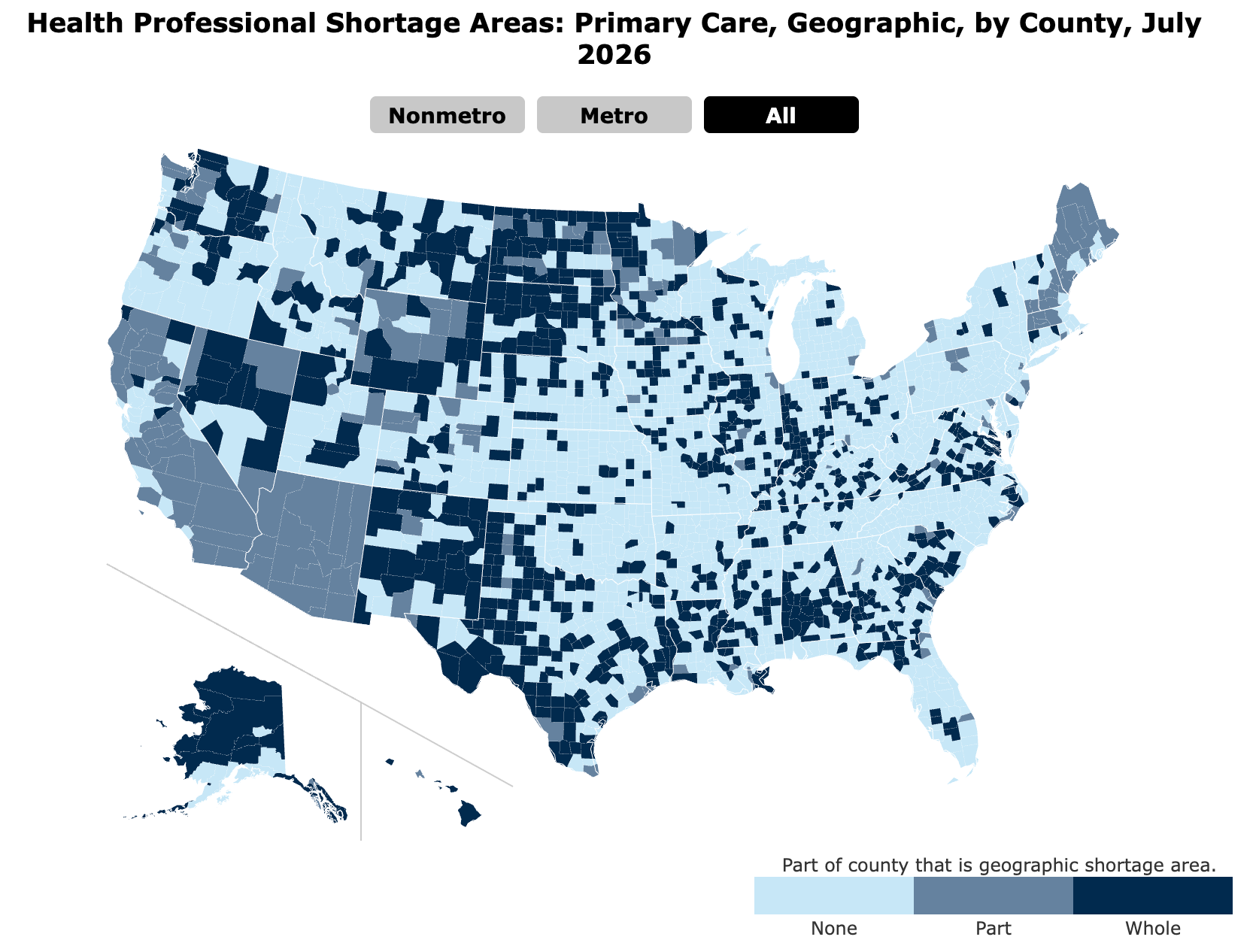
All of this adds up to major primary care shortage areas throughout the U.S., as shown in the graph below.

None of this is the doctor’s fault. YLE’s survey found that three-quarters of people trust their own doctor once they have one, but the hard part is getting one in the first place. Doctors are victims of this broken system, just like their patients.

How do the systems get out of this mess?

The fixes aren’t a mystery, but all either require federal legislative action or slow multi-state rollouts.

  1. Pay primary care doctors for conversations with patients—the ones that keep people healthy and prevent disease—rather than for the volume of patients seen in a day. This is called value-based or capitation payment. This can be a fixed amount per patient per month, with bonuses for keeping people healthy.

  2. Expand primary care residency slots and loan-forgiveness programs so that medical students can afford to choose this field. Residency slots are capped by funding, which has been nearly frozen at 1997 levels for decades.

  3. Strip away administrative burdens that eat into the hours doctors should spend with patients. Primary care doctors spend a large share of their day on prior authorizations required by insurance and clicking through health records, instead of with patients. This is where AI could help.

Some states are already experimenting with mandating that a bigger share of health care spending go to primary care (Rhode Island, Delaware, Colorado, Oregon).

But policy moves slowly, and you likely need a doctor’s appointment before Congress acts.

So what can the average person do?

In the meantime, much lies with individuals. A few tips:

  • Seek out community health centers (findahealthcenter.hrsa.gov).

  • Look for skilled NPs and PAs. (I’m a big fan if it’s the right fit.)

  • Consider telehealth-based primary care if you live in a remote area or if access to in-person care is limited.

  • Crowdsource from friends you trust. Ask your dentist and other doctors you like, “Who would you send your own family to?” Skip online reviews—studies show they don’t correlate with quality of care; instead, they measure wait times and parking, not whether the doctor gets it right!

Then work on becoming a more empowered patient. Being your best self-advocate is a skill to be learned. (This is the meat of my book, Beyond the Prescription, out this week.) Given your doctor’s time constraints, you need to do everything possible to squeeze the juice out of the 15 minutes you have with them.

  • Articulate your goals and name your fears, vulnerabilities, and real-life limitations. Learn how to ask the right questions for the problems you actually have.

  • Write down your three most important concerns beforehand, bring biographical context your doctor won’t ask about, keep a living one-page health summary document on your phone with all of your medications, supplements, past medical issues, and habits (good and bad!).

  • Make sure it’s the right fit. You deserve someone who actively listens, adheres to medical evidence, is willing to say “I don’t know,” and shows interest in you as a real person, not just as a set of body parts. You are entitled to make follow-up appointments to discuss further questions or get clarification on advice.

Bottom line

The system won’t fix itself soon, but patients aren’t powerless in the meantime. The question isn’t just how to find a doctor—it’s how to become the kind of patient who gets real care even inside a strained system. Health isn’t about having all the answers; it’s about asking better questions—of yourself and the people responsible for your care.


Lucy McBride, MD, is a primary care physician with 25 years of clinical experience in Washington, DC. She writes the newsletter Are You Okay? and is the author of Beyond the Prescription: A Doctor’s Guide to Taking Charge of Your Health, out this week from Simon & Schuster.

Your Local Epidemiologist (YLE) comprises a team of experts, ranging from physicians to immunologists to epidemiologists to nutritionists, working together with one goal: to “translate” ever-evolving public health science so that people are well-equipped to make evidence-based decisions. The YLE suite of newsletters reaches over 475,000 people across more than 132 countries. This newsletter is free to everyone, thanks to the generous support of fellow YLE community members. To support the effort, subscribe or upgrade below:

Subscribe now

Read the whole story
sarcozona
46 minutes ago
reply
Epiphyte City
Share this story
Delete

This El Niño Is a Warning

1 Share


This is an edition of Heatmap Daily, an evening review of the day’s news written by our executive editor. Sign up for it here.

El Niño is here.

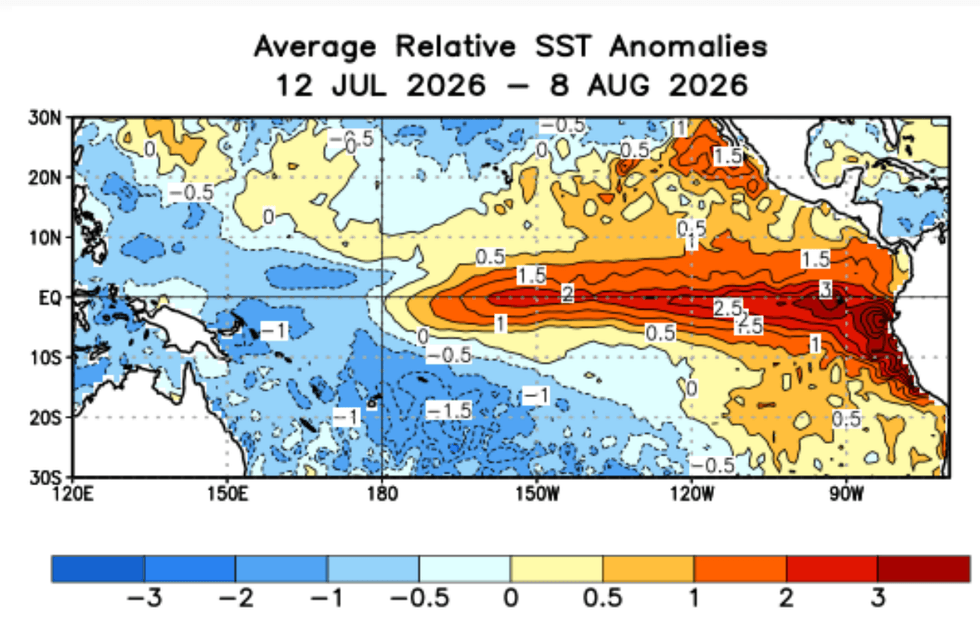
The world’s largest ocean slipped into the weather pattern in the spring, according to the National Oceanic and Atmospheric Administration, and the sea surface is now significantly warmer than average in one important region. When you chart ocean temperatures on a map, the “El Niño tongue” (yes, that is what scientists call it) clearly appears:

A chart of average relative sea surface temperature anomalies from July 12th, 2026, to August 8th, 2026. The El Ni\u00f1o tongue is clearly visible against an overall colder-than-average background. NOAA

It might be more accurate to describe El Niño as something that happens to the planet, though. The Pacific occupies about one-third of Earth’s surface. When that third becomes unusually warm, it transforms weather around the world, driving wetter conditions in California, Central America, and South America; and drier weather in Asia, Africa, and Australia.

So far, so normal. El Niño is a standard fluctuation in the Earth’s climate system; we experienced the last one in 2023 and 2024.

But that is roughly where what’s normal about this year’s El Niño ends.

For one, this El Niño is far more intense than we should expect at this time of year. In an El Niño, the Pacific’s average temperature usually rises through the end of December or so; the phenomenon’s original name in Spanish, El niño de Navidad, alluded to the surprising arrival of warm currents in South America around Christmas. In the modern satellite era, the warmest El Niño ever measured happened in 2015, and ocean temperatures peaked at 3.1 degrees Celsius in November and December of that year. We called that a “Super El Niño” for just how abnormal it was.

Yet the Pacific is already more than 2.6 degrees Celsius (or nearly 5 degrees Fahrenheit) above normal — making this the third strongest El Niño ever measured in the satellite era — and it is only August. We still have four months to go, and this El Niño is already a record-smasher. More ominously, models expect that this El Niño could eventually grow to more than 4 degrees Celsius, or 7 degrees Fahrenheit, above normal.

What will that mean for the world? According to a recent Science study, the average El Niño can cost the global economy more than $3 trillion. The world is richer now than it was a decade or two ago, which should make it better able to withstand disaster. But this El Niño is so far out of sample that it’s hard to know what it could do.

And perhaps more importantly — as the climate scientist Zeke Hausfather, the guest of our new episode of Shift Key says today — it will offer a kind of preview of what the planet’s normal climate will resemble a decade from now. This El Niño is likely to push 2027’s average temperature above 1.5 degrees Celsius, the nominal threshold at which countries hoped to limit warming as part of the Paris Agreement (although, as you’ll hear, it is slightly more complicated than that).

Which is all to say: I encourage you to listen to our new episode, which is available on Apple, Spotify, or RSS. (A transcript is also available for Heatmap subscribers.) We tackle questions including:

  • Why do the models think this El Niño will be so bad?
  • Why do we believe this El Niño could be the worst one in 500 or 1,000 years?
  • Is climate change getting worse faster than we thought it would — is it accelerating?

There’s one thought that I didn’t include in the episode, however. Since late 2023, political discussion of climate change has decreased. This isn’t a phenomenon limited to any one faction of the Democratic Party — the progressives Abdul El-Sayed and Zohran Mamdani have downplayed climate policy roughly as much as, say, moderates like Mary Peltola and James Talarico have — but it is a clear trend. The American media’s coverage of climate change has declined during the same period. This “climate hushing” is not because politicians stopped caring per se, I think, but because nobody is sure how to talk about the issue in a politically useful way anymore, especially after the “climate = jobs” rhetoric that underpinned the Biden administration’s policy failed to retain voters in 2024.

I don’t believe (and think that political science has disproven) that extreme weather can “awaken” the public to climate change. Even against a gradually warming baseline, the weather — and public attention — shift far too often for that. But media coverage is loosely responsive to events. When the super El Niño of 2015 and 2016 smashed the then-record for the hottest year ever measured, it helped initiate a new era of public and elite concern about climate change. That El Niño’s heat waves, wildfires, and mass coral bleaching previewed the far worse disasters of the decade that followed. This El Niño’s disasters and broken temperature records could be worse — and even less ignorable.

Read the whole story
sarcozona
59 minutes ago
reply
Epiphyte City
Share this story
Delete

Canada has higher measles rate per capita than U.S.: WHO data

1 Comment

Measles data from the World Health Organization show that Canada has half the number of confirmed cases as the United States, despite having a population only about one-tenth the size of its neighbour.

WHO says 47,459 measles cases have been confirmed across the Americas as of July 18, which is three times higher than the total reported cases all of last year in the region.

The United States has 2,260 of those cases, while Canada has confirmed 1,107.

The WHO says the disease has claimed 45 lives so far this year in the Americas, largely in Guatemala and Mexico.

It says in an alert that the Americas need to strengthen their vaccination, surveillance and rapid outbreak response measures amid rising measles cases across the region.

“Measles leaves no room for complacency. We know how to stop it: achieving high vaccination coverage, detecting suspected cases early, and responding rapidly to interrupt chains of transmission,” said Daniel Salas, the executive manager of WHO’s regional office for the Americas called the Pan American Health Organization, in a news release.

“Every outbreak exposes immunity gaps that must be urgently addressed, particularly among children, under-vaccinated communities, and populations with limited access to health services.”

PAHO said North and South America are seeing their highest number of confirmed cases in more than two decades.

Roughly 186,000 measles cases have been reported worldwide as of July. That’s a 12 per cent increase compared with the same period last year.

Read the whole story
sarcozona
1 day ago
reply
remarkable public health failure
Epiphyte City
Share this story
Delete

A fleet idled by conflict is now spinning an ‘ecological roulette’ across the world’s ports

1 Share
Vessels stalled for months in the Strait of Hormuz are fouled with marine life. Scientists agree some will seed species invasions as the ships disperse. What they can’t say is whether anyone would notice.
Read the whole story
sarcozona
1 day ago
reply
Epiphyte City
Share this story
Delete
Next Page of Stories