While public health systems have plenty of room to become more trustworthy, I am increasingly convinced that much mistrust stems also from health systems. In a recent YLE survey, for example, more than 1 in 2 participants had difficulty finding a primary care provider.
I called Lucy McBride, a primary care physician with 25 years of experience and author of Beyond the Prescription: A Doctor’s Guide to Taking Charge of Your Health, and asked her to run down what’s happening and what people can actually do about it.
Lucy, take it away…
When I took my dad to the emergency department in December, I couldn’t help overhearing the conversations around us as we waited for his results. Through paper-thin curtains separating us from other patients, everyone was discussing problems that a primary care doctor could handle—walking pneumonia, an infected wound, blood pressure gone haywire. Here, it was easier to access care because EDs can’t turn you away, but unfortunately, it was way more expensive for the patient.
It gave me the sobering realization: nothing has changed in 20 years. When I was working in the Johns Hopkins ED, we were providing primary care for East Baltimore, like insulin for diabetics who couldn’t get a refill from their doctor in time or UTIs that couldn’t wait for 3 weeks for the only appointment offered to them. To this day, I get messages from friends and relatives who have questions that their primary care doctor could answer.
These aren’t one-off scenarios. More than 100 million Americans lack access to primary care. Some of this is due to cost, but a lot of it is due to supply.
Why are we so short on primary care?
Economics.
Prevention is not the priority in U.S. health care; damage control is, and the money proves it. Less than 5% of health care spending in the U.S. goes toward primary care, while the other 95% flows to hospitals, procedures, prescriptions, and administration. This imbalance sets off a chain reaction in which really no one is winning except the balance sheets.
Domino 1: Primary care doesn’t pay, so fewer doctors choose it. Other specialists earn 40–90% more than primary care physicians, with surgical fields paying nearly double. Why? Because our fee-for-service system pays for procedures. The average reimbursement for a primary care visit is $259, versus $1,092 for a gastroenterology visit.
This doesn’t just impact the current physicians, but the pipeline of physicians. Class of 2025 graduates carried an average of $200,000–$250,000 in debt. Faced with that math, why would a med student pick a lower-paying field? The Bureau of Health Workforce projects a shortfall of over 87,000 primary care physicians by 2037.
Domino 2: The doctors who stay get crushed. Most of us went into primary care to listen to, teach, and guide patients throughout their lives. But in order to keep the clinic alive, physicians have to see more patients. We aren’t given the time that is needed to spend with a patient. So that means only 15 minutes to see an 80-year-old who’s just been diagnosed with cancer, grieving a spouse, and now has new chest pain. The mission becomes impossible, and burnout follows fast.
Domino 3: Burnout drives doctors out, deepening the shortage: 45% of primary care doctors report burnout, and 39% of those plan to stop seeing patients. This is turning into a workforce exodus.
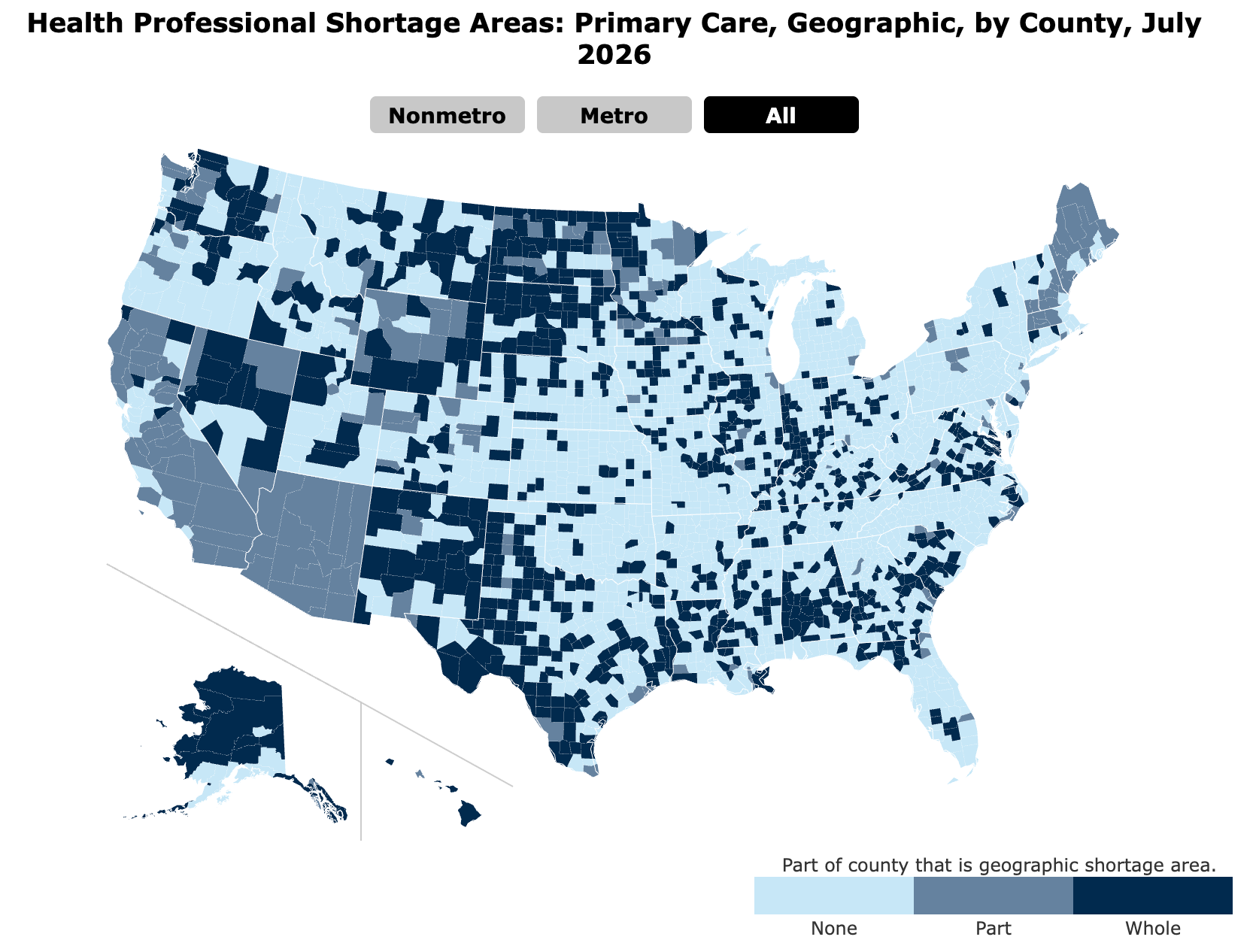
All of this adds up to major primary care shortage areas throughout the U.S., as shown in the graph below.
None of this is the doctor’s fault. YLE’s survey found that three-quarters of people trust their own doctor once they have one, but the hard part is getting one in the first place. Doctors are victims of this broken system, just like their patients.
How do the systems get out of this mess?
The fixes aren’t a mystery, but all either require federal legislative action or slow multi-state rollouts.
Pay primary care doctors for conversations with patients—the ones that keep people healthy and prevent disease—rather than for the volume of patients seen in a day. This is called value-based or capitation payment. This can be a fixed amount per patient per month, with bonuses for keeping people healthy.
Expand primary care residency slots and loan-forgiveness programs so that medical students can afford to choose this field. Residency slots are capped by funding, which has been nearly frozen at 1997 levels for decades.
Strip away administrative burdens that eat into the hours doctors should spend with patients. Primary care doctors spend a large share of their day on prior authorizations required by insurance and clicking through health records, instead of with patients. This is where AI could help.
Some states are already experimenting with mandating that a bigger share of health care spending go to primary care (Rhode Island, Delaware, Colorado, Oregon).
But policy moves slowly, and you likely need a doctor’s appointment before Congress acts.
So what can the average person do?
In the meantime, much lies with individuals. A few tips:
Seek out community health centers (findahealthcenter.hrsa.gov).
Look for skilled NPs and PAs. (I’m a big fan if it’s the right fit.)
Consider telehealth-based primary care if you live in a remote area or if access to in-person care is limited.
Crowdsource from friends you trust. Ask your dentist and other doctors you like, “Who would you send your own family to?” Skip online reviews—studies show they don’t correlate with quality of care; instead, they measure wait times and parking, not whether the doctor gets it right!
Then work on becoming a more empowered patient. Being your best self-advocate is a skill to be learned. (This is the meat of my book, Beyond the Prescription, out this week.) Given your doctor’s time constraints, you need to do everything possible to squeeze the juice out of the 15 minutes you have with them.
Articulate your goals and name your fears, vulnerabilities, and real-life limitations. Learn how to ask the right questions for the problems you actually have.
Write down your three most important concerns beforehand, bring biographical context your doctor won’t ask about, keep a living one-page health summary document on your phone with all of your medications, supplements, past medical issues, and habits (good and bad!).
Make sure it’s the right fit. You deserve someone who actively listens, adheres to medical evidence, is willing to say “I don’t know,” and shows interest in you as a real person, not just as a set of body parts. You are entitled to make follow-up appointments to discuss further questions or get clarification on advice.
Bottom line
The system won’t fix itself soon, but patients aren’t powerless in the meantime. The question isn’t just how to find a doctor—it’s how to become the kind of patient who gets real care even inside a strained system. Health isn’t about having all the answers; it’s about asking better questions—of yourself and the people responsible for your care.
Lucy McBride, MD, is a primary care physician with 25 years of clinical experience in Washington, DC. She writes the newsletter Are You Okay? and is the author of Beyond the Prescription: A Doctor’s Guide to Taking Charge of Your Health, out this week from Simon & Schuster.
Your Local Epidemiologist (YLE) comprises a team of experts, ranging from physicians to immunologists to epidemiologists to nutritionists, working together with one goal: to “translate” ever-evolving public health science so that people are well-equipped to make evidence-based decisions. The YLE suite of newsletters reaches over 475,000 people across more than 132 countries. This newsletter is free to everyone, thanks to the generous support of fellow YLE community members. To support the effort, subscribe or upgrade below:
Subscribe now
 Log in




 NOAA
NOAA