Versant Ventures, Eli Lilly, and a handful of other investors announced Monday that they have poured $100 million into a new startup devoted to solving a gene therapy challenge that has ensnared many well-funded academics and biotechs before it.
The company, called Seawolf Therapeutics, is trying to deliver genes to patients without the use of viruses. In addition to the $100 million fundraising, Sanofi has also inked a partnership with the company.
Viruses have proven to be powerful gene delivery drones in several rare diseases, and they are being tested in hundreds of trials. But they come with drawbacks. A patient can only ever receive a single dose, after which they develop antibodies against the virus. And at high doses the treatments can have serious side effects.
To be effective, Canada’s new national security plan must learn from the Canadians who know transnational repression, terrorism and mass violence firsthand
As a UK heatwave intensified in early summer this year, the health impacts began to worsen. This is Gill’s story
Location: London, UK
Disaster: UK heatwave, 2026
Gill (not her real name), 43, is a teacher in London. In 2026, during the hottest summer on record, she suffered a seizure after experiencing heat exhaustion while teaching. The heatwave was made worse by the climate crisis.
When i was in middle school, we regularly had days where the teachers told us to put our heads down and rest because it was too hot to teach, where you couldn’t hold a pencil because you were sweating so badly, sweat dripped off of students and puddled on the floor around our chairs. It was the rural south and starting school in August was novel enough the adults still complained about it. There’s a new middle school now, with air conditioning, but i wonder about students in even poorer places and how they’re coping with the new climate.
All these horrible impacts of climate change are just more widespread versions of things that have already happened. We should have acted then.
Imagine scrolling through Instagram and coming across a plant that turns out to be a species unknown to science. That is precisely how the story of this week's plant, Victoria colombiana, began!
Victoria is a genus of aquatic plants belonging to the waterlily family (Nymphaeaceae), famous for producing some of the largest floating leaves in the plant kingdom, sometimes exceeding three metres in diameter. These gigantic leaves are supported by a remarkable network of ribs on their underside, which also bears numerous sharp prickles. Their flowers are equally fascinating: they open white on the first night and turn pink on the second, attracting beetles that help with pollination.
Carlos Magdalena holding a Victoria colombiana leaf. In this picture, it is easy to appreciate the ribs on the underside of the leaf. Photo by Mauricio Bernal.
In 2021, Carlos Magdalena —a waterlily specialist at the Royal Botanic Gardens, Kew, famously known as the Plant Messiah— came across Instagram photographs taken by Jeremiah Haris of a giant waterlily growing in the region of Inírida, in eastern Colombia, near the borders of Venezuela and Brazil. Although the plant had initially been identified as Victoria amazonica, something about the pictures caught his attention: the waterlily was growing somewhere no Victoria species had previously been recorded.
After spotting the Instagram photographs, Magdalena began exploring satellite images of the region and found what appeared to be giant waterlily leaves floating in several lagoons. He then joined forces with researchers from Bogotá's botanical garden and members of local Indigenous communities to organise an expedition in July 2024. However, after five days exploring the flooded forests, the team had found only two individuals, neither of which was flowering. Without flowers, they lacked the material needed to formally describe the species, and their return flight was fast approaching.
Inírida's riverine landscape. Photo by Carlos Magdalena.
Just when everything seemed lost, something extraordinary happened. At 11 pm, on the night before their flight home, Magdalena shared his frustration with Gustavo Melo, their boatman and a member of the Indigenous Tucano community. To everyone's surprise, Melo knew exactly where to find more plants! So, at 1 am, the team ventured into the flooded forest in complete darkness, trusting Melo's knowledge of the region to guide them. Shortly before sunrise, they reached a small lake where five additional waterlilies were growing, including one in flower! The team finally had the specimens they needed and even managed to catch their flight back to Bogotá. You can read the full account of this remarkable expedition in Kew's announcement.
Inirida's riverine landscape at sunrise. Photo by Carlos Magdalena.
So, what makes Victoria colombiana different from its relatives? Although it closely resembles Victoria amazonica, it has several distinctive features. Its flowers have shorter, more densely packed prickles that are surprisingly flexible, while its ovary has a somewhat square outline rather than the rounded shape found in Victoria amazonica. These differences, together with its geographical distribution, led researchers to describe it as a new species in a study published last month.
Victoria colombiana (left, Photo by Nilo Rodriguez) and Victoria amazonica (right; Photo by fernanda_santos via iNaturalist, CC BY-NC 4.0).
However, the discovery raises another question: how could such an enormous plant have gone unnoticed by scientists for so long? After all, its leaves can reach around two metres across, making them visible even in satellite photographs! One explanation is that these plants inhabit remote lagoons within seasonally flooded forests, where accessing populations can be challenging. Moreover, researchers found that the leaves were much easier to spot in satellite images taken when water levels were low, providing an additional challenge for anyone trying to locate them.
Perhaps the most intriguing aspect of this discovery is what it tells us about the evolution of giant waterlilies. Researchers found that different Victoria species tend to occur in separate river basins across South America. Because their seeds cannot survive drying out and are thought to disperse mainly through rivers and floodwaters, changes in river courses and the isolation of river basins over millions of years may have contributed to the evolution of different species. In other words, the history of these magnificent plants may be closely linked to the history of South America's rivers!
Victoria colombiana leaf pads on a river in Inírida, Colombia. Photo by Carlos Magdalena.
Sadly, the story also has a worrying side. Researchers at Kew estimate that only 30–50 individuals of Victoria colombiana may remain in the wild, although further surveys are needed to establish its actual population size. Conservation initiatives involving Colombian botanical gardens and Indigenous communities could therefore play an essential role in protecting this newly recognised species.
To me, Victoria colombiana is a wonderful reminder that botanical discoveries can begin in the most unexpected places, even on social media! However, recognising this species took much more than an Instagram photograph: it required satellite imagery, fieldwork and the knowledge of people who were already familiar with these plants and their environment. And if a plant large enough to be spotted from space remained unrecognised by science until now, imagine how many more botanical surprises might still be waiting for us!
Cover picture: Victoria colombiana bud by Nilo Rodriguez
Matt Lambert, a former emergency room physician and health care technology executive, shot five people and then himself on Thursday in D.C., apparently motivated by a bitter, ongoing and all-consuming legal dispute with the Metropole Condominium Association and the building’s property manager.
The back-and-forth had been dragging on for more than a year, draining his retirement savings and fueling a deepening desperation.
Just under a year ago, I spoke to him about it. Lambert reached out to me in late 2025 when I was a reporter at The Washington Post, pitching a story about how his million-dollar Logan Circle penthouse had been rendered unlivable. I continued reporting the story into the new year, but the article was abandoned when I was laid off from the Post in early 2026.
In a series of interviews in late November and December 2025 — including two visits inside his gutted penthouse at the Metropole on 15th Street Northwest — Lambert described how a dispute over severe water leaks and black mold had turned into “psychological warfare” between himself, building manager James Stuart, the management company EJF Real Estate Services and their insurance defense attorneys.
“It’s affected every part of my life — my sleep, dietary habits,” Lambert told me in December. “I pride myself on my resilience, and I’ve been kind of surprised at how much it has been affected.”
On Thursday, D.C. police said, Lambert shot and killed Stuart at the VIDA Fitness Center located on the ground floor of the building in a targeted attack just before 8 a.m., then shot four more people in the vicinity and barricaded himself in his apartment before shooting and killing himself. Of the other four people who were shot, one was in critical condition, while three others had non-life-threatening injuries.
While at no point in the reporting process did Lambert give any indication he would resort to violence, he did frequently use intense, combative language — and at one point, his frustration bled into what at the time felt like dark humor. During a December visit with a neighbor, Lambert criticized the condo association’s legal strategy by making an offhand reference to Luigi Mangione, the suspect in the 2024 shooting death of UnitedHealthcare’s CEO who is accused of inscribing “delay, deny, depose” on his ammunition.
“What are they called? Delay, deny, defend … the Luigi three?” Lambert said.
Lambert, who bought the $1.1 million top-floor unit in 2016, had recently put the penthouse on the market with plans to relocate to New York. But he said the conflict trapped him in D.C., beginning after a building facade rehabilitation that ran from April 2023 to August 2024. While the project was underway, he said, water began running down the interior of his windows and wetting his floors after rainstorms — with cracks, peeling paint and visible mold spreading across his walls once crews finished work on his corner in August 2024. When he hired independent testers in October 2024 to show Stuart and contractors evidence of widespread moisture and airborne mold, Lambert said, the meeting ended abruptly.
According to Lambert, when his attorney asked Stuart whether he could smell the mold, Stuart replied that the apartment “smelled like cologne,” walked out and turned the matter over to the building’s lawyers.
Because my reporting on the dispute was not completed at the time, I was never able to present Lambert’s allegations to Stuart or EJF Real Estate Services to get their perspective. The Washington Sun was unable to reach the management firm earlier Thursday.
In November 2024, Lambert said, he paid $12,000 out of his own pocket to strip his apartment down to the metal studs and subflooring, uncovering floor-to-ceiling black mold. When the building’s engineers blamed the moisture on Lambert’s own appliances, he said he went six months without using his shower, heat or dryer — instead showering downstairs at VIDA Fitness, and heating his unit solely with his fireplace — to try to prove them wrong.
In March 2025, Lambert sued the Metropole Condominium Association in D.C. Superior Court, accusing the association of negligence, breach of fiduciary duty and nuisance over what he alleged were botched renovations and rebuffed repair requests. The association denied responsibility but lost a bid to have the case thrown out last year, court records show. When leaks persisted after rainstorms, Lambert said, the building’s defense counsel pivoted to blaming humidity from VIDA Fitness’s industrial dryer vents, which ran behind his unit, and moved to pull the gym into the lawsuit, delaying the case by another 90 days.
By December 2025, Lambert, who was 54 at the time, said he had spent nearly $200,000 on legal and engineering fees — borrowing against his retirement savings to fund the litigation — while living with only a couch and a desk inside his stripped-down apartment.
Lambert said in an interview at the time that he was preparing to have his attorney pull every email exchanged between him and Stuart for court discovery, accusing Stuart of giving conflicting answers to residents and fabricating maintenance history.
Inside the Metropole last year, Lambert said the standoff had made him “radioactive.” He repurposed a whiteboard he normally used for work into a timeline tracking the building management’s slights. Feeling stonewalled by Stuart and the condo board, he launched an anonymous social media troll account called “Of Mice and Mold” to target Stuart and EJF over unfinished building repairs. He placed flyers on streetlights and trash cans around Logan Circle and hosted open houses in his gutted unit to show neighbors his engineering reports.
He compared the building’s gossip and factions to being trapped in petty drama.
“High school never ends. Michael, we are stuck in high school,” Lambert told me. “And it would be humorous if it wasn’t significant investment at risk, and really spending a lot of money that I’ve saved my entire life that I wanted to spend for retirement — I’m spending it right now with no end in sight. I’ve become increasingly aggressive in my messaging, not only in the building, but also with that Twitter page.”
A Thursday morning post on the X account said, “My manifesto is an engineering report,” and contained screenshots of documents describing how problems with the facade and balcony had caused extensive leaks in Lambert’s unit.
Standing in his deconstructed living room in December, Lambert pointed to a copy of Sun Tzu’s “The Art of War” sitting in his unit.
“I go through every emotion every day on this. … Do I keep fighting? Do I not fight? And ‘The Art of War’ talks about, you know, the battle’s won before it’s ever fought. It says if you’re going to commit, don’t half commit, fully commit.”
Lambert said part of the reason he was willing to fight was that he was a single man with no children.
“They’re trying to make me quit. They’re trying to make me go broke,” Lambert said of the legal fight. “If I come out of this and I don’t get a satisfactory outcome, I won’t have a bunch of money, but I can live with that better than rolling over. … They don’t have my permission to treat me this way.”
Raised in Appalachia by a single mother who died of cancer during his first year of medical school at Marshall University, Lambert worked as an ER doctor for 20 years before pivoting to health care IT. He moved to D.C. around 2010, later serving as chief medical information officer for major hospital systems in Seattle and New York City and working remotely as a chief medical officer for a Los Angeles-based health data company.
During one December visit inside Lambert’s gutted unit, a fellow resident who had also been waiting months for leak repairs complained that when he called the management company, “you never get a call back from James.”
Lambert immediately chimed in that he knew Stuart’s daily routine at the VIDA Fitness downstairs.
“If you want to see the building manager,” Lambert said, “he comes in the gym about 8 o’clock.”
I have never thought of food without thinking of the calorie. By the time I could read, it was there, on the back of every box and jar at the grocery store, alerting me to how many of these things I was about to put in my body. I never really knew what a calorie was, though as I got older and in line with many women my age, I internalized the idea that I should eat as few as possible. But I never thought deeper about it, or about how it became the omnipresent measure of all foodstuff.
According to historian Dr. Nina Mackert, interviewed below, it didn’t have to be this way. In fact, it probably shouldn’t have. The calorie, one way to measure the energy value of food, was not a particularly good measure of nutritive value, satiety, pleasure, or many other things we need and want from our food. But the calorie “was politically versatile and therefore successful in serving divergent political agendas and arguments,” she writes in her new book, Inventing The Calorie: The Politics of Food in the Early 20th-Century US.
The calorie as it pertains to food (rather than just a thermodynamic unit of energy) was developed in the 1880s, at the onset of the Progressive Era, a time of mass social and political upheaval. People were looking for order amid the chaos, writes Mackert. And so, as a “scientific unit for measuring and comparing food needs, diets, and bodies,” the calorie represented a way to quantify something as previously mysterious as the body (though whether it actually does that is another question). In an era obsessed with classification, whether that was timekeeping or attempting to categorize race, the calorie was primed to be adopted. And abused.
It was breathtaking to read how the calorie, a scientific measurement, was used to justify just about every existing prejudiced argument, some of which directly contradicted each other. A scientist seemed to pull the idea that adult women need fewer calories than adult men out of thin air, and yet I have seen that assumption persist to this day. Capitalists used the calorie to argue “that hunger and malnutrition were not caused by poverty under capitalism but rather by poor spending choices,” and that workers should instead learn what foods are calorie-rich and cheap. It was used to uphold white supremacy, with backward arguments that people of color needed fewer calories because they just didn’t work very hard. And then, as the economy boomed and consumers navigated culinary abundance rather than lack, the calorie did a 180. It was used to encourage the white middle class to embrace calorie counting and “moderation,” to differentiate themselves from the working poor and people of color, who were assumed to not be able to control their appetites.
It also created new prejudices. The idea of the calorie seeded rampant fatphobia in America, as larger bodies began to be considered not just a happenstance of genetics, but “a sign of immoral, inefficient, and irresponsible consumption.” Health began to be calculated around “ideal” averages of weights, and the knowledge that reducing calories could reduce weight (however unreliable that association is) made being anything but slim a matter of personal choice — the wrong one.
As I read Mackert’s descriptions of how the calorie was used to legitimize anxieties that white men were “falling behind” at the turn of the 20th century, and how it was used to portray fatness as a symptom of laziness, I thought of every protein-maxxing bro that’s ever appeared on Joe Rogan’s podcast. It feels like we are again in a time of great social and political change, so is there any wonder that we are seeing white men embrace macro counting, protein gains, and other forms of vaguely scientific-sounding diet advice? Or that tech bros are constantly in pursuit of “optimization” of the human body? Or that, with the relentless marketing of GLP-1s for weight loss, we are regularly being told that thinness is as easy as taking a pill, and choosing not to do so is a personal failing? We are still looking for order amid the chaos, and over 100 years later, the calorie, and many things like it, promises that we’ll find it.
Here, Mackert, a professor of North American history and public history at the University of Hamburg, breaks down just how the calorie embedded itself into our everyday lives, and why despite constant criticism, it has endured.
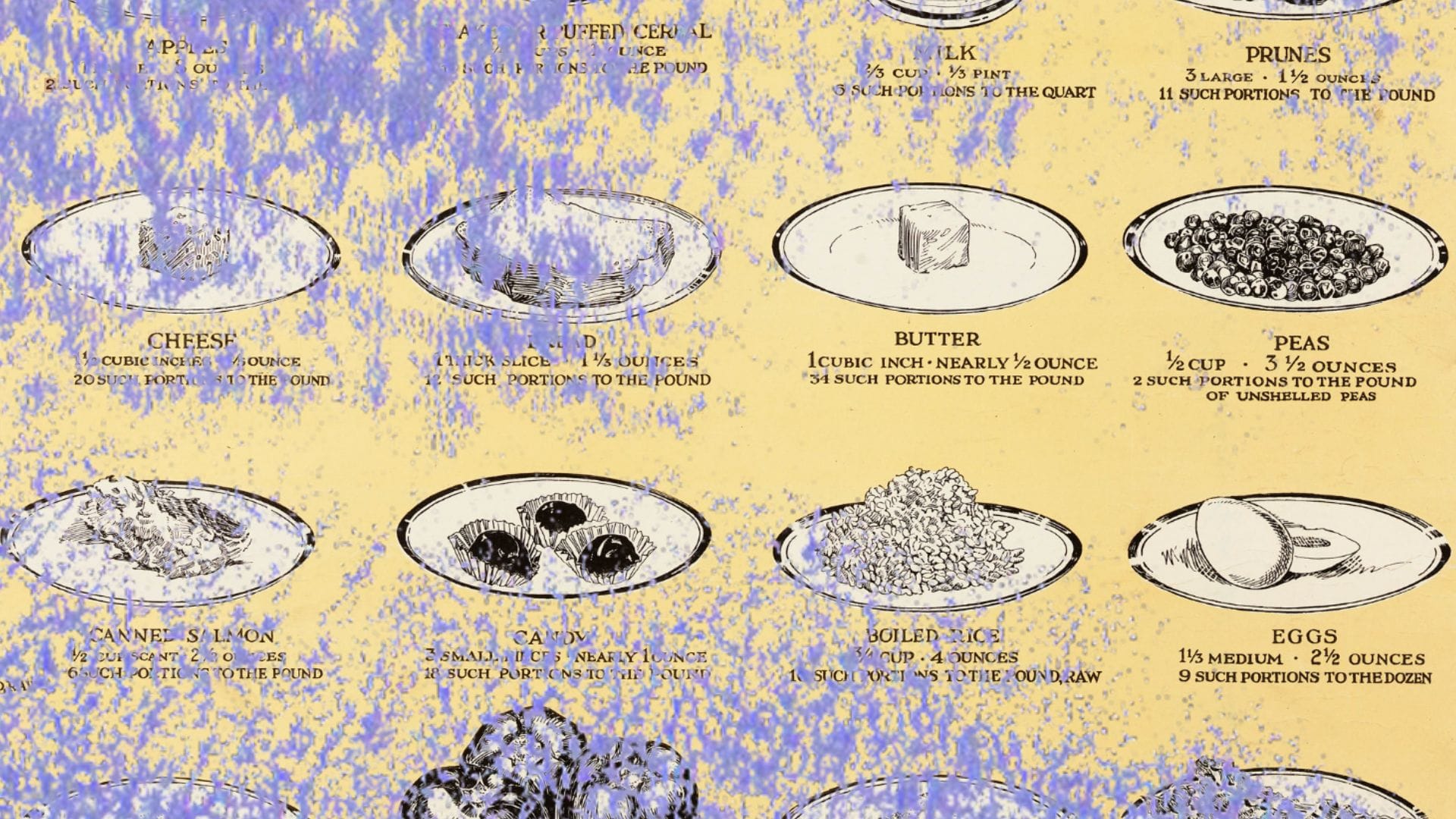
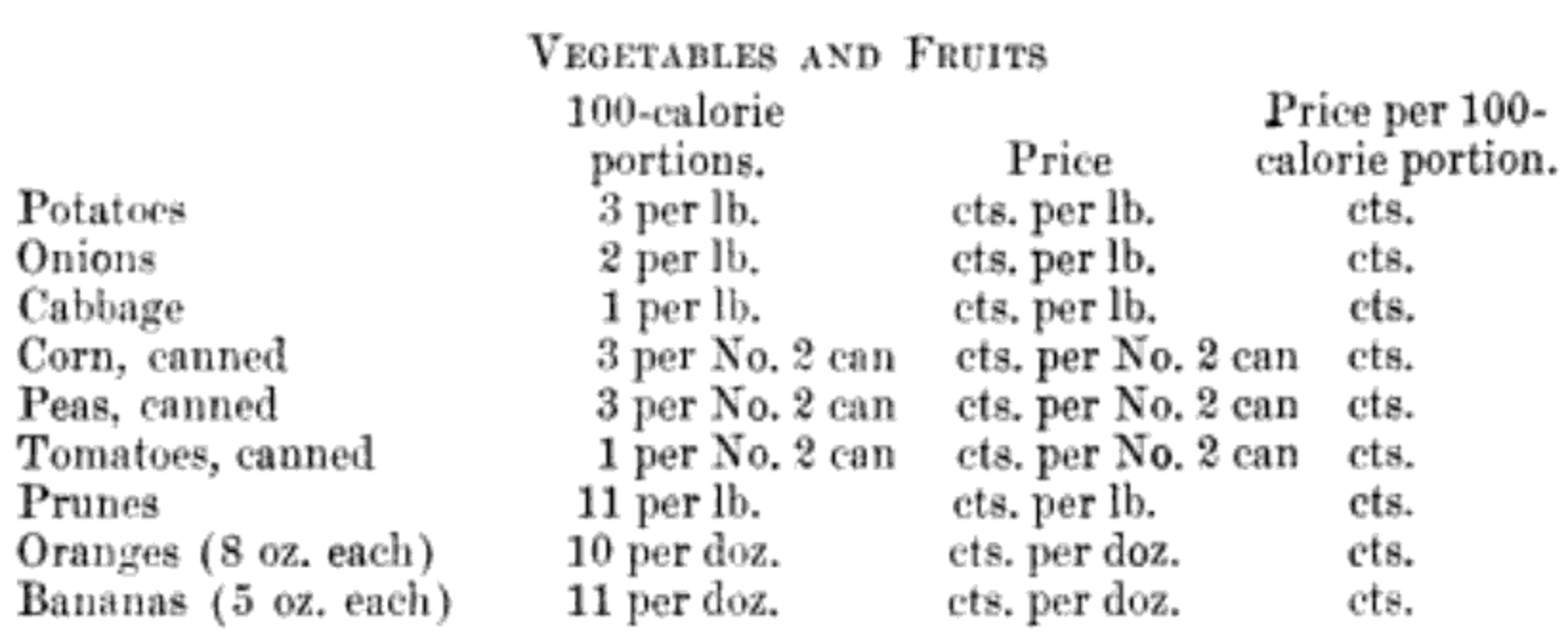
A chart showing the relative cost of different foods based on how many calories they have, in an article advising housewives on calculating the "cheapest efficient body fuel." American Food Journal Vol. 15, 1920.
Jaya Saxena: What first got you interested in looking into the calorie and its place in modern society?
Dr. Nina Mackert: I became interested in the history of body fat. As a scholar of body history, I was coming from a position of huge unease about modern fat shaming. I looked into the history of the Fat Man's Club, which was a group of businessmen in Gilded Age America, and they centered their weight. They did these weigh-ins at the beginning of every meeting, and the goal was to be the heaviest person. Newspapers started to observe these groups with growing ridicule, so I looked at these groups as an example of increasing unease about fat at the turn of the 20th century. But I felt there was something missing on the measures that emerged at the time. Not just BMI, which became important very much later, but I felt someone needed to write a history of the calorie, because it really is a key to understanding modern society and modern fat shaming.
Calories are just so ingrained in many people's lives as the main way to relate to nutrition and food. How did people think about the relationship between food and the body and energy before we had the language of the calorie?
First off, it was not about weight loss before. People did not strive to become thin. Thinness was not yet an aesthetic or moral goal. It was connected to poverty, to hunger, to starvation. But also, bodies were not considered something under individual control. They were given by divine providence, or by fate, and there was nothing that you could control more to your liking. There was a mixture of different bodily ideals, and the absence of this individual imperative to change the body according to society’s liking. It was nothing that could be measured on a supra individual level. And there were not bodily standards; not even the idea of ideal weight was born.
That was such a fascinating shift from talking about what is healthy for one individual person to the idea of an average ideal weight that suddenly you’re not living up to.
One of my early projects with this book was to make clear that measuring food in calories was not inherent; it was a decision based on a very specific industrial logic at the end of the 19th century, when industrializing societies heralded efficiency and productivity. Modern nation-states were confronted with the problem of feeding the industrial masses, and they had a certain configuration of problems. Because of the scientific discourse on thermodynamics at the time, nutrition scientists decided that energy was a productive thing to measure. And the book shows how it became an allegedly self-evident and natural thing for us to measure calories.
Whenever a political culture foregrounds individual responsibility for your fate, then it was a time when body norms were particularly aggressive and toxic
You point out how this supposedly scientific measure was used to justify all of these existing political and social views and prejudices, even when the evidence produced refuted those claims, or even when there's contradictory evidence. People seem to really be able to mold the calories to justify what they already wanted to justify. Why was this measure so easy to manipulate?
First of all, I want to say that it is a scientific measurement. And I think this is important. Contrary to pseudoscientific racism, for instance, there were all these experiments, and there were solid chemists doing things. Many natural scientists would agree that natural science produces ideas that are inherently fragile, and inherently tied to social and political problems. So it's not that I would say this is unscientific and political, but that it's scientific and political. I think this is really evident in these different efforts to set scientific standards and nutritional standards according to race and gender, for instance.
One of the most interesting things to me while doing this research was that the current critique of the calorie that most of us are familiar with was already prevalent during the late 19th and early 20th century. That is actually impossible to mold bodies or health according to food energy units, on the basis of counting calories, et cetera. I'm really interested in how this mélange of scientific ideas, of political circumstances, political problems, created this very lasting unit that obviously sits on a very fragile basis.
You write about how the calorie was used at this pivotal point in the labor movement, by the capitalist managerial class to position workers more as consumers. And this idea of consumer citizenship, where your diet, your health, and your ability to live are more about your buying habits than how much money you make. I'm curious to hear a little more about how the calorie allowed us to view others and ourselves as primarily consumers?
The calorie is about consumption, essentially. Its thermodynamic base locates the source of productivity of anything in its consumption. The idea of calories is that they provide energy for you to do something through consumption. According to the logic of the calorie, more consumption means more productivity. Even nowadays in Germany, there are always these discussions about how much money do people need? And how could we cut welfare spending? And there are right-wing politicians explaining how people can eat more cheaply by telling them about calorie counts. It can also be used in some initiatives for people to say they need to meet certain calorie needs; it holds the potential to ask for more. But frankly, it's been used most of the time to teach people how to need less.
We have some very similar stuff happening here. RFK Jr. recently was telling people they should just eat cheaper cuts of organ meat.
This large focus on consumption inherent in calorie counting is actually one of the main reasons why it became so successful in a consumer society, because consumer society is so fraught, so pervaded by notions of good and bad consumption, by notions of good and bad people, et cetera. Modern consumer society requires both self-restraint and consumption. It also measures status by consumption, and you're asked to consume, with pleasure, whatever the food industry throws at you. Many of the diet manuals in the early 20th century already say you can eat anything; you can eat butter, you can eat pie, you can eat cake, et cetera. But you’re also constantly required to exercise self-control.
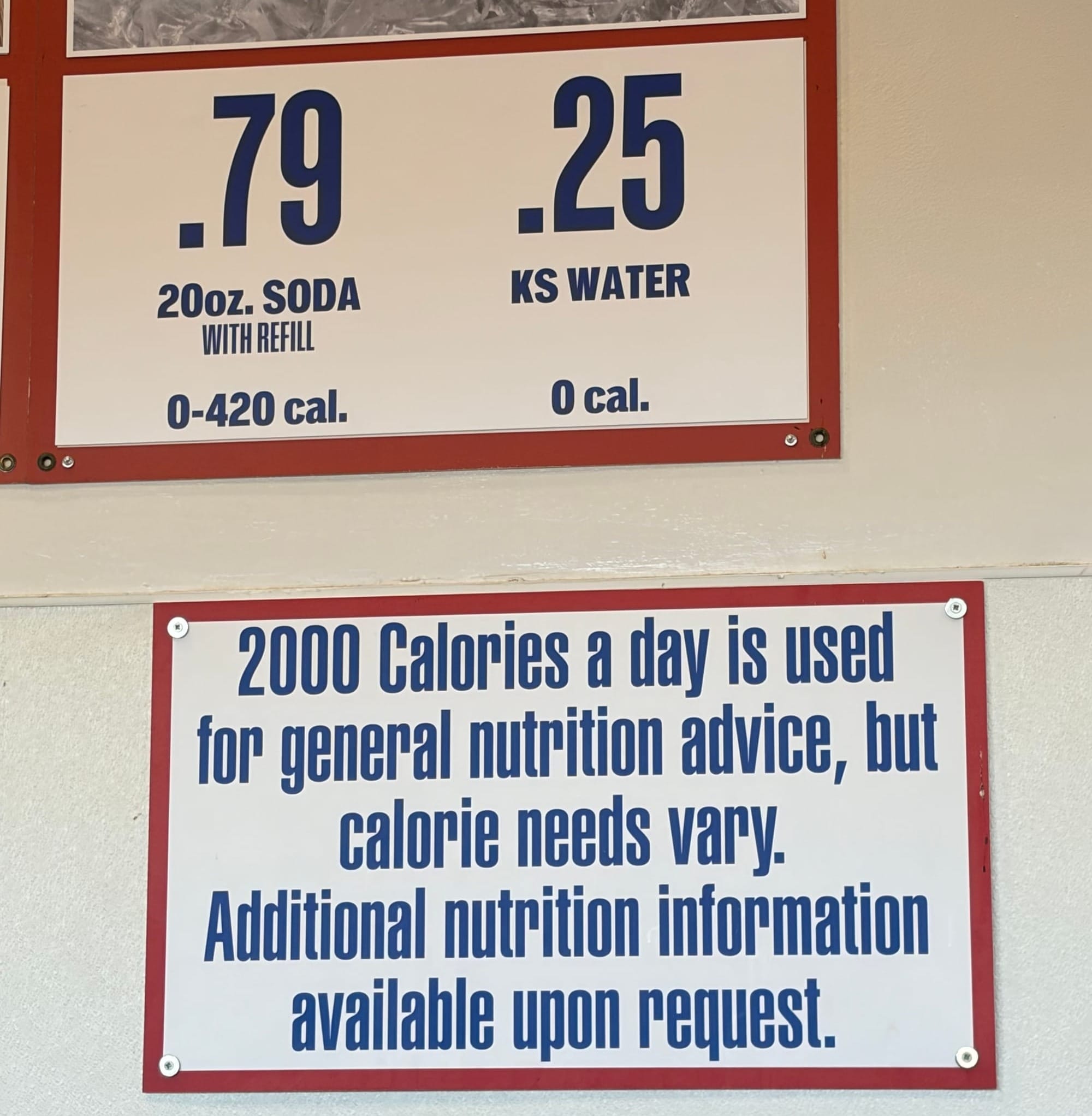
A calorie count sign at Costco. Jaya Saxena/Ravenous
Calculations of how many calories people need vary wildly throughout its history. And now we have this 2,000 a day standard recommendation. Where did that number come from?
I don't actually know. Having researched the basis for these historical figures, which were already arbitrary, I can say that this number is an average for an average person, and this average person is obviously non-existent. You cannot homogenize all people by one average. But public health experts and nutrition experts and social reformers felt the need to explain dietary needs to the people in a profoundly simple manner. That's also where the 100-calorie portion came from; this idea that people needed to be taught how to eat properly. So experts came up with these very general simplifications that are so general that they might not be of use to anyone.
My interest in this project came also from observing myself. I'm not exempt from all of this. I go into the supermarket and look at the back of products where the nutrition facts are. And it's like, how do these numbers gain their power to suggest to us the truth of any particular food?
What you wrote about the Progressive Era, and the drive to view the body as this machine that can be optimized, sounded so familiar. It’s felt like recently there really has been this push for body optimization, whether it’s with protein, peptides, adaptogens, or whatever. Is there something in the air that is bringing this language of optimization back?
I do see parallels between the early 20th century and the early 21st century. But let me start with the differences. If we look back on the Progressive Era, among many reformers there was this well-intended idea of alleviating poverty and the bad consequences of capitalism. They were being paternalistic and racist in the course, but it was, I think, a different project than neoliberal health politics. If you look at the course of the 20th century, you can see that whenever a political culture foregrounds individual responsibility for your fate, then it was a time when body norms were particularly aggressive and toxic. This changed a little bit after the Progressive Era, during the Great Depression, and with the New Deal, when the focus was more on collective solutions. But you can see it coming back in the 1970s, even before [Ronald] Reagan, with the idea that people were responsible for their health, that people's individual responsibility needed to be foregrounded in public health.
We are also at a very particular moment in history right now. These movements can connect so well to neoliberal politics because neoliberal politics has been teaching us for decades that there's a survival of the fittest, and that there is a survival of the most responsible, and of the most able, and of those who can optimize themselves best. In the end, that has an authoritarian effect, because they naturalize a social hierarchy of the able, and these autocratic movements can easily pick up on that. I think that's the reason why we see this very fatphobic backlash right now.
What do you think about calorie counts on menus?
As a historian, I am interested in them, but I don't think we need to count calories to talk about health. I think they are a technology of governing that seeks to nudge people to make the right choices, but not because they have a choice, but because these choices are circumscribed in a very particular way, and calories kind of suppose or suggest us in a very particular direction.
Is there anything the calorie is useful for for a consumer?
I'm not a nutrition scientist, and I don’t have an agenda to teach people how to eat right, because I am interested in how societies talk about eating right, and how these norms of eating right work. So, I'm not the person to give advice about how to eat. I think the calorie has been important in creating the basis of modern food aid, and in modern efforts of alleviating poverty and hunger. But this also came with a certain price, so I would not say that there's any way of counting calories that serves solely great goals in an ethical way. I’d rather get rid of the calorie.
This interview has been edited for length and clarity.
Ravenous is an independent food culture publication. Subscribe today to read everything we have to offer.
Medieval art used fat bodies to represent gluttony all the time. Like yes there were changes in how we think about fatness and eating in the 19th & 20th centuries, but the general association and its moral valence isn’t new
 Log in












 reply