


plant lover, cookie monster, shoe fiend
20782 stories
·
19 followers

B.C. promised millions each year to help people with brain injuries. What happened?

1 Share
B.C. promised millions each year to help people with brain injuries. What happened?
͏ ‌     ͏ ‌     ͏ ‌     ͏ ‌     ͏ ‌     ͏ ‌     ͏ ‌     ͏ ‌     ͏ ‌     ͏ ‌     ͏ ‌     ͏ ‌     ͏ ‌     ͏ ‌     ͏ ‌     ͏ ‌     ͏ ‌     ͏ ‌     ͏ ‌     ͏ ‌     ͏ ‌     ͏ ‌     ͏ ‌     ͏ ‌     ͏ ‌     ͏ ‌     ͏ ‌     ͏ ‌     ͏ ‌     ͏ ‌     ͏ ‌     ͏ ‌     ͏ ‌     ͏ ‌     ͏ ‌     ͏ ‌     ͏ ‌     ͏ ‌     ͏ ‌     ͏ ‌     ͏ ‌     ͏ ‌     ͏ ‌     ͏ ‌     ͏ ‌     ͏ ‌     ͏ ‌     ͏ ‌     ͏ ‌     ͏ ‌     ͏ ‌     ͏ ‌     ͏ ‌     ͏ ‌     ͏ ‌     ͏ ‌     ͏ ‌     ͏ ‌     ͏ ‌     ͏ ‌     ͏ ‌     ͏ ‌     ͏ ‌     ͏ ‌     ͏ ‌     ͏ ‌     ͏ ‌     ͏ ‌     ͏ ‌     ͏ ‌     ͏ ‌     ͏ ‌     ͏ ‌     ͏ ‌     ͏ ‌     ͏ ‌     ͏ ‌     ͏ ‌     ͏ ‌     ͏ ‌     ͏ ‌     ͏ ‌     ͏ ‌     ͏ ‌     ͏ ‌     ͏ ‌     ͏ ‌     ͏ ‌     ͏ ‌     ͏ ‌     ͏ ‌     ͏ ‌     ͏ ‌     ͏ ‌     ͏ ‌     ͏ ‌     ͏ ‌     ͏ ‌     ͏ ‌     ͏ ‌     ͏ ‌     ͏ ‌     ͏ ‌     ͏ ‌     ͏ ‌     ͏ ‌     ͏ ‌     ͏ ‌     ͏ ‌     ͏ ‌     ͏ ‌     ͏ ‌     ͏ ‌     ͏ ‌     ͏ ‌     ͏ ‌     ͏ ‌     ͏ ‌     ͏ ‌     ͏ ‌     ͏ ‌     ͏ ‌     ͏ ‌     ͏ ‌     ͏ ‌     ͏ ‌     ͏ ‌     ͏ ‌     ͏ ‌     ͏ ‌     ͏ ‌     ͏ ‌     ͏ ‌     ͏ ‌     ͏ ‌     ͏ ‌     ͏ ‌     ͏ ‌     ͏ ‌     ͏ ‌     ͏ ‌     ͏ ‌     ͏ ‌     ͏ ‌     ͏ ‌     ͏ ‌     ͏ ‌     ͏ ‌     ͏ ‌     ͏ ‌     ͏ ‌     ͏ ‌     ͏ ‌     ͏ ‌     ͏ ‌     ͏ ‌     ͏ ‌     ͏ ‌     ͏ ‌     ͏ ‌     ͏ ‌     ͏ ‌     ͏ ‌     ͏ ‌     ͏ ‌     ͏ ‌     ͏ ‌     ͏ ‌     ͏ ‌     ͏ ‌     ͏ ‌     ͏ ‌     ͏ ‌     ͏ ‌     ͏ ‌     ͏ ‌     ͏ ‌     ͏ ‌     ͏ ‌     ͏ ‌     ͏ ‌     ͏ ‌     ͏ ‌     ͏ ‌     ͏ ‌     ͏ ‌     ͏ ‌     ͏ ‌     ͏ ‌     ͏ ‌     ͏ ‌     ͏ ‌     ͏ ‌     ͏ ‌     ͏ ‌     ͏ ‌     ͏ ‌     ͏ ‌     ͏ ‌     ͏ ‌     ͏ ‌     ͏ ‌     ͏ ‌     ͏ ‌     ͏ ‌     ͏ ‌     ͏ ‌     ͏ ‌     ͏ ‌     ͏ ‌     ͏ ‌     ͏ ‌     ͏ ‌     ͏ ‌     ͏ ‌     ͏ ‌     ͏ ‌     ͏ ‌     ͏ ‌     ͏ ‌     ͏ ‌     ͏ ‌     ͏ ‌     ͏ ‌     ͏ ‌     ͏ ‌     ͏ ‌     ͏ ‌     ͏ ‌     ͏ ‌     ͏ ‌     ͏ ‌     ͏ ‌     ͏ ‌     ͏ ‌     ͏ ‌     ͏ ‌     ͏ ‌     ͏ ‌     ͏ ‌     ͏ ‌     ͏ ‌     ͏ ‌     ͏ ‌     ͏ ‌     ͏ ‌     ͏ ‌     ͏ ‌     ͏ ‌     ͏ ‌     ͏ ‌     ͏ ‌     ͏ ‌     ͏ ‌     ͏ ‌     ͏ ‌     ͏ ‌     ͏ ‌     ͏ ‌     ͏ ‌     ͏ ‌     ͏ ‌     ͏ ‌     ͏ ‌     ͏ ‌     ͏ ‌     ͏ ‌     ͏ ‌     ͏ ‌     ͏ ‌     ͏ ‌     ͏ ‌     ͏ ‌     ͏ ‌     ͏ ‌     ͏ ‌     ͏ ‌     ͏ ‌     ͏ ‌     ͏ ‌     ͏ ‌     ͏ ‌     ͏ ‌     ͏ ‌     ͏ ‌     ͏ ‌     ͏ ‌     ͏ ‌     ͏ ‌     ͏ ‌     ͏ ‌     ͏ ‌     ͏ ‌     ͏ ‌     ͏ ‌     ͏ ‌     ͏ ‌     ͏ ‌     ͏ ‌     ͏ ‌     ͏ ‌     ͏ ‌     ͏ ‌     ͏ ‌     ͏ ‌     ͏ ‌     ͏ ‌     ͏ ‌     ͏ ‌     ͏ ‌     ͏ ‌     ͏ ‌     ͏ ‌     ͏ ‌     ͏ ‌     ͏ ‌     ͏ ‌     ͏ ‌     ͏ ‌     ͏ ‌    ­ ­ ­ ­ ­ ­ ­ ­ ­ ­ ­ ­ ­ ­ ­ ­ ­ ­ ­ ­ ­ ­ ­ ­ ­ ­ ­ ­ ­ ­ ­ ­ ­ ­ ­ ­ ­ ­ ­ ­ ­ ­ ­ ­ ­ ­ ­ ­ ­ ­ ­ ­ ­ ­ ­ ­ ­ ­ ­ ­ ­ ­ ­ ­ ­ ­ ­ ­ ­ ­ ­ ­ ­ ­ ­ ­ ­ ­ ­ ­ ­ ­ ­ ­ ­ ­ ­ ­ ­ ­ ­ ­ ­ ­ ­ ­ ­ ­ ­ ­ ­ ­ ­ ­ ­ ­ ­ ­ ­ ­ ­ ­ ­ ­ ­ ­ ­ ­ ­ ­ ­ ­ ­ ­ ­ ­ ­ ­ ­ ­ ­ ­ ­ ­ ­ ­ ­ ­ ­ ­ ­ ­ ­ ­ ­ ­ ­ ­ ­ ­ ­ ­ ­ ­ ­ ­ ­ ­ ­ ­ ­ ­ ­ ­ ­ ­ ­ ­ ­ ­ ­ ­ ­ ­ ­ ­ ­ ­ ­ ­ ­ ­ ­ ­ ­ ­ ­ ­ ­ ­ ­ ­ ­ ­ ­ ­ ­ ­ ­ ­ ­ ­ ­ ­ ­ ­ ­ ­ ­ ­ ­ ­ ­ ­ ­ ­ ­ ­ ­ ­ ­ ­ ­ ­ ­ ­ ­ ­ ­ ­ ­ ­ ­ ­ ­ ­ ­ ­ ­ ­ ­ ­ ­ ­ ­ ­ ­ ­ ­ ­ ­ ­ ­ ­ ­ ­ ­ ­ ­ ­ ­ ­ ­ ­ ­ ­ ­ ­ ­ ­ ­ ­ ­ ­ ­ ­ ­ ­ ­ ­ ­ ­

‘Ignored Again’

Millions of Canadians suffer from brain injuries, and a special fund was developed in B.C. to help. But as Bethany Lindsay reports, very little of that money has made its way to those people in more than a decade.


Read the story below or go to our website.

The IJF's Featured Stories

B.C. promised millions each year to help people with brain injuries. What happened?

By Bethany Lindsay

Over the last three decades, the charity led by “Man in Motion” Rick Hansen has received more than $57 million from the B.C. government to support people with brain and spinal cord injuries.


The B.C. Neurotrauma Fund has provided up to $2 million every year since 1997 for research and services addressing these injuries, all chosen by the Rick Hansen Foundation. 


But an IJF analysis of the last six years of annual reports for the fund found no mention of funding specifically devoted to brain injury supports or studies, highlighting a concern advocates have been raising since 2014. Instead, the money from the fund has largely gone to spinal cord injury research and health-care strategies, as well as public advocacy by Hansen.

Continue Reading

‘Questionable Business Model’

An analysis from lobbying watchdog group F Minus found fossil fuel giants and local governments seeking help with climate mitigation are retaining the same lobbying firms.


Read the story below or go to our website.

Alberta lobby firm retained by fossil fuel companies and local governments struggling with climate mitigation

By Brett McKay, Local Journalism Initiative Reporter

Municipalities struggling with the increasing frequency of flooding, drought and wildfire brought on by climate change are hiring professional lobbying firms to get action from Alberta’s government. And the firms that several local governments now employ are also lobbying for major fossil fuel companies, a report from the lobbying watchdog group F Minus found.


“That's a very questionable business model of essentially getting paid to further a problem that is resulting in more business for the firm from other clients,” said James Browning, executive director of F Minus.


“These firms are getting paid to further Can­ada's dependence on fossil fuels, but then of course that dependence is leading to worse long-term climate impacts for these local governments, which then generates more business for the same lobbying firm.”

Continue Reading
Bluesky icon
X icon
LinkedIn icon

Copyright © 2026
Investigative Journalism Foundation


This email was sent to ywlpndcj80wccy8djyz5@kill-the-newsletter.com
why did I get this?    unsubscribe from this list    update subscription preferences
Investigative Journalism Foundation · 192 Spadina Ave · Toronto, ON M5T 2C2 · Canada


Kill the Newsletter! feed settings

Read the whole story
sarcozona
6 hours ago
reply
Epiphyte City
Share this story
Delete

Scientists Warn Carney’s Changes Will Bring ‘Wilful Extinction’ | The Tyee

1 Share

In an urgent and unprecedented plea, five former chairs of the Committee on the Status of Endangered Wildlife in Canada are sounding the alarm about a Carney government proposal that would allow the “wilful extinction” of species across the country.

The five scientists say the Species at Risk Act will become “meaningless” and “merely paper protection” if the government follows through with a plan to exempt major projects — such as the West Coast oil pipeline — from what’s known as the “jeopardy test” if projects are deemed to be in the national interest.

The test prohibits Ottawa from authorizing projects or actions that would harm listed species and their critical habitats if they would jeopardize their survival. More than 600 species, including B.C.’s spotted owls and killer whales — also known as orcas — are currently listed under the act.

The recent announcement that the West Coast pipeline may be deemed of “national interest” places B.C.’s endangered southern resident killer whales “directly in the crosshairs of this change,” the scientists said Tuesday in a media release.

“Are Canadians willing to bet this unique population of killer whales against another oil pipeline?” they asked.

The scientists, who are from B.C., Quebec and Nova Scotia, said the pipeline “could decimate the entire population of the imperiled killer whales through time” by increasing tanker traffic noise and significantly destroying habitat for the whales’ main prey, Pacific salmon.

But under the proposed change to the Species at Risk Act, they said, “this real risk of extinction would be moot.”

“Canadians must learn about this, or risk becoming unknowingly complicit in the wilful extinction of Canadian wildlife species,” the scientists said.

The Committee on the Status of Endangered Wildlife in Canada is an independent advisory panel to the federal government that assesses species at risk of extinction and makes recommendations to list them as endangered, threatened or a species of special concern.

Recent budget cuts have left the watchdog committee struggling to do its job as the number of at-risk species in Canada steadily climbs.

‘Why would they do that?’

The committee’s five former chairs also published an open letter Tuesday that they sent to the federal government on July 21, strongly urging Carney and his cabinet to remove the proposed alteration to the Species at Risk Act from any impending legislative changes.

David Green, a biologist and McGill University professor emeritus who chaired the committee for four years, told The Tyee that the current government might use any new discretionary power judiciously, “but future governments may not.”

image atom
BC Aims to Revive Spotted Owls in the Wild. So Why Log Fire Lake?
read more

“That’s the real danger,” Green said. “Once the species is gone, it’s gone forever. You’re not going to bring it back if it goes extinct.”

The letter comes as the Carney government takes stock following a public comment period on sweeping changes it proposes for environmental regulations and permitting to speed up approval and construction of major projects such as pipelines, ports and mines.

The changes would also make it easier to destroy fish habitat and allow Carney and his cabinet to create federal economic zones where a broad range of industrial development could be pre-approved.

Cabinet would also be able to pre-approve pipelines before a route is established and exempt them from federal impact assessments.

The proposed change to the Species at Risk Act, which has been in place since 2002, comes as nature is in an unprecedented decline and the World Economic Forum warns that biodiversity and ecosystem loss is the second biggest risk the world faces in the next 10 years. One key measure of biodiversity loss is the number of species at risk of extinction.

The change is also being proposed as other jurisdictions take a hatchet to legislation aimed at protecting at-risk species.

image atom
Canada’s Endangered Species Watchdog Is Strapped for Cash
read more

In Ontario, Premier Doug Ford has weakened what was widely viewed as Canada’s gold standard for provincial endangered species legislation.

South of the border, U.S. President Donald Trump is in the process of dismantling his country’s Endangered Species Act, which safeguarded wildlife on private and state lands as well as federal lands.

Green said Canada cannot rely on the United States to save species. “They have no interest in that. That’s clear. So, it’s our job. It’s our heritage.”

He said it’s the first time that the five living ex-chairs of the committee have issued a public appeal and written to the government.

The other former chairs are Marco Festa-Bianchet from the Université de Sherbrooke, Marty Leonard, a retired professor from Dalhousie University, Eric Taylor, a professor emeritus at the University of British Columbia and John Reynolds from Simon Fraser University.

Green said he signed the letter because he can see “a danger” in the proposed changes to the Species at Risk Act, which was passed by a Liberal government led by former prime minister Jean Chrétien.

image atom
Even Harper ‘Did Not Put Extinction on the Table’
read more

Green was the committee’s chair from 1998 to 2002, when the government was garnering support for the act from the provinces and territories.

“They put an enormous amount of time and effort into it,” he recalled, adding that the government brought the act to the House of Commons three times before it finally passed.

“To see the current Liberal government propose an amendment that would just override the whole thing seems to me just really strange. Why would they do that?” he asked.

The Species at Risk law is in place, Green said, so that we “have to think really hard before taking actions that will potentially destroy things that can’t be replaced.”

He said he hopes people care about nature the way they care about great works of art or literature, and that Canadians will think about the ramifications of removing the jeopardy test from the Species at Risk Act.

“You may think this is expedient now, but what does that mean in the future?”  [Tyee]

Read the whole story
sarcozona
7 hours ago
reply
Epiphyte City
Share this story
Delete

The Burden of Chronic Illness That I Rarely Talk About – A Life Hidden

2 Shares

Being ill is hard.  What an obvious thing to say – and yet how often it goes unspoken. 

I’ve written about many aspects of life with long-term illness: from the grief of dreams shattered, to the isolation and lack of support.  But there’s a hardship at the core of it all that I’ve never directly addressed: the struggle of living in a body that is the source of so much suffering.  It can be exhaustingly, relentlessly difficult. 

It’s important to acknowledge that there are many people far worse than me, particularly those too ill to even read these words.  I’ve now reached a point where I have times of symptomatic relief; times when I can enjoy life rather than just exist.  I will never not be grateful for this.  

Yet living in my own body continues to be the most enormous challenge.  There are the migraines that repeatedly floor me.  The bodily pain that at times reduces me to tears with its intensity.  The lights that swirl in my eyes, and the dizzy sensation of the blood having been drained from my body.  These are not just symptoms: they are part of the fabric of my life.  They are the demons around which I must constantly tiptoe; the trapdoors that open beneath me without warning. 

These are not just symptoms: they are part of the fabric of my life.  They are the demons around which I must constantly tiptoe; the trapdoors that open beneath me without warning

There’s often a deep stoicism in those of us who have known lengthy illness: a quiet acceptance of bodily suffering that conceals its true burden.  For our own survival, we’ve learnt to normalise feeling unwell.  We measure our symptoms not against the healthy body, but against its worst potential.  We think of the depths we once experienced, or how much worse we know it can get – and we tell ourselves that this is ok, really.  We can live with this. 

Having endured years of relentless physical agony, the load I carry today seems comparatively light.  This perspective allows me to make the most of my ongoing limitations, but at times can overshadow the very real burden that I continue to bear.  Because it is draining to exist in a body that revolts at light and sound and movement.  A body that collapses in response to company, exertion, environmental changes, routine viruses – even emotions.  A body capable of producing extremes of suffering, often for no discernible reason. 

There is always sacrifice: always a demand from past or future that necessitates a scaling back in the present

My symptoms may no longer be continually active, but the potential for them remains a constant presence.  Those who see me at my laughing, smiling best could never imagine the delicate balancing act behind every moment.  The impossible decisions over what is too much or not enough; the silent background calculations as to how close I might be to collapse.  There is always sacrifice: always a demand from past or future that necessitates a scaling back in the present. 

There is perhaps a reason why I’ve never publicly shared a piece like this before.  A cruel perception exists among some that the chronically ill – and particularly those of us with ME – are preoccupied with our own bodies.  The fear of being judged in this way has a tendency to silence healthy expression.  The truth is that, wherever possible, I place my focus on anything other than my condition.  But I cannot change the fact that I exist in a body that requires great reserves of mental energy.  Or the reality that when trust in one’s own body has been shattered, life will always have a hum of background fear.  Today’s suffering, however bad it may be, is usually not the hardest part: it’s tomorrow’s uncertainty that is heaviest to bear. 

Today’s suffering, however bad it may be, is usually not the hardest part: it’s tomorrow’s uncertainty that is heaviest to bear

Over time I’ve learnt to find peace in my enforced stillness.  On better days I can even find a poetic beauty in this life of quiet contemplation.  How lucky I am to watch the sky move through its many moods, and see the seasons transform the garden.  But joy is harder to hold onto on days when pain crushes me, or I feel too unwell to move.  Acknowledgment of that reality is important.  

Because no matter how I approach each day, I still live in a very ill body, and have done so since I was a child.  I deserve to honour that fact, along with the resilience that has allowed me to bear it for so long.  

Sometimes it simply needs to be said: being ill is hard.  

A gravel road leads through a field of dry grass, towards the sea

Image credit: Erik Mclean on Unsplash

Read the whole story
sarcozona
8 hours ago
reply
Epiphyte City
Share this story
Delete

STAT+: Cancer patients face longer wait times to begin treatment, according to new study

1 Share

Waiting for treatment to start can be an excruciating period for cancer patients. There can be fears that the disease is spreading, or progressing to a point where therapies become less effective. Yet over the last few decades, the time cancer patients are waiting between diagnosis and treatment has steadily grown, according to a new study of more than 2.7 million patients.

“What was striking was the consistency,” said Tim Donahue, the senior author on the study and a surgical oncologist at the University of California, Los Angeles. “Across every cancer we studied, patients are waiting longer today than they were a decade ago.”

Donahue and his colleagues analyzed data from the National Cancer Database, a national data repository from the American College of Surgeons, from 2012 to 2023. They looked only at patients with stage 1 to 3 cancers that were considered eligible for surgery at diagnosis across six different cancers. Then, they compared the time between diagnosis and any first treatment, which included surgery as well as radiation or chemotherapy or other medical therapies. 

Continue to STAT+ to read the full story…


Read the whole story
sarcozona
12 hours ago
reply
Epiphyte City
Share this story
Delete

Build Canada Homes’ vague goals concern experts

1 Share

Housing experts are applauding Ottawa’s goal of building more affordable homes. But they want clarity about how the new Crown corporation Build Canada Homes will help accomplish this goal. 

Read the whole story
sarcozona
12 hours ago
reply
Epiphyte City
Share this story
Delete

Why you can’t find a primary care doctor

1 Share

While public health systems have plenty of room to become more trustworthy, I am increasingly convinced that much mistrust stems also from health systems. In a recent YLE survey, for example, more than 1 in 2 participants had difficulty finding a primary care provider.

I called Lucy McBride, a primary care physician with 25 years of experience and author of Beyond the Prescription: A Doctor’s Guide to Taking Charge of Your Health, and asked her to run down what’s happening and what people can actually do about it.

Lucy, take it away…


When I took my dad to the emergency department in December, I couldn’t help overhearing the conversations around us as we waited for his results. Through paper-thin curtains separating us from other patients, everyone was discussing problems that a primary care doctor could handle—walking pneumonia, an infected wound, blood pressure gone haywire. Here, it was easier to access care because EDs can’t turn you away, but unfortunately, it was way more expensive for the patient.

It gave me the sobering realization: nothing has changed in 20 years. When I was working in the Johns Hopkins ED, we were providing primary care for East Baltimore, like insulin for diabetics who couldn’t get a refill from their doctor in time or UTIs that couldn’t wait for 3 weeks for the only appointment offered to them. To this day, I get messages from friends and relatives who have questions that their primary care doctor could answer.

These aren’t one-off scenarios. More than 100 million Americans lack access to primary care. Some of this is due to cost, but a lot of it is due to supply.

Why are we so short on primary care?

Economics.

Prevention is not the priority in U.S. health care; damage control is, and the money proves it. Less than 5% of health care spending in the U.S. goes toward primary care, while the other 95% flows to hospitals, procedures, prescriptions, and administration. This imbalance sets off a chain reaction in which really no one is winning except the balance sheets.

Domino 1: Primary care doesn’t pay, so fewer doctors choose it. Other specialists earn 40–90% more than primary care physicians, with surgical fields paying nearly double. Why? Because our fee-for-service system pays for procedures. The average reimbursement for a primary care visit is $259, versus $1,092 for a gastroenterology visit.

This doesn’t just impact the current physicians, but the pipeline of physicians. Class of 2025 graduates carried an average of $200,000–$250,000 in debt. Faced with that math, why would a med student pick a lower-paying field? The Bureau of Health Workforce projects a shortfall of over 87,000 primary care physicians by 2037.

Domino 2: The doctors who stay get crushed. Most of us went into primary care to listen to, teach, and guide patients throughout their lives. But in order to keep the clinic alive, physicians have to see more patients. We aren’t given the time that is needed to spend with a patient. So that means only 15 minutes to see an 80-year-old who’s just been diagnosed with cancer, grieving a spouse, and now has new chest pain. The mission becomes impossible, and burnout follows fast.

Domino 3: Burnout drives doctors out, deepening the shortage: 45% of primary care doctors report burnout, and 39% of those plan to stop seeing patients. This is turning into a workforce exodus.

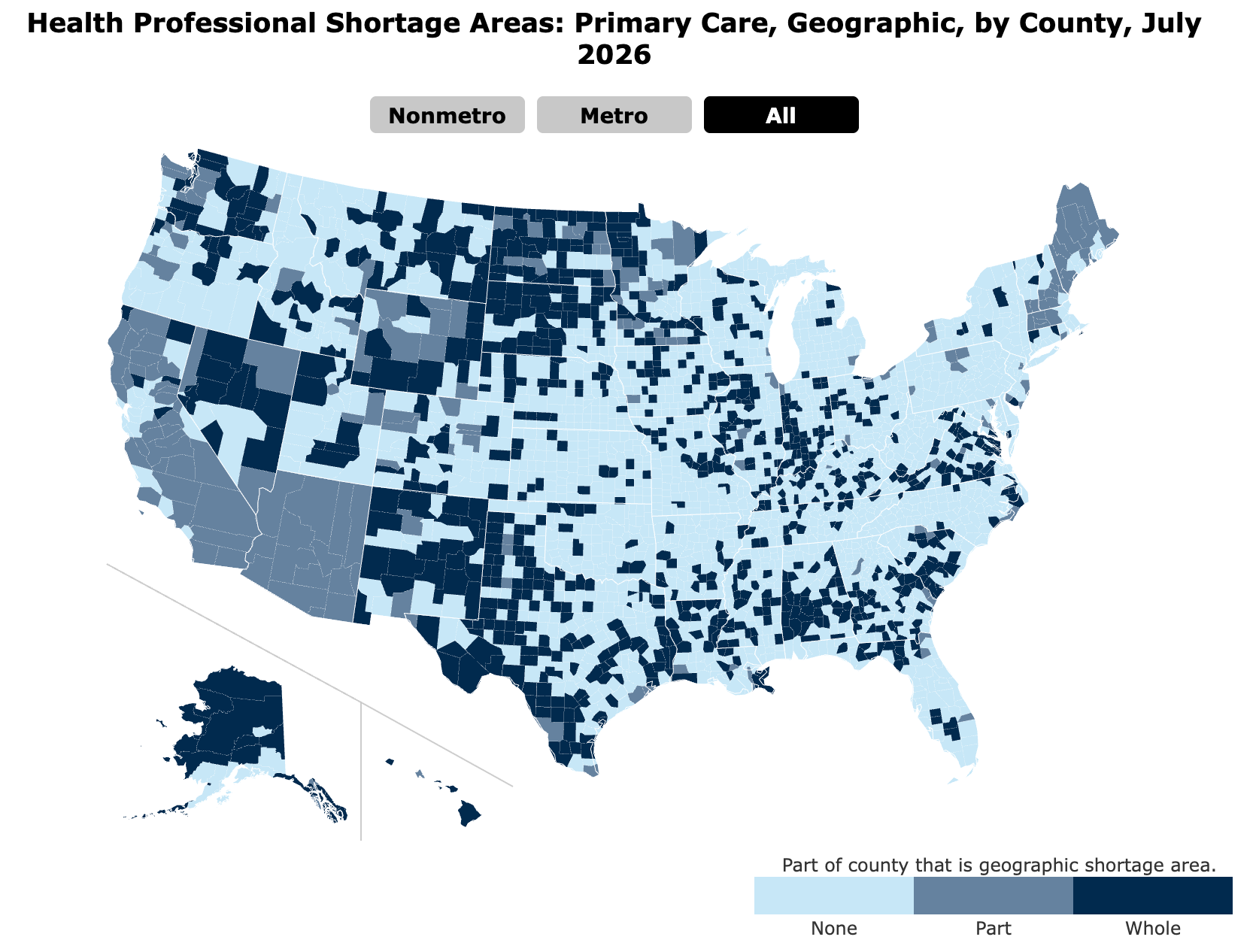
All of this adds up to major primary care shortage areas throughout the U.S., as shown in the graph below.

None of this is the doctor’s fault. YLE’s survey found that three-quarters of people trust their own doctor once they have one, but the hard part is getting one in the first place. Doctors are victims of this broken system, just like their patients.

How do the systems get out of this mess?

The fixes aren’t a mystery, but all either require federal legislative action or slow multi-state rollouts.

  1. Pay primary care doctors for conversations with patients—the ones that keep people healthy and prevent disease—rather than for the volume of patients seen in a day. This is called value-based or capitation payment. This can be a fixed amount per patient per month, with bonuses for keeping people healthy.

  2. Expand primary care residency slots and loan-forgiveness programs so that medical students can afford to choose this field. Residency slots are capped by funding, which has been nearly frozen at 1997 levels for decades.

  3. Strip away administrative burdens that eat into the hours doctors should spend with patients. Primary care doctors spend a large share of their day on prior authorizations required by insurance and clicking through health records, instead of with patients. This is where AI could help.

Some states are already experimenting with mandating that a bigger share of health care spending go to primary care (Rhode Island, Delaware, Colorado, Oregon).

But policy moves slowly, and you likely need a doctor’s appointment before Congress acts.

So what can the average person do?

In the meantime, much lies with individuals. A few tips:

  • Seek out community health centers (findahealthcenter.hrsa.gov).

  • Look for skilled NPs and PAs. (I’m a big fan if it’s the right fit.)

  • Consider telehealth-based primary care if you live in a remote area or if access to in-person care is limited.

  • Crowdsource from friends you trust. Ask your dentist and other doctors you like, “Who would you send your own family to?” Skip online reviews—studies show they don’t correlate with quality of care; instead, they measure wait times and parking, not whether the doctor gets it right!

Then work on becoming a more empowered patient. Being your best self-advocate is a skill to be learned. (This is the meat of my book, Beyond the Prescription, out this week.) Given your doctor’s time constraints, you need to do everything possible to squeeze the juice out of the 15 minutes you have with them.

  • Articulate your goals and name your fears, vulnerabilities, and real-life limitations. Learn how to ask the right questions for the problems you actually have.

  • Write down your three most important concerns beforehand, bring biographical context your doctor won’t ask about, keep a living one-page health summary document on your phone with all of your medications, supplements, past medical issues, and habits (good and bad!).

  • Make sure it’s the right fit. You deserve someone who actively listens, adheres to medical evidence, is willing to say “I don’t know,” and shows interest in you as a real person, not just as a set of body parts. You are entitled to make follow-up appointments to discuss further questions or get clarification on advice.

Bottom line

The system won’t fix itself soon, but patients aren’t powerless in the meantime. The question isn’t just how to find a doctor—it’s how to become the kind of patient who gets real care even inside a strained system. Health isn’t about having all the answers; it’s about asking better questions—of yourself and the people responsible for your care.


Lucy McBride, MD, is a primary care physician with 25 years of clinical experience in Washington, DC. She writes the newsletter Are You Okay? and is the author of Beyond the Prescription: A Doctor’s Guide to Taking Charge of Your Health, out this week from Simon & Schuster.

Your Local Epidemiologist (YLE) comprises a team of experts, ranging from physicians to immunologists to epidemiologists to nutritionists, working together with one goal: to “translate” ever-evolving public health science so that people are well-equipped to make evidence-based decisions. The YLE suite of newsletters reaches over 475,000 people across more than 132 countries. This newsletter is free to everyone, thanks to the generous support of fellow YLE community members. To support the effort, subscribe or upgrade below:

Subscribe now

Read the whole story
sarcozona
12 hours ago
reply
Epiphyte City
Share this story
Delete
Next Page of Stories