plant lover, cookie monster, shoe fiend
20732 stories
·
19 followers

The U.S. Took Over Venezuela’s Oil Industry. Where Has All the Money Gone? | Council on Foreign Relations

1 Share

The American and Venezuelan people remain in the dark about how the Trump administration is controlling billions of dollars of Venezuelan oil revenue. Without accountability mechanisms or a clear democratic roadmap, the United States risks entrenching a corrupt successor regime.

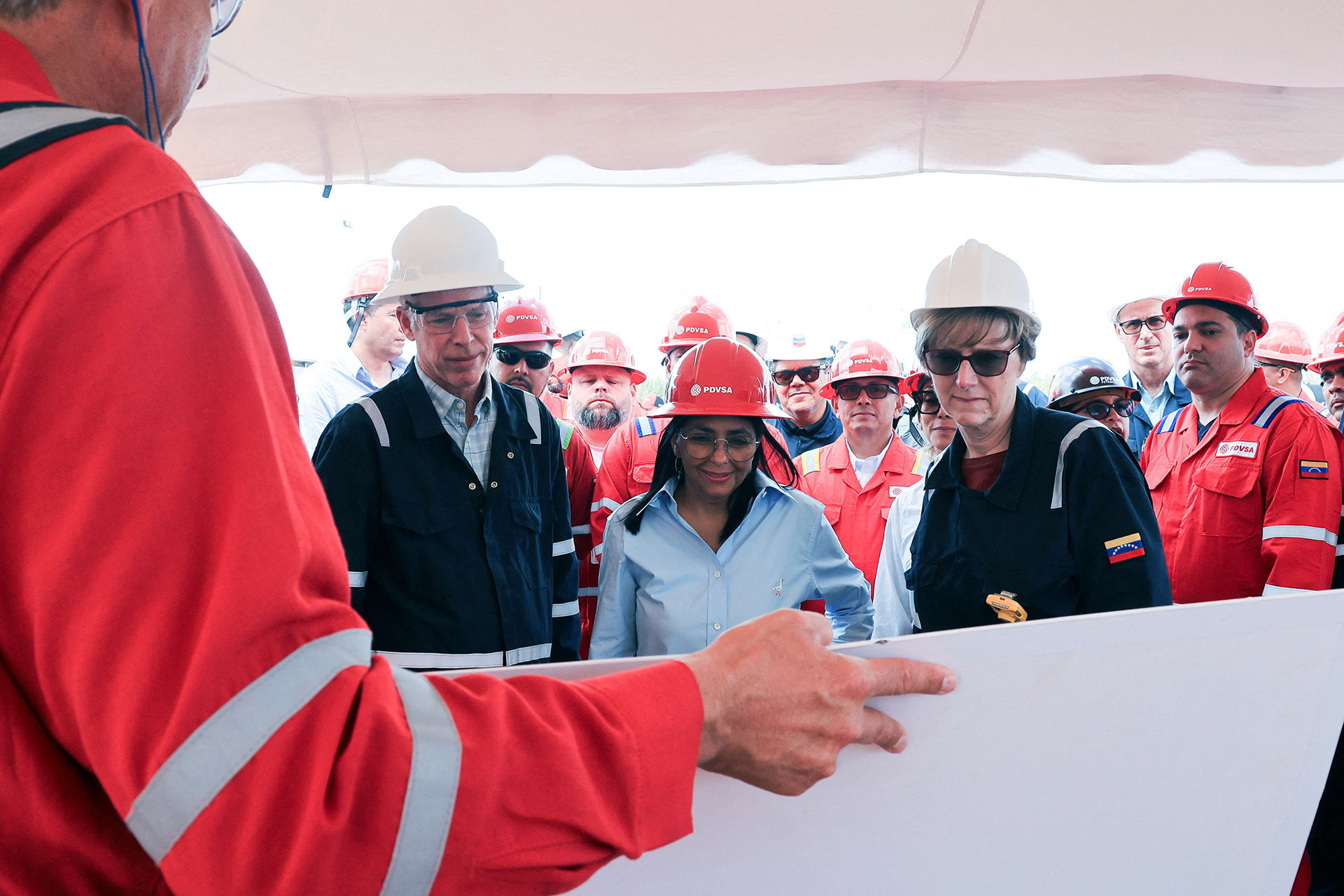
<p>U.S. Energy Secretary Chris Wright, Venezuela’s interim President Delcy Rodríguez, and U.S. Charge d’Affaires to Venezuela Laura Dogu visit oil production facilities in Maturin, Monagas state, Venezuela, on February 12, 2026.</p>
U.S. Energy Secretary Chris Wright, Venezuela’s interim President Delcy Rodríguez, and U.S. Charge d’Affaires to Venezuela Laura Dogu visit oil production facilities in Maturin, Monagas state, Venezuela, on February 12, 2026. Miraflores Palace/Reuters

Published
  • International Affairs Fellow in National Security, sponsored by Janine and J. Tomilson Hill

Roxanna Vigil previously served as a senior sanctions policy advisor at the U.S. Treasury Department’s Office of Foreign Assets Control. Before that, she served as the director for Andean affairs at the National Security Council, where she handled foreign policy and national security issues for Bolivia, Colombia, Ecuador, Peru, and Venezuela.

In the first four months of the United States exerting control over Venezuela’s oil exports, almost one hundred million barrels of oil worth an estimated $8 billion have flowed through a process marked by no transparency and minimal oversight. While the Trump administration has repeatedly framed this control as benefiting both countries, it has not publicly disclosed how much Venezuelan oil it has sold, how much revenue it has collected, or how it has used those funds since seizing control of the country’s oil exports following the January 3 military intervention that deposed Venezuelan leader Nicolás Maduro.

Based on tanker-tracking data from Bloomberg and reports on discounts applied to Venezuelan crude, the estimated value of U.S.-controlled oil exports has increased from $600 million in January (about 380,000 barrels per day) to about $3.7 billion in April alone (about 1.1 million barrels per day). The largest recipients of Venezuelan oil since January 3 have been the United States (43 percent), India (26 percent), and Spain (8 percent).

The Trump administration has shared some details with Congress. Secretary of State Marco Rubio testified in January that $300 million had flowed through a “short-term” account in Qatar and been disbursed to Venezuela, while another $200 million was “still sitting” in the account. He indicated the administration would conduct a retroactive audit on the funds that moved through the Qatar account. The following month, Secretary of Energy Chris Wright said during a press interview that the full $500 million had been transferred to Venezuela and that the administration would use U.S. Treasury accounts going forward.

But the administration has yet to provide a public accounting of the Qatar account, including how the funds were spent or what safeguards were in place to prevent corruption and money laundering. In April, a State Department witness told Congress that the department had authorized the disbursement of about $3 billion to Venezuela, but the witness did not know how much money remained in the U.S. Treasury accounts. It is not clear if the balance in either the Qatar or U.S. Treasury accounts has been shared with Congress.

Same corrupt regime, different leader

Rubio himself told Congress in January that “what you have in Venezuela is a corrupt and broken oil company run by the government” and that “the glue that held the regime together was corruption and graft.” Five months later, nothing has changed on the ground with regard to the ruling elites who remain in power in Venezuela. Notably, interim President Delcy Rodríguez retains control over the different Chavista factions as she complies with the narrow economic concessions demanded by Washington. U.S. President Donald Trump appears satisfied with the arrangement and has praised Rodríguez for doing a “great job.” Rubio also told Congress that Venezuela has agreed to submit monthly budget requests for State Department approval to receive its share of oil revenue.

Rodríguez is getting much of what she wants in return, including diplomatic recognition and sanctions relief. The reestablishment of diplomatic relations with the United States has legitimized her position and opened the door for Venezuela to restore ties with the international community that were severed in 2019. The Trump administration has issued temporary sanctions relief in the form of waivers (general licenses) that authorize U.S. companies and individuals to do business in various aspects of Venezuela’s oil, mining, and financial sectors. These waivers can be revoked at any time and have been issued in a policy vacuum.

Unlike the first Trump administration, which issued a framework outlining concrete steps the Venezuelan government would need to take to earn lasting sanctions relief, there is no plan specifying the actions required for such relief now. For any transition plan tied to the full lifting of U.S. sanctions to be credible, it would need to be negotiated by Venezuelans themselves and meet basic democratic benchmarks; this would include releasing all political prisoners (more than four hundred remain detained in Venezuela), holding free and fair elections, and establishing an independent legislature, judiciary, and electoral authority.

However, there is something Rodríguez wants but has not yet received: $5 billion in Special Drawing Rights at the International Monetary Fund (IMF), which Venezuela has been unable to access since 2019. The United States should condition this access on Venezuela taking concrete steps toward a democratic transition. Ideally, this would be paired with a broader plan linking further sanctions relief to political concessions—something the Trump administration has yet to produce.

But it will take more than just economic pressure alone to facilitate a lasting democratic transition. The Trump administration’s decision to exclude the Venezuelan opposition and civil society from discussions with Rodríguez over the country’s future is a mistake. A successful transition will require the United States to exert significant pressure on Rodríguez to make meaningful political concessions and include the opposition and civil society at the negotiating table. The Venezuelan opposition’s May 29 “Panama Manifesto” carefully endorses the Trump administration’s three-phase plan while explicitly calling for presidential elections, political negotiations, and broader national dialogue.

No accountability, no answers

Venezuela’s state-owned oil and gas company, known as PDVSA, has not published oil revenue figures since 2016, and the Trump administration has not publicly disclosed the exact figures it controls. It is also unclear who within the administration oversees those funds. Trump said he would control the revenue when he announced the first fifty-million-barrel tranche on social media just days after Maduro’s ouster. However, Executive Order 14373, which establishes Foreign Government Deposit Funds as property of the Venezuelan government held in custody by the Treasury Department, indicates that the secretary of state will give the Treasury instructions for disbursements.

Except for a few details shared with Congress and in Executive Order 14373, the Trump administration has provided almost no information on the system it has established to sell Venezuelan oil, collect the revenue, and use the funds. The administration has also not released the written agreements it has entered into with the Venezuelan government, traders, buyers, banks, and other entities involved in the process. Both Rubio and Treasury Secretary Scott Bessent separately committed to Congress to share a copy of the written agreements governing U.S. control of Venezuelan oil exports, though it is unclear whether those copies were delivered to Congress, and no copies have been made public.

Despite Rubio’s insistence before Congress that commodities trading companies Trafigura and Vitol were a “short-term fix” to quickly sell the first tranche of oil, both companies—each of which has a history of bribery schemes related to oil sales—remain involved in Venezuela five months later. A third trader, GE Warren, has since entered the picture, and the Trump administration has offered no explanation for their ongoing role. In mid-April, the State Department witness told Congress that accounting firm KPMG would conduct quarterly audits of how Venezuelan oil revenues are being spent, to include a retrospective audit “from the beginning,” but said he did not know when the reports would be available.

The system’s opacity is not limited to oil. The Trump administration is also controlling Venezuelan gold and other mineral exports. Secretary of the Interior Doug Burgum, after leading a delegation of mining executives to Venezuela in March, indicated that he secured “$100 million of gold” and helped broker a deal for Venezuela to sell up to one thousand kilograms of gold to trader Trafigura. Based on the restrictions in the waivers published by the Treasury Department’s Office of Foreign Assets Control related to gold and other minerals, export revenue is also going into U.S. Treasury accounts under the same opaque system as the oil funds.

A closing window for change

Congress has raised concerns about the lack of transparency and the absence of a plan for a democratic transition in Venezuela. U.S. Democratic lawmakers sent a formal request [PDF] to the Government Accountability Office (GAO) asking it to audit the system the Trump administration has established to control Venezuela’s oil exports, and separately introduced legislation requiring an independent GAO audit of that system. While Republican lawmakers have largely remained silent on the issue, some have pressed the Trump administration for an election date in Venezuela and pushed back on Trump’s claim that Venezuela’s opposition leader, María Corina Machado, does not have popular support. Washington will need to respond to the opposition’s “Panama Manifesto” with its own concrete plan or face growing pressure from members of Congress on both sides of the aisle who question whether it has aligned itself with Rodríguez at the cost of any real democratic process.

The United States has a narrow window to translate its influence in Venezuela into meaningful democratic progress by conditioning future sanctions relief and access to $5 billion at the IMF on concrete political concessions. Rather than Washington unilaterally deciding Venezuela’s future, the terms for a transition to democracy should be informed by U.S.-facilitated negotiations that include Rodríguez, the Venezuelan opposition, and civil society. In the absence of a clear plan that leads to a genuine democratic transition and includes transparency and accountability mechanisms, the United States risks propping up the same authoritarian regime responsible for the worst peacetime migration and humanitarian crisis in the Western Hemisphere in recent history.

Data note: A $15 per barrel discount was applied to the monthly Brent spot price to account for crude quality across Venezuela’s export blends and trader intermediation costs, yielding a conservative estimate of the value of Venezuelan crude exports.

This work represents the views and opinions solely of the author. The Council on Foreign Relations is an independent, nonpartisan membership organization, think tank, and publisher, and takes no institutional positions on matters of policy.

Read the whole story
sarcozona
50 minutes ago
reply
Epiphyte City
Share this story
Delete

CDC report highlights mold disease, a worry after flooding | AP News

1 Share

NEW YORK (AP) — A first-of-its-kind U.S. study suggests invasive mold infections may be an underappreciated — and potentially deadly — threat.

The researchers detected about 450 cases in Atlanta-area hospitals over five years. About a third of the patients died in the hospital.

The findings, published this week by the U.S. Centers for Disease Control and Prevention, come from an attempt to better gauge how common these kinds of illnesses are. The government does not require doctors to report the illnesses.

“It’s kind of the first time we’ve had an estimate like this,” said the CDC’s Dr. Jeremy Gold, the study’s senior author.

And it’s important to understand it now, because the problem may grow in the future, he added. Mold exposure is a recurring problem in the wake of hurricanes, floods and other natural disasters influenced by climate change, researchers have found.

“I agree that the frequency of fungal infections will likely increase with climate change,” said Dr. Jeffrey Jenks, an infectious disease researcher at Duke University.

Meanwhile, there’s a growing population of older people who are more susceptible to such illnesses, Gold said.

Invasive mold diseases are rare infections caused by certain species. Most people who get infected inhale mold spores, but they can also enter the body through cuts or wounds or from contaminated medical equipment.

The spores don’t cause health problems for most people, but they can be life-threatening to some, including the elderly, cancer patients and others with weakened immune systems.

Previously, CDC researchers estimated more than 15,000 hospitalizations a year could be tied to invasive mold disease.

To better understand how common cases might be at a local level, the research team worked with four Atlanta-area hospitals and their affiliated outpatient clinics to look for potential cases from 2020 to 2024.

They initially identified nearly 1,000 potential cases, but winnowed the number down to about 450 by ruling out patients who may have had signs of exposure but didn’t qualify as having invasive mold disease.

The researchers found that hospitals can expect to see 3 to 5 cases per year for every 100 inpatient beds. The rates were higher at larger academic hospitals that tend to see more complicated illnesses.

Most patients had impaired immune systems or — in a number of cases — were weakened after falling sick from COVID-19.

Mold exposures can occur in hospitals or other healthcare facilities, but the study did not try to determine where each patient was first exposed, Gold said.

It’s hard to generalize what was seen in the Atlanta area to other parts of the country where mold may be more or less of a problem, he said. But it should give hospital administrators at least a rough idea about whether the number of cases they see is what might be expected or whether it’s an outbreak, Gold added.

Jenks called the study’s findings “valuable,” but said “seeing results from similar studies done in different parts of the United States would be helpful.”

___

The Associated Press Health and Science Department receives support from the Howard Hughes Medical Institute’s Department of Science Education and the Robert Wood Johnson Foundation. The AP is solely responsible for all content.

Read the whole story
sarcozona
7 hours ago
reply
Epiphyte City
Share this story
Delete

US looting of Venezuela continues amid earthquake disaster - World Socialist Web Site

1 Share

More than a month after the June 24 earthquakes devastated northern Venezuela, the confirmed death toll has risen to 5,546, with 16,740 injured. The United Nations fears that as many as 51,000 people may still be missing.

The widening humanitarian crisis has not stopped the Trump administration from withholding billions of dollars from Venezuelan oil sales—with estimates as high as 96.5 percent of the revenue.

While US and Venezuelan troops patrol the streets to intimidate workers going without basic necessities, imperialist looting is taking place on a historic scale.

Demolition of damaged structures has now begun across the affected zone—in some cases over the bodies of the dead and even as families continue to dig for the remains of their relatives.

José Félix Valera, a social activist in La Guaira, told Truthdig that contractors, mainly American, are clearing land where families are still searching for relatives. “I saw people stop a building from being demolished, and three days later they found a young man alive,” Valera said.

The scale of the disaster is unfathomable. The Venezuelan government reports 190 buildings collapsed and 856 severely damaged, but NASA’s assessment puts the figure at 58,000 buildings destroyed or damaged.

The World Bank estimates $19.6 billion in direct damages but says the full cost of physical recovery—including debris clearance and rebuilding to modern standards—could reach $50 billion, close to half of Venezuela’s entire GDP.

According to official figures, some 18,000 people have lost their homes completely, and more than 23,000 remain in shelters. The UN humanitarian relief agency projects that 1.3 million people will require assistance over the next six months.

Conditions on the ground are deteriorating toward a secondary catastrophe. Dust from pulverized concrete hangs in the humid air on top of the smell of corpses. Garbage accumulates in the streets, as families camp outside buildings declared too dangerous to enter.

An estimated 1.2 million tons of debris must be managed, much of it contaminated with fuels, motor oil, paints, solvents and plastics released when the buildings came down.

Diego Díaz Martín of the environmental organization Vitalis warned the AP that seasonal rains could trigger landslides across earthquake-weakened hillsides, while many affected areas have not been assessed.

Safe drinking water is scarce. There are no guarantees the water in tanker trucks has been properly treated, the AP reports. Unsafe water and inadequate sanitation are already triggering disease outbreaks.

“Earthquakes do not cause outbreaks by themselves,” said Dr. Mauricio Cerpa, an epidemiologist with the Pan American Health Organization. “The risk comes from the post-disaster conditions.” He added that those with chronic illnesses such as diabetes and hypertension face mounting danger due to the collapse of the healthcare system.

Against this mounting catastrophe, Washington has committed $386 million in assistance, and Venezuela secured a further $346 million in emergency financing from the IMF. Set against $50 billion in recovery costs, these sums are derisory.

Venezuela still under sanctions as oil revenue is seized

Meanwhile, sanctions remain in force and $22 billion in Venezuelan state assets remain frozen and billions more are being taken by US imperialism.

The financial mechanism at the center of this arrangement deserves the closest scrutiny.

Since the January 3 invasion that abducted President Nicolas Maduro, the United States has directly controlled the sale of Venezuelan crude. The Financial Times calculates that the Trump administration has collected more than $13 billion in revenue from Venezuelan oil sales so far.

Washington has said almost nothing about where that money has gone, with an executive order describing the US role as “custodial.” Trump, for his part, boasted in June that the US had recovered the cost of the military operation in Venezuela “28 times” through oil, adding that the United States is “making a lot of money, too.”

The accounting available from Venezuelan sources exposes what these formulations conceal. Analysis published by Aporrea drawing on PDVSA, OPEC and Central Bank of Venezuela (BCV) data finds that through the end of June, cumulative exports reached roughly 189 million barrels with an approximate value of $14.43 billion—of which approximately 96.5 percent remains retained by the U.S. Treasury.

Payments from buyers are deposited into US-controlled accounts, held for as long as Washington decides, and then released to Venezuela in whatever quantity Washington finds convenient.

Questions about this article? Ask Socialism AI

The paper trail is deliberately opaque. A first tranche in January 2026 was valued at roughly $500 million, but only $300 million was actually confirmed transferred by both Venezuelan and US officials; the remaining $200 million was reportedly held in an account in Qatar, with no confirmation from either side that it was ever released.

In late April, the State Department authorized approximately $2.5 billion in additional disbursements, for an unconfirmed January–June total of $3 billion. Officially, only around $300 million has entered the BCV.

There is no independent audit, no public ledger and no mechanism by which the Venezuelan population can determine what has become of its key natural resource. There is likewise no way of knowing what portion has found its way into the accounts of the Trump family and its business associates.

In order to safeguard this sacking operation, the US military occupation continues to deepen. Former Vice President Elías Jaua told Truthdig: “The United States has not only taken over the country’s main airport and seaport but also deployed 900 Marines in La Guaira and 2,000 across the entire operation.”

He added that US forces have conducted drone and helicopter mapping of the entire Venezuelan coastline, imposing de facto control over Venezuelan airspace and coastal waters from US bases in Puerto Rico, Panama and Trinidad and Tobago. American troops now patrol La Guaira accompanied by an Israeli military delegation.

The government of interim President Delcy Rodríguez, Maduro’s former vice president, functions entirely according to Trump’s demands. Caracas has announced its withdrawal from the International Criminal Court, now a key target of US provocations. It lodged a diplomatic protest against Iranian Foreign Minister Abbas Araghchi for observing that “Iran is not Venezuela, where you take one person and everyone else gets scared and backs down.”

Caracas has removed Russia’s Rosneft from oil projects and halted oil shipments to China that had serviced Venezuelan debt. Secretary of State Marco Rubio is reported to be directly managing Venezuelan export allocations, sidelining European companies as well. Rodríguez has hosted an Israeli delegation and a US congressional delegation led by the fascistic Florida Republican Brian Mast, while moving to restore relations with the far-right governments in Chile and Peru.

Seven months after US special forces abducted President Nicolás Maduro and his wife Cilia Flores—both of whom have pleaded not guilty to charges including drug trafficking conspiracy, with trial set for June 2027 —the transformation of Venezuela as a US protectorate is complete.

The metamorphosis of the Chavistas from proponents of “Socialism of the 21st Century” into the managers of US imperialist interests is the most damning refutation possible of the entire perspective of bourgeois nationalism and left reformism. It demonstrates that no nominally left or nationalist force operating within the framework of capitalism can secure national sovereignty or lasting social improvement.

This capitulation is being demanded with special ferocity precisely because US imperialism itself is in crisis—burdened by record debt and trade deficits, a weakening dollar and a losing economic contest with China. Its response is to squeeze Latin America dry through methods of direct colonial rule not seen in a century.

Just as workers and young people in the United States increasingly reject the myth of American capitalism as a land of opportunity and turn toward socialism, workers across Latin America can see that capitalism offers them neither social improvement nor physical safety. The radicalization now developing throughout the region requires a genuinely socialist political program and a revolutionary party.

Sign up for the WSWS email newsletter

Read the whole story
sarcozona
7 hours ago
reply
Epiphyte City
Share this story
Delete

Drifting SpaceX rocket heading for accidental collision with moon | SpaceX | The Guardian

2 Comments

A drifting SpaceX rocket is on a collision course with the moon after launching a pair of lunar landers more than a year ago.

The rocket’s upper stage will unintentionally slam into the moon on Wednesday, carving out a crater and sending up a plume of dust and rubble that scientists – and sky gazers – are eager to observe.

Space tracking expert Bill Gray predicts an impact of 5,400mph (8,700km/h) – seven times the speed of sound – near Einstein Crater on the moon’s sunlit western limb. With the action unfolding in the wee hours of the morning for the US, the eastern portions of the US and Canada, and much of South America, should have the best views.

While scientists are not too concerned about this particular piece of space junk, it highlights the growing threat as more and more items cram into orbit.

“Things are getting crowded up there,” said Gray, who plans to view the aftermath from New Brunswick, Canada.

It was never SpaceX’s intent to hit the moon. But space experts said the crash could have been avoided if the upper stage had been nudged into orbit around the sun.

It will be the second dead rocket known to crash into the moon accidentally. A Chinese rocket segment dug out a pair of craters on the lunar far side in 2022.

The new smashup will occur on the moon’s near side, packing the equivalent energy of three tons of TNT explosives.

The impact flash, lasting less than a second, will probably be too dim to see from Earth, according to experts. But the stream of ejected material could stretch for several miles into space and remain visible to telescopes for tens of minutes.

“Gravity on the moon is low and there is no wind to blow the dust away,” said Los Alamos national laboratory’s Benjamin Fernando, who is encouraging observations by professionals and amateurs alike.

“Part of the reason for our interest in this event is to figure out how much of a hazard debris impacts pose to future astronauts,” he added in an email.

Fernando anticipates an impact crater nearly 90ft across and 16ft deep (27 meters across and 5 meters deep), too small to see from Earth but visible to spacecraft.

Nasa’s Lunar Reconnaissance Orbiter and South Korea’s Danuri lunar orbiter will gather before-and-after shots of the crash scene.

Read the whole story
sarcozona
19 hours ago
reply
Cool, trashing the moon now
Epiphyte City
Share this story
Delete
1 public comment
fancycwabs
15 hours ago
reply
I can only assume he was trying to blow the Webb space telescope out of the sky and missed.
Nashville, Tennessee

What Parents Need to Know About Long COVID in Kids

1 Share

Anyone who has dealt with fatigue, brain fog, shortness of breath or the array of other symptoms that persist months after recovering from SARS-CoV-2 infection, understand the frustrations of experiencing Long COVID. Though COVID-19 is not as present in our lives as it was a few years ago, the CDC reports that millions of people in the U.S. have been affected by Long COVID, and it remains a serious health concern.

This chronic condition is more common among people who have had severe COVID-19 illness or those who are unvaccinated; Long COVID can occur in people of all ages including children. Though symptoms can vary, children who have Long COVID may experience functional limitations, including illness-related chronic absenteeism from school. Although more research is needed to understand why some people get Long COVID, staying up to date on COVID-19 vaccination is the best way to prevent the infection that may lead to Long COVID.

Dr. Uzma Hasan, Regional Director of Pediatric Infectious Diseases at Northern New Jersey Barnabas Health Medical Group, helped open the first pediatric Long COVID clinic in the country. She is also part of an NIH funded RECOVER study looking at the causes of Long COVID. Dr. Hasan’s initiatives around pediatric Long COVID have helped inform the way doctors across the country address this potential threat to children’s health. As parents and children prepare to return to school, we turned to Dr. Hasan to help understand the signs and symptoms of Long COVID among children and discover ways to prevent it.  

Identifying Long-COVID Symptoms in Children

One of the biggest misconceptions about Long COVID is that it only occurs in children and adults who have experienced severe COVID-19 infection. But this isn’t true. “Surprisingly, we see a lot of kids coming in who have either asymptomatic COVID infection or mild COVID symptoms that wind up with Long COVID symptoms,” Dr. Hasan explains. “And they often have multi-system manifestations.”

This means the symptoms that Dr. Hasan encounters in her practice among children are widespread. Besides brain fog and fatigue, symptoms often include GI problems, rapid heartbeat, dizziness, lightheadedness, aversion to smells and trouble keeping food down. In the New York, New Jersey area where Dr. Hasan practices, she has even seen more exotic presentations ranging from children with ringing in their ears, facial paralysis, cardiac enzyme elevation and co-infections, like mono.

Additionally, Dr. Hasan mentions that she has seen an increasing number of children and teens who developed mental health problems, like anxiety and depression, because of the impact that the physical symptoms from Long COVID have on them. “Teens who had previously aced high school or college courses start struggling with basic math or having trouble staying focused,” she says. “They have multiple days of absences and have trouble functioning in a school setting.”

As researchers continue to study Long COVID, a few risk factors have been identified that may explain why certain children are more likely to develop Long COVID symptoms. “We found that children who had a history of atopy, a group of allergic conditions like seasonal allergies, asthma or eczema, were more prone to develop Long COVID,” she said. “We also noticed that children who had prolonged fevers from COVID-19 infection would show up later with persistent symptoms.”  

Help Treat and Prevent Your Child’s Long COVID

As a pediatric physician, Dr. Hasan is cautious when prescribing COVID-19 treatments for her patients, stressing that, “we are always super careful about introducing new drugs to children and only do so if we have robust data.” Dr Hasan adds that she tends to suggest anti-viral treatment and other proven treatments when they are diagnosed with COVID-19. These treatments include monitoring symptoms, getting plenty of rest and fluids, and staying away from others while symptoms persist. “But any child who has COVID-19 symptoms for over a month really should see their doctor so they can determine the treatment plan that is best for them."

Long COVID is diagnosed based on a patient’s history and findings from a physical examination. There is no testing that can be used to definitively diagnose or rule out Long COVID. Treatments for Long COVID can vary for each person and the recovery is individually tailored based on the person’s specific symptoms and health needs.

Dr. Hasan emphasized that one of the best things parents can do to help prevent their child from Long COVID is to make sure that they stay up to date on receiving COVID-19 vaccinations. “I strongly recommend the vaccine to my patients because it significantly reduces the risk of developing Long COVID,” she remarked.

If your child has been diagnosed with Long COVID, or is experiencing symptoms such as brain fog, fatigue, lightheadedness and GI issues, it is important to communicate these issues with school personnel. A school nurse, teacher and/or principal are good places to start the conversation about which accommodations may be necessary to support your student in an academic setting. Oftentimes, these can be outlined in a school health plan that is shared with school personnel to best support your child.

Dr. Hasan continues to work with other experts on a RECOVER trial, studying Long COVID symptoms during early childhood, that will hopefully lead to better treatments and prevention for Long COVID for children in the future.

To learn more about Long COVID including symptoms, managing treatment and finding support, visit our website.

Blog last updated: July 29, 2026

Read the whole story
sarcozona
1 day ago
reply
Epiphyte City
Share this story
Delete

Hunger hampers Ebola response as cases top 3,200 in DR Congo

1 Share

Hunger hampers Ebola response as cases top 3,200 in DR Congo

Health

The UN emergency food agency appealed for immediate funding on Wednesday, warning that deepening hunger is undermining the response to an Ebola outbreak in the Democratic Republic of the Congo (DRC) that has now infected more than 3,200 people.

Ebola feeds on delay, fear and hunger,” said Carl Skau, acting Executive Director of the World Food Programme (WFP). “Stopping this outbreak requires all hands on deck and communities at the centre.”

Declared in eastern DRC on 15 May, the Ebola outbreak is the fastest growing on record. Full-blown Ebola caused by the Bundibugyo virus is marked by severe bleeding and a fatality rate of around 40 per cent.

What you need to know

  • This is the largest Ebola outbreak caused by the Bundibugyo virus to date, according to the latest update from the World Health Organization (WHO)
  • 48 health zones across five provinces in eastern DRC are affected: Ituri, North Kivu, South Kivu, Tshopo and Haut-Uele
  • Ituri, the outbreak’s epicentre, remains one of the country’s most severe hunger hotspots, with 1.9 million people facing crisis levels of food insecurity or worse
  • More than 2.65 million people in the 48 Ebola-affected health zones face acute food insecurity, including more than 628,000 people in emergency conditions, according to the UN-backed global monitor Integrated Food Security Phase Classification (IPC)

‘Food is frontline Ebola containment’

The UN World Food Programme (WFP) issued a stark warning that food assistance and logistics are critical to containing the outbreak.

“Food assistance is frontline Ebola containment,” Mr. Skau said. “It helps families stay home, supports safe isolation, builds trust with communities and keeps health teams moving. We know what works. What we need now is the speed and resources to scale it before this outbreak outruns the response.”

Such efforts also help reduce movement of people in search of food, supports safe isolation, lowers the risk of harmful coping strategies and creates the social conditions for health actors to operate safely and effectively, the agency said.

What’s the UN doing?

The UN is actively helping authorities respond to the outbreak, including through its food agency, WHO and its children’s fund, UNICEF.

Here are highlights of some WFP efforts in DRC:

  • Since the onset of the outbreak, the agency’s UN Humanitarian Air Service (UNHAS) has operated 495 flights, transported 3,395 humanitarian responders and delivered 56 metric tonnes of essential cargo to frontline locations, including newly affected provinces such as Haut-Uele and Tshopo
  • WFP has delivered more than 160,000 hot meals to patients, contacts and frontline workers in 17 treatment and isolation centres
  • WFP has also provided dry food rations to 23,000 people in North Kivu, South Kivu and Ituri, including 14,000 people under quarantine with monthly food assistance
  • An additional 36,000 people in Ebola-affected zones have been reached with general food assistance

Challenges ahead

Speed and resources are the main challenges, and every delay gives Ebola more room to spread, while gaps in logistics, food assistance and community support risk weakening containment efforts, according to WFP.

At the same time, insecurity, access constraints, community unrest and limited operational capacity in newly affected areas continue to complicate surveillance, supply movements and response scale up.

To sustain all operations in DRC for the next six months, WFP requires $293.6 million, which includes funding emergency logistics and food assistance in Ituri and other affected areas.

Learn more about the UN Ebola response here.

Watch now

Watch the daily noon news briefing at UN Headquarters in New York, where WFP’s Mr. Skau and UN Senior Ebola Coordinator Julien Harneis share the latest updates on response efforts on the ground via videoconference from Bunia, DRC, and answer questions from the press:

Read the whole story
sarcozona
1 day ago
reply
Epiphyte City
Share this story
Delete
Next Page of Stories