Since September 11, 2001, the United States has launched or led military operations across at least eighty-five countries. Up to 4.7 million people have died as a direct or indirect result of these post-9/11 wars, according to Brown University’s Costs of War Project. Thirty-eight million have been displaced, at a financial cost exceeding $8 trillion.
The 2003 US invasion of Iraq — launched on the false premise of weapons of mass destruction — dismantled the Iraqi state, dissolved its military, and ignited a sectarian civil war carrying decades-long consequences, among them the rise of the Islamic State. By mid-2014, ISIS had seized large swaths of Iraq and Syria, declaring a caliphate across a territory roughly the size of Jordan.
The bombs were Dutch. The intelligence was American. The dead were Iraqi — and no one has been held responsible.
The United States assembled a coalition of at least eighty nations — Operation Inherent Resolve — to destroy the so-called caliphate from the air, directing operations from thousands of miles away through allied jets, classified intelligence, and computer-generated damage estimates.
Hawija, a traditionally Sunni town, fell to ISIS in June 2014 and remained under its control until October 2017. The coalition’s target — an ISIS facility assembling vehicle-borne improvised explosive devices — had been monitored from Virginia since December 2014. It sat in what planners called an “industrial zone.” In Iraq, this is not a depopulated business park but mixed-use: people live above workshops, homes share walls with shops, and government buildings sit beside small factories.
“There was a baseline lack of understanding of local context,” says Emily Tripp, director of Airwars, an investigative organization tracking civilian harm from air and drone strikes. “They just assumed civilians weren’t there.”
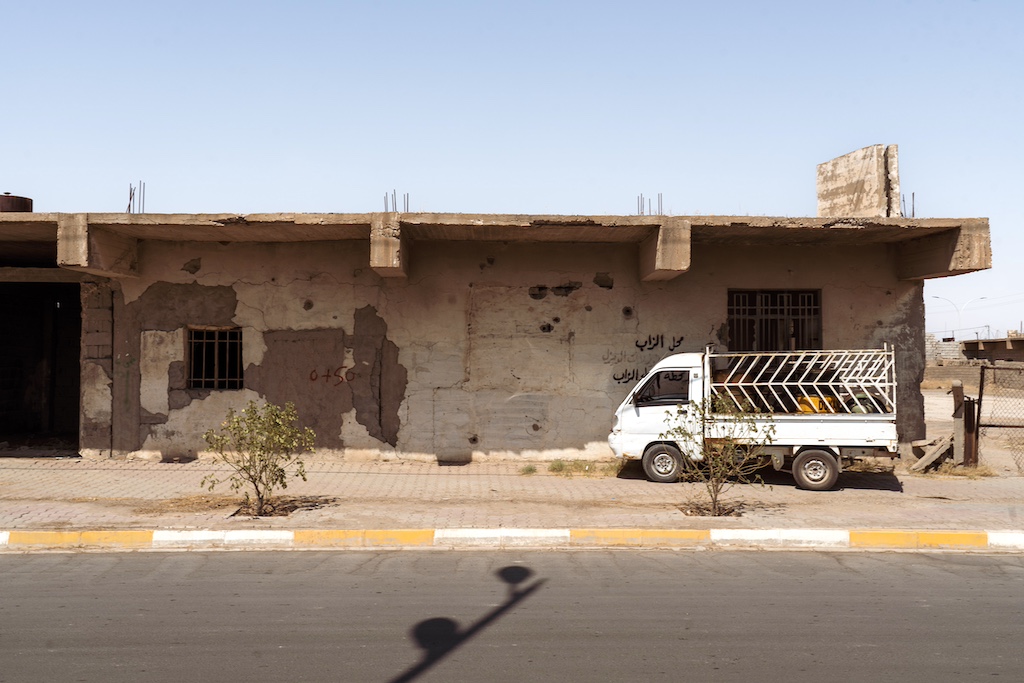
Buildings across Hawija remain pockmarked by the violence of years of war, as the town fell under ISIS control in June 2014 and remained so until October 2017. (Jaclynn Ashly / Jacobin)
A Dutch commission of inquiry last year found the coalition should have known civilians were present — the International Organization for Migration (IOM) had publicly documented the influx of displaced people into Hawija’s industrial zone as early as February 2015.
Targeting was US-led and intelligence was US-controlled, running through the coalition’s operations center in Qatar. US agencies vetted the target, identified as sitting in an urban industrial zone surrounded by residential areas. The Central Intelligence Agency (CIA) specifically flagged the proximity of one. The strike was initially rated CDE-5 High, the “Collateral Damage Estimation” indicating expected civilian casualties, so planners revised the loadout to lighter Small Diameter Bombs, lowering it to CDE-5 Low.
But the model excluded secondary explosions, as the stored quantity was unknown. All US agencies — including the CIA — approved the strike, and the CIA’s flag about the residential neighborhood was never passed to the Dutch pilots or authorizing officers.
The Netherlands drew the strike as the only coalition member other than the United States with Small Diameter Bombs. Dutch Red Card Holders — national officials with veto power — saw that the target sat in a populated area with residential blocks nearby, as well as a mosque. Unable to independently verify US intelligence, they pushed the strike from 9 p.m. to midnight, betting fewer civilians would be outside.
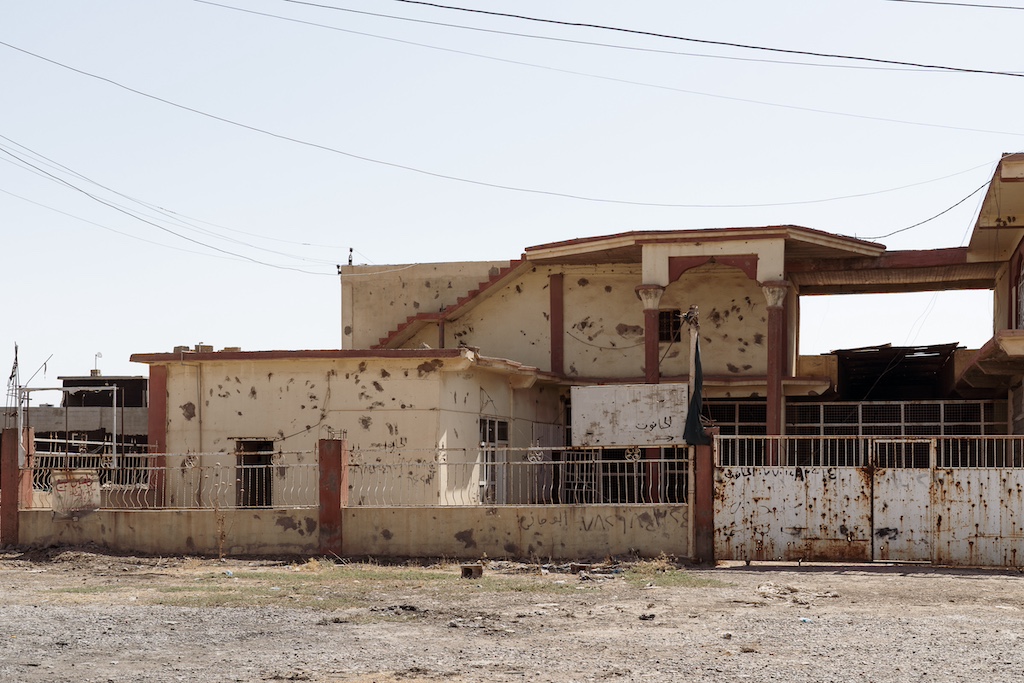
Bullet-scarred walls stand as reminders of the layered conflicts that have shaped Hawija, where residents endured both ISIS rule and the coalition air campaign waged to dislodge it. (Jaclynn Ashly / Jacobin)
Just after midnight, two Dutch F-16s released their bombs. A massive secondary explosion followed — unlike anything seen in a coalition strike. Civilian casualties were immediately assumed, yet the Dutch Ministry of Defence told Parliament there were no indications of civilian harm — a position it maintained for years despite internal intelligence to the contrary. Dutch military intelligence later estimated fifty thousand to one hundred thousand kilograms of explosives at the site — up to five times the United States’s initial post-strike estimate.
Driving through Hawija today, the scars remain — pockmarked walls, empty lots, rubble strewn across the ground. Seated on the floor of his still window-shattered home, his small children around him, Khaled Ahmad, forty-seven, recounts what happened.
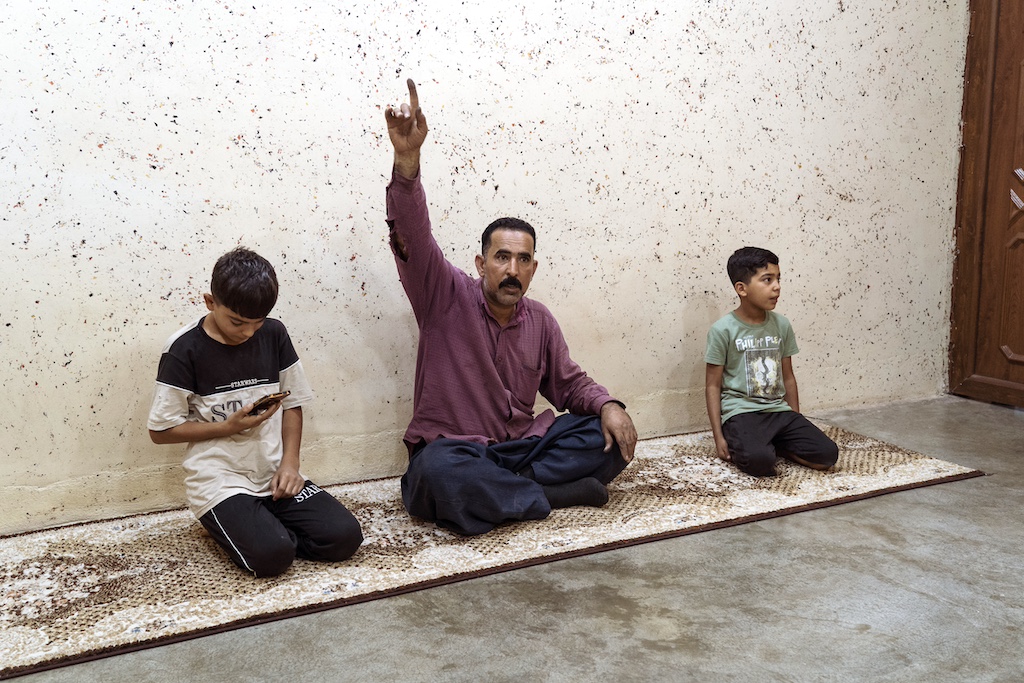
Khaled Ahmad sits on the floor of his still window-shattered home in Hawija with his sons, recounting the night of June 2, 2015, when shrapnel killed his twenty-year-old brother within minutes and wounded his mother, who died of stomach cancer a month later. (Jaclynn Ashly / Jacobin)
He had been sleeping on the roof with his family. Windows shattered, doors blew inward, and part of the house collapsed. His wife’s legs were cut by flying glass. His youngest son suffered a head injury. Shrapnel tore through his twenty-year-old brother, killing him within minutes. His sixty-year-old mother was also wounded; weeks later, she developed stomach cancer and died a month after.
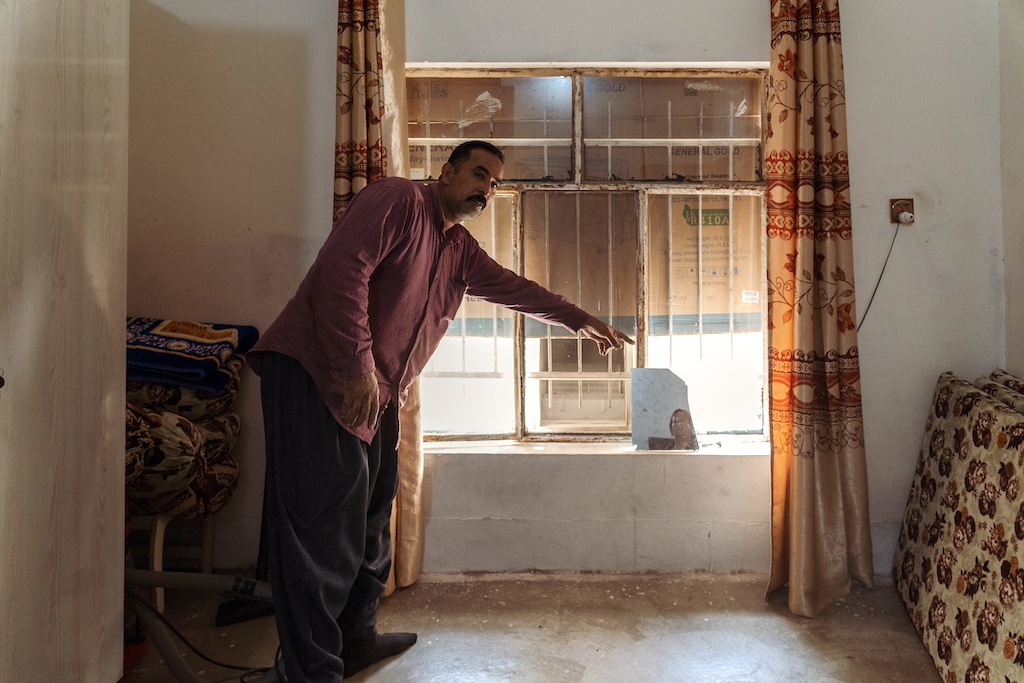
Khaled Ahmad shows the windows of his home in Hawija, still shattered more than a decade after the 2015 blast that destroyed his car-electrical shop — his only source of income — a kilometer away. (Jaclynn Ashly / Jacobin)
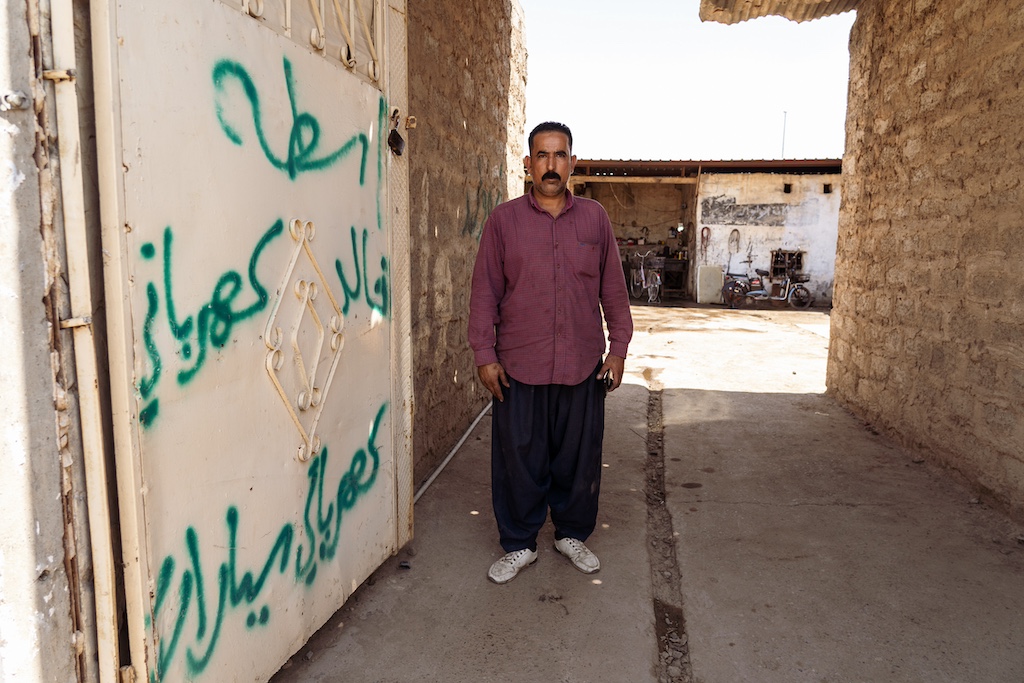
Khaled Ahmad stands outside the empty plot where his car-electrical shop once stood a kilometer from the blast site — destroyed in the 2015 strike and never rebuilt. (Jaclynn Ashly / Jacobin)
Ahmad’s car-electrical shop — his only income, a kilometer from the blast — was destroyed. It remains that way. “My mother was the beating heart of our family, and I think about my brother every single day,” he says. “Families in Hawija are still broken by this.”
What followed was not rescue but chaos under ISIS control. The group ran the hospitals and controlled movement.
“Using explosive weapons in urban areas under insurgent control creates an extremely difficult situation for civilians,” says Lauren Gould, associate professor in conflict studies at Utrecht University. “There are no troops on the ground to secure access to care. ISIS made medical access political — people with severe injuries were turned away.”
Others pledged allegiance for treatment. Some were stitched by pharmacists without anesthesia. Those who could afford smugglers navigated checkpoints and mined roads to hospitals in Mosul, Kirkuk, or Baghdad. Treatable injuries became permanent.
In a sunlit sitting room across town, Hussein Ibrahim Hussein, fifty-six, edges forward. He lived five hundred meters from the blast. “Our home was completely destroyed,” he recalls. Many neighbors were displaced families hoping to reach Kurdish-controlled Kirkuk city. “Their bodies were scattered across the streets.”
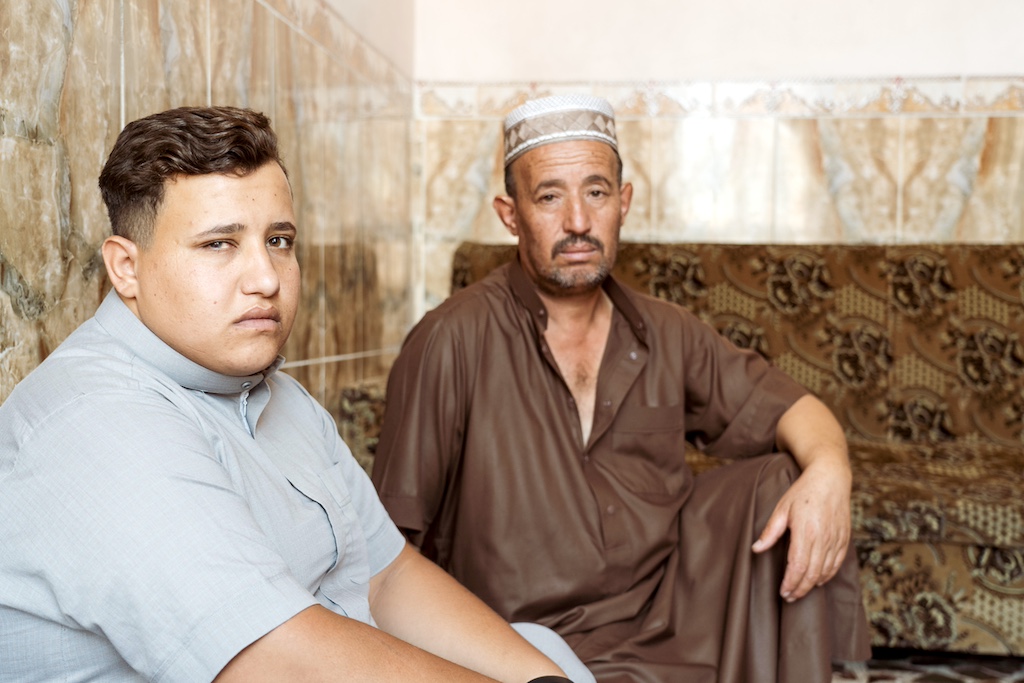
Hussein Ibrahim Hussein with his son, now twenty-two, who was blinded in his right eye by a fifteen-centimeter shard of glass from the 2015 blast and says, “I feel like they stole my future from me.” (Jaclynn Ashly / Jacobin)
His brother was found dead on the road, thrown from the house. His son’s face was covered in blood — a fifteen-centimeter shard of glass lodged in his right eye. Overwhelmed doctors could offer only first aid, so Hussein smuggled his son out. “I sold all my wife’s gold — everything,” he says.
After fleeing to Turkey and Iran and five years seeking treatment, every diagnosis was the same: irreversible retinal detachment and permanent blindness. His son, Hussein Ibrahim, now twenty-two, suffers balance problems and headaches that leave him unable to work. “I feel like they stole my future from me,” he says, eyes fixed on the floor.
Like many victims of coalition airstrikes, Hawija’s residents did not know whose planes struck them. Only when Dutch media reported on the strike in 2019 did the community learn the bombs had been Dutch.
 Log in


 Dr Margaret Connolly was one of six Irish citizens detained, flotilla organisers have said