plant lover, cookie monster, shoe fiend
20591 stories
·
19 followers

We Don’t Need Chinese Exceptionalism

1 Share

Chinese and American flags flying together

Thirty years ago I knew that China would be the next “America”. The next “Britain.” The next industrial and technological hegemon.

I wrote about this back in the early 2000s, at BOPNews, the Agonist and FDL. When the Chinese were let into the WTO by Bill Clinton their rise and replacement of the US became inevitable.

At one time the British were the greatest in the world. They were exceptional: smarter and more powerful than anyone else.

Then we had a century of American exceptionalism. The American way was the best way. Americans were superior. They were more creative. Their government system was the ideal system, etc, etc…

American exceptionalism was and is ugly. The American system was not the best of all time (contra the idiotic “End of History” thesis) and neither was the British or, more generally, European “Liberal Democracy”.

Nor is the Chinese system the greatest of all time. Chinese culture is not the world’s greatest culture. The Chinese people are not innately superior to other people.

China industrialized the same way that almost everyone did. They had support from the current industrial hegemon, same as both America and Japan did. (Japan had British help during the Meiji period and American help after WWII.) They ran a protectionist mercantile export policy. Instead of tariffs they used currency manipulation.

British financiers built a ton of American industry, because profits were higher in America than in the more mature industrial state of Britain. Americans offshored and outsourced to China because profits were higher in China.

There’s no way to do mass offshoring to a country without also transferring technology, but more than that, wherever the manufacturing floor is, the technological lead follows. It takes twenty to thirty years to gain the tech lead once you’ve gained the manufacturing lead.

China also ran the rest of the Japanese playbook: get your population educated, starting with getting everyone primary education. Then get everyone secondary education. Only then do you go all out at the university level.

This is the way almost every nation (there are less than five exceptions) has industrialized. If you want the full explanation, read “Bad Samaritans.”

What makes China different is what made the US different from Britain: it’s a continental power with a much larger population than the previous hegemonic power. So it can scale better and once it takes the leads the previous power is cooked.

This is why Japan had to cut a deal with the US: why it could be forced to give up its tech and industrial lead: it’s an island nation with a smaller population than the US. That can’t be done to China, because it’s larger and because so much of what it needs now comes from uninterruptible continental supply chains. (Plus, very soon, they will be a greater naval power than America.)

We’re going to have a “Chinese Century” and we’re going to have to put up with tons of claims of Chinese exceptionalism. Their system is innately better, they have a superior culture, they’re more creative than everyone else and heck, as a race they’re superior.

They aren’t. They don’t even have as good a claim as Britain did: they weren’t the first. They just did what a ton of other countries did, including the US, Japan, South Korean and Taiwan.

This doesn’t mean they don’t deserve admiration and credit for becoming the hegemonic power. They still had to do a lot of things right, including taking advantage of a foolish and stupid financializing elite in America, just as the Americans took advantage of a foolish and stupid financializing elite in Britain. They worked hard. They worked smart. They deserve their century in the sun, and if they’re smart and capable, maybe they’ll get two centuries if climate change doesn’t take them down.

But they aren’t innately superior. They’re following a well worn playbook, taking advantage of the usual cycle of ideological change within hegemonic powers.

The screams of America exceptionalism were bullshit. Claims of Chinese exceptionalism are also bullshit except in the sense that they are currently on top. Over time they will be corrupted from within, because this is a universal pattern which always happens and someone else will take the lead. They will remain a great power if

1) they avoid collapse into warlordism, however, because they are a continental power who will retain a large population even after the onrushing demographic collapse; and,

2) There isn’t another true revolution in production and technology like the industrial revolution, which happens somewhere other than China.

America exceptionalism was ugly and tiresome. So is Chinese exceptionalism.

Everyone reads these article for free, but the site and Ian take money to run. If you value the writing here and can, please subscribe or donate.


Read the whole story
sarcozona
3 hours ago
reply
Epiphyte City
Share this story
Delete

Distributing Resources Based On Jobs Is Outdated And Stupid

1 Share

I want to spend more time writing about the baseline assumptions of our political economy.

One of the worst is that people have to work to get resources. “If you don’t work, you don’t eat”.

This made sense at one time, when famines were common, food and resources were scarce and predatory nobles and priests took most of the surplus. There wasn’t a lot of space for people who didn’t work.

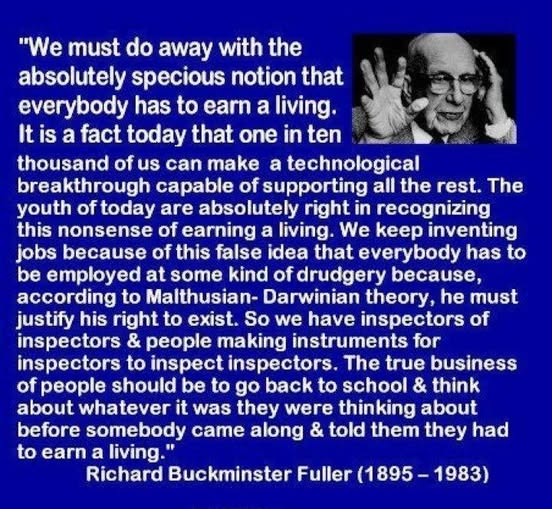
But it doesn’t make sense now. Buckminster Fuller most famously said it:

The fact is that we have more than enough of everything basic, or could easily make it. Food, housing (there are less homeless people in the western world than empty homes), basic electronics, health care, etc, etc…

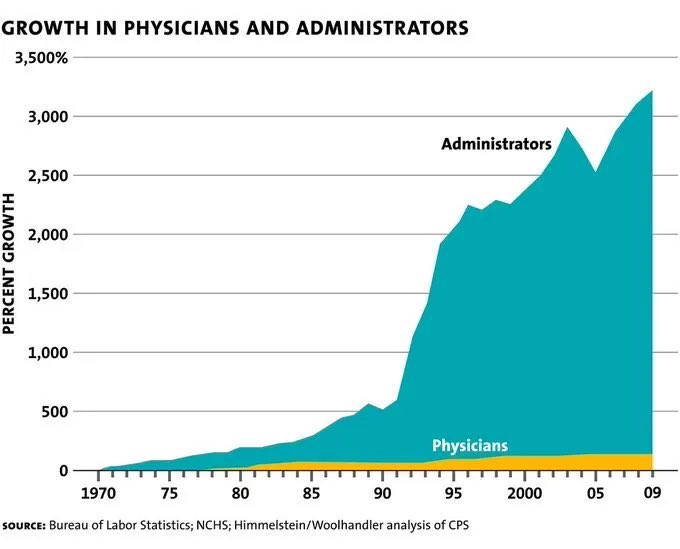
We waste vast amounts of resources, and we make people work at jobs that either produce nothing or are actually a negative.

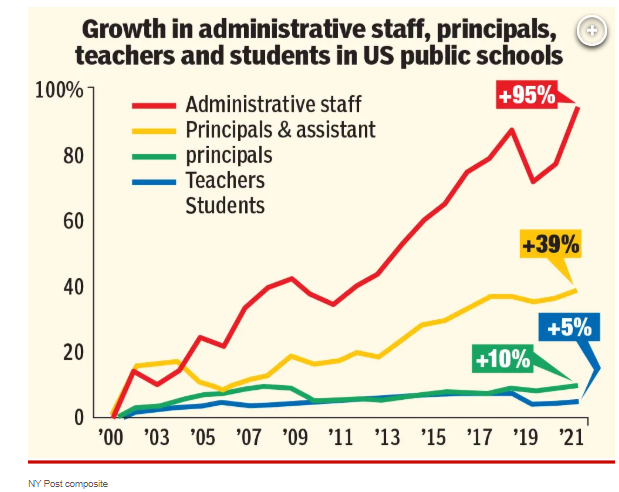
Most of those administrators spend their time denying care, not providing it. About a third should become technicians, nurses, orderlies and doctors, the rest aren’t needed at all. The same chart exists for schools:

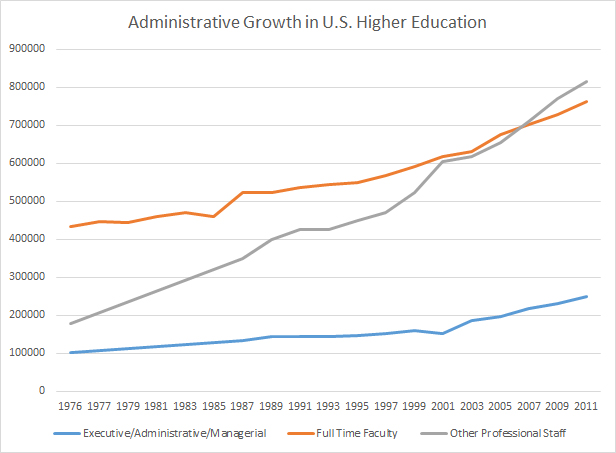
And while not quite as bad, for universities:

The vast majority of all of this is sheer waste, but it’s also a waste of human lives. These people aren’t doing anything necessary, but they are forced to spend their lives doing meaningless “work”.

At least much of this administrative bloat is just wasteful. People working shadow banking, Private Equity and Wall Street make their money buy rolling up companies, loading them up with debt, laying people off, raising prices and then causing bankruptcy of firms which were actually profitable, who provided real work and products at reasonable prices.

They are actively damaging. It would be more than worth it to forbid such people from working at all and pay then low six figures to stop hurting other people.

Same thing goes with most prison guards and police, who do not reduce crime, but do increase incarceration.

The truth is that at least half of jobs shouldn’t exist. They either aren’t necessary, or they’re actively harmful. It would be better just give people money.

None of this is to deny that there is work which needs to be done. But a vast switch from administration and financial industries and dochebags selling internet ads into actual productive enterprises would produce a far better economy. Even so, all our advances in production mean that we genuinely do or can produce far more than we need. So just give people enough money to live a good life, reduce the standard work week to three days, and let people who want to contribute work at jobs which make the world better, not worse, and which aren’t makework.

We can’t even imagine a world where we don’t force people to spend their entire lives doing things they wouldn’t do if they weren’t scared of starvation and homelessness. We can’t conceive of a world where we don’t create goods designed to wear out, and instead create long lasting appliances and computers and roads and cars and high speed rail and so on: goods designed to last. We need profit, so we produce vast amounts of crap we only need because of of that “need” for profit.

This insanity has caused global warming, mass extinctions and vast amounts of needless unhappiness, bad health and lives wasted doing meaningless or harmful work.

We need a better way, and the first step is to end the idea that if you don’t work you shouldn’t have a home, food and a decent life.

More on this in the future.

Read the whole story
sarcozona
3 hours ago
reply
Epiphyte City
Share this story
Delete

BREAKING: Trump Administration Orders Dismantling of the U.S. Forest Service

1 Comment
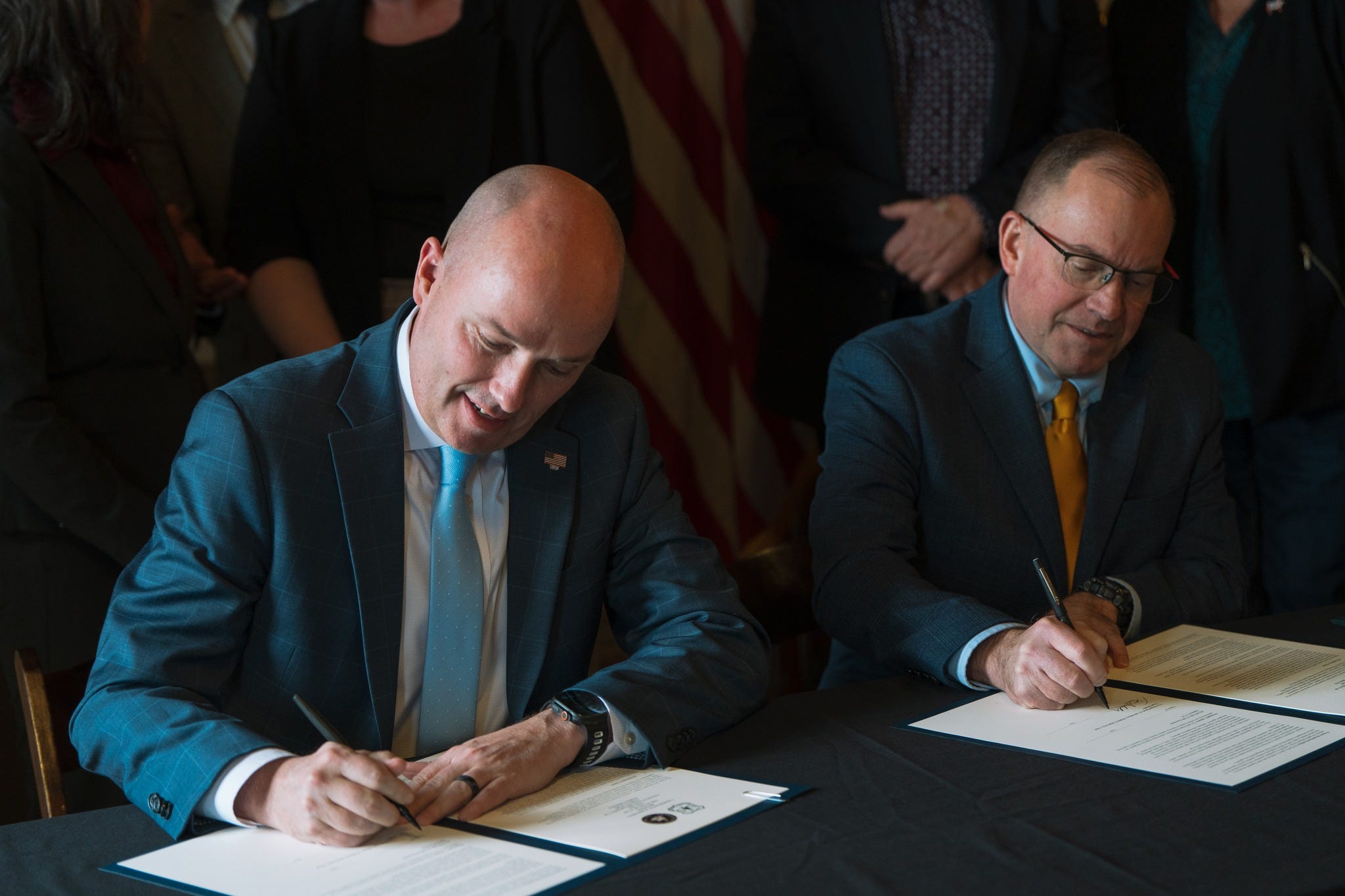
Utah Governor Spencer Cox (left) and logging executive and USFS Chief Tom Schultz (right) sign a partnership agreement.

Late Tuesday afternoon, with the subtlety of a wrecking ball and the morality of a foreclosure notice, the Trump administration announced the most devastating attack on the U.S. Forest Service in the agency’s 121-year history. Not a budget cut. Not a policy shift. Not a “reorganization.” An execution.

They’re ripping the headquarters out of Washington and shipping it to Salt Lake City, Utah — the beating heart of the anti-public-lands movement in America. They’re shuttering every single one of the nine regional offices that have governed this agency since Gifford Pinchot built the system over a century ago — and with them, the career professionals who spent entire lifetimes earning the expertise and the authority to push back when politicians came calling with bad ideas and worse motives. They’re destroying more than fifty research facilities across thirty-one states, labs that house decades of irreplaceable long-term science, the kind you literally cannot restart once it’s gone. And they’re replacing all of it — the offices, the scientists, the institutional knowledge, the professional independence — with fifteen political appointees called “state directors,” embedded in state capitals alongside the very governors, legislators, and industry lobbyists who have spent their careers demanding that the Forest Service log more, protect less, and get out of the way.

One hundred and ninety-three million acres of your national forests. An area larger than Texas. The largest public land agency in the country. Just handed, on a silver platter, to the people who’ve spent their entire careers trying to destroy it.

And they did it with a press release on a Tuesday.

Upgrade to Paid

Let me be very clear about what’s happening here, because the press release is designed to make your eyes glaze over. It’s written in the dead language of bureaucratic euphemism — “mission delivery,” “state-based organizational model,” “operational service centers” — and that’s the point. They want you bored. They want you to think this is an org chart shuffle. They want you to read the word “streamlining” and move on with your day.

Don’t.

What this actually is, stripped of the Orwellian window dressing, is the largest forced purge of a federal land management agency in American history. It dwarfs anything that’s come before. The BLM headquarters move in Trump’s first term — widely understood, even then, as a deliberate gutting of the agency — involved a few hundred positions. This involves thousands. That one closed zero regional offices. This one closes all ten. That one touched one agency’s headquarters. This one dismantles the headquarters, collapses the regional structure, and wipes out the scientific backbone of the largest forestry organization on Earth.

The BLM move was a knife in the dark. This is a chainsaw in broad daylight. And just like the BLM move, it will work exactly as designed. Because we know what happens when you tell career public servants to uproot their families and move across the country on six months’ notice. We have the data. We watched it happen in real time.

Of 328 BLM positions ordered to relocate, 287 employees left the agency. Only 41 moved at all — scattered across various western offices. And only three — three human beings — actually relocated to the new “headquarters” in Grand Junction. The agency lost 87% of its Washington-based workforce. Decades of institutional knowledge, scientific expertise, and legal acumen walked out the door and never came back.

That wasn’t an accident. That was the plan. And the plan worked so well they’re doing it again at twenty times the scale.

Because the people who leave won’t be random. They’ll be the lifers. The scientists. The ones with thirty years of field experience who know what a logging plan will do to a watershed before anyone runs a model. The ones who know the law cold, who know where the bodies are buried, who have the institutional authority and the backbone to say “no” when a politician calls and demands more timber sales. Those are the people who can’t uproot their lives. Those are the people who will retire, or resign, or take jobs in the private sector.

And those are exactly the people this administration wants gone.

Because once they’re gone, you replace them. With loyalists. With industry allies. With people who have never set foot in a national forest but know exactly whose phone calls to return. You don’t need to fire anyone. You just announce a “move” and let attrition do the killing for you.

Then you fill the vacancies with your own people and pretend the agency still exists.

Of all the places on this Earth to send the agency that manages America’s national forests, they chose Salt Lake City, Utah.

Coincidence?

No.

Utah. The state that is, right now, at this very moment, suing the federal government to seize 18.5 million acres of your public land. A case engineered from the start to reach a sympathetic Supreme Court and detonate 150 years of settled public land law.

Utah. The state whose governor, Spencer Cox, just weeks ago signed a deal with this same Forest Service Chief — the former logging executive — giving Utah de facto control over Forest Service operations on eight million acres of national forest. A “partnership” we called out at the time for exactly what it was: a dry run for transfer. Control without ownership. The first step in a playbook designed to embed the state in federal decision-making so deeply that the line between federal and state management disappears, and when the inevitable push for full transfer comes, the argument writes itself: “We’re already managing it. Why shouldn’t we own it?”

Utah. The state that produced Mike Lee — the rat in the walls of Congress, the most dangerous anti-public-lands politician in modern American history — a man who has spent his entire miserable career trying to sell your national parks, gut the Wilderness Act, auction off BLM land to developers, and dismantle every protection standing between your forests and the industries that want to devour them. And if you think Mike Lee didn’t have his fingerprints all over this decision, I have a bridge over the Colorado River to sell you.

Utah. The state that has been ground zero for the anti-public-lands movement for as long as the movement has existed. A hotbed of Sagebrush Rebellion ideology, where the political class has spent decades trying every conceivable legal, legislative, and administrative maneuver to wrest federal land out of public hands and into the grip of state politicians and their industry patrons.

And now the United States government is handing them the headquarters of the agency that manages 193 million acres of national forest.

In the USDA’s press release, Utah Governor Spencer Cox calls this “a big win for Utah.”

Yes. Obviously.

And of course he’s in the release — when you’re effectively calling the shots, you tend to get top billing at the Forest Service.

It’s the biggest win Utah’s anti-public-lands machine has ever secured — bigger than Bears Ears, bigger than the Forest Service “partnership,” bigger than anything Mike Lee has managed to slither through Congress.

Because this one didn’t need Congress. This one didn’t need the courts. This one just needed a press release and a compliant logging executive with a title that says “Chief” on it.

I need to stop here because this part will make your blood boil.

Forest Service Chief Tom Schultz — a logging executive, installed by this administration to oversee the dismemberment of the agency he now claims to lead — had the gall, the sheer sickening audacity, to say this in the press release:

“I’m honored to help guide this new chapter for the Forest Service, following the vision set forth by President Theodore Roosevelt and Gifford Pinchot more than a century ago.”

Let that sink in.

Theodore Roosevelt created the national forests to protect them from exactly the kind of industrial plunder this administration is enabling. Gifford Pinchot built the Forest Service from scratch, brick by brick, to ensure that America’s forests would be managed by trained professionals in the public interest — not by political appointees serving the timber industry from a satellite office in the state that wants to own those forests.

Roosevelt fought the robber barons. Pinchot fought the timber trusts. They built this agency as a shield for the American public against the exact forces that are now being handed the keys.

And Tom Schultz — a man who made his career cutting trees for profit before being plucked from the industry to run the agency that’s supposed to regulate it — invokes their names while dismantling their life’s work.

It’s vile.

Roosevelt would have run this man out of Washington on a rail. Pinchot would have fought this tooth and nail with every ounce of breath in him. And both of them would be sickened — not just by the decision, but by the grinning cowardice of a political appointee who uses their legacy as a fig leaf while gutting everything they fought to build.

If the headquarters move is the gunshot, the destruction of the research program is the burial.

More than fifty research and development facilities across thirty-one states. Gone. Consolidated into a single location in Fort Collins, Colorado. And “consolidated” is doing a lot of heavy lifting in that sentence, because what it actually means is that decades of place-based, long-term ecological research — the kind that literally cannot exist anywhere else because it depends on specific forests, specific watersheds, specific ecosystems studied over generations — will be snuffed out.

You cannot move a thirty-year watershed study. You cannot relocate a decades-long old-growth monitoring program. You cannot box up a forest and ship it to Colorado. When these facilities close, the experiments die. The datasets end. The partnerships with universities that took generations to build collapse. And the institutional knowledge of the scientists who ran those programs walks out the door, because the administration damn well knows most of them won’t follow a forced relocation to a single consolidated office that has nothing to do with the ecosystems they’ve spent their careers studying.

This is the most respected forestry research program on the planet. It’s the reason we understand wildfire behavior, forest disease, watershed health, carbon storage, old-growth ecology, and climate adaptation. It’s the scientific backbone that every responsible land management decision depends on. It’s the envy of land managers across the world.

And they’re destroying it. Not because it’s expensive — the entire research budget is a rounding error. Not because it’s inefficient — decentralized, place-based research is the only kind of forest science that works. They’re destroying it because science is an obstacle.

Because a scientist who says “you can’t log that watershed without destroying it” is inconvenient. A researcher who publishes data showing that a timber sale will wipe out a salmon run is a problem. A lab that documents the damage from mining runoff or road-building or clear-cutting is an enemy.

And enemies get eliminated.

Once the science is gone, there’s nobody left to flag the damage. Nobody left to say “this will destroy this stream” or “this species can’t survive this level of harvest.” The unprecedented mandatory logging quotas from the reconciliation bill can proceed without anyone left who has the data, the authority, or the institutional standing to object. The timber industry gets its clearcuts. The mining companies get their access roads. And the next time someone asks “what will this do to the forest?” the answer will be silence, because the people who knew are gone and the studies that would have told us were terminated by press release on a Tuesday in March.

We’ve been writing about this for over a year. We’ve been called alarmist. We’ve been told “that’s not going to happen.”

Here’s the playbook, one more time, because it’s no longer a prediction. It’s a live feed:

Step 1: Starve the land agencies of funding, staff, expertise, and authority. Done. This administration gutted more than 25% of land management agency staff. It proposed a budget that slashed the Forest Service by a third. It tried to eliminate all Forest Service research funding.

Step 2: Break the agency’s ability to function. Done. Mass firings. Deferred resignations. DOGE operatives embedded inside the agency. Psychological warfare campaigns designed to demoralize career employees into quitting.

Step 3: Point to the dysfunction you engineered and declare the institution a failure. Done. The press release itself does this, citing “decades of mismanagement and costly deferred maintenance” — problems created by the very people now using them as justification for demolition.

Step 4: Reorganize the broken agency into something that serves your interests, not the public’s. Happening right now. Today. On your screen. With a press release that uses the words “common sense” five times.

Step 5: Hand the pieces to your allies in state government and industry. Also happening right now. The headquarters goes to Utah. State directors answer to state politicians. The research that would have documented the damage: gone. The career professionals who would have resisted: purged through “relocation.”

And there is Step 6, the one they haven’t announced yet but that every single move in this sequence is building toward:

Step 6: Transfer the land.

Because once you’ve moved the headquarters to the state that wants to own the forests, installed state-aligned political appointees as managers, destroyed the independent science, eliminated the institutional capacity to resist, and created a structure where state governments are functionally running federal forests already — the argument for formal transfer becomes very, very easy.

“We’re already managing it. Why should Washington own it?”

That’s the endgame. And after today, the path to it has never been shorter.

Zoom out. Look at the mosaic. All of it. Everything that’s happened in the last fourteen months:

A logging executive installed as Forest Service Chief. An oil governor running Interior. Steve Pearce, a man who believes Theodore Roosevelt was wrong to create national parks and forests, nominated to run the BLM. NEPA dismantled. The Endangered Species Act under siege. The Roadless Rule rescinded. Alaska’s wildlands opened to industry. Mandatory logging quotas signed into law. The God Squad convened for the first time in thirty years to override endangered species protections for oil drilling. Utah’s governor cutting a deal for control of your national forests. Utah suing for 18.5 million acres of your BLM land. Russ Fulcher circulating letters in Idaho preparing counties for federal land transfer. Mike Lee hiding poison pills in must-pass bills trying to sell your lands.

And now this. The crown jewel. The big one.

The agency that manages 193 million acres of your forests — relocated to the state that wants to own them, stripped of its science, stripped of its regional expertise, stripped of its institutional independence, and reorganized into a structure purpose-built for political compliance.

Anyone who still thinks these are unrelated events, disconnected policy decisions made by different people at different times for different reasons, is in willful denial. This is a coordinated demolition of federal land stewardship in America. Every piece connects. Every move advances the same goal: transferring control of your public lands from professional public servants accountable to you to political operatives accountable to the extraction industry.

The Forest Service was the last major federal land agency that still had the institutional muscle to resist. It had the scientists. It had the regional foresters. It had the culture, imperfect as it was, that still believed forests belonged to the public.

After today, that agency no longer exists.

There will still be people wearing the shield. There will still be an org chart and a budget line. But the Forest Service that Gifford Pinchot built — the institution that pioneered the radical idea that America’s forests are not timber inventory to be liquidated but a public trust to be stewarded — was killed today.

And they did it without a single vote in Congress.

Call your senators. Call your representative. Not next week or later. Now.

Tell them this is not a reorganization — it’s the destruction of a federal agency by executive fiat and that Congress must intervene. Tell them to block all funding for this relocation and restructuring until the full implications have been studied, debated, and voted on by the people’s elected representatives.

Tell them you know what happened to the BLM. Tell them 87% staff loss is not efficiency. Tell them that three people showing up to Grand Junction is not “moving closer to the land.” Tell them that if they allow this to proceed, the Forest Service will suffer the same fate at twenty times the scale, and the blood will be on their hands.

Tell them you know the endgame. Tell them this is the on-ramp to land transfer. Tell them that handing the headquarters to Utah while Utah is actively suing to seize your public land is not a coincidence — it’s a tell.

And tell every conservation organization, every outdoor recreation company, every hunting and fishing group, every single person who has ever set foot on a national forest and felt something — tell them the time for polite statements and “concern” is over. The building is on fire. The arsonists are inside. And if we don’t act now, there will be very little left to save.

Stay loud. Stay angry. Stay relentless.

They want us tired and resigned. Don’t give them that satisfaction.

These forests belong to you. Fight for them like your life depends on it.

Because it does.

Share

Upgrade to Paid

Thanks for reading. Until next time,

-Jim

Leave a comment

Read the whole story
sarcozona
4 hours ago
reply
fuck
Epiphyte City
Share this story
Delete

Evolution of a Garden Border

1 Share
 An editor for a magazine that published an article on our garden several years ago described it as "an unusual garden." This struck me as not an insult per se, but perhaps uninformed. Do I need to defend my plant choices? Does it have to be what your magazine considers a "usual" garden? I think the comment was directed primarily at my plant palette. Mostly dry loving plants, no boxwood hedge parterres or floriferous herbaceous borders here, though I do admire the look. No, ours is a low-maintenance dry garden rich in drought-adapted plants. Low maintenance for its size, that is if it were a typical 50' x 100' urban lot it would be really low maintenance. Nothing is low maintenance on two acres.

Maybe a better description would be "a bit wild." Whatever one's definition, we continue to garden with drought-adapted plants. That leads me to today's post about what we call the south bank. As its name suggests, it's the southern most border stretching from east to west along the some 300' line of our fence. It's primarily full sun with average to poor soil, once covered in field grass. It's about as far away from garden hoses as can be on our property. We've been putting in plants over the years, connected the dots with wood chips and FM recently added a few finishing touches around the olive trees. I thought it would be fun to see its progression these past several years as it has been a border we hadn't anticipated or even dreamed of; it just sort of came about in typical Chickadee Gardens fashion.

This is what a portion of it looks like today. But first, there was this:

In 2015 it was simply field grass. This view is to the west.

In early 2016, some of the very first plants I put in the ground were these four Olea 'Arbequina'. While they did die to the ground after a severe winter (2017/18), they did regrow from the roots. We'll see them a bit later. This is looking east.

About 2019 or so, looking east. You can see the olive "shrubs" along the fence line. This is after they had regrown a bit the summer following the bad winter. The hazelnuts in the center were here, we planted a few little things around them and thus, hazelnut island was born.

Hazelnut island as it looked last autumn. It has filled in and many plants have been added on either side. But I'm jumping ahead once more.

Right about in the middle, we planted three Cupressus 'Donard Gold' that were given to me by a friend in about 2017. This image is from 2018, so a year in the ground.

Standing at the fence looking north, three Cupressus 'Donard Gold' barely stand out at this point.

Getting a little larger, a little more presence.

A little larger still, as are the olive trees on the right.

Really large.

As seen from standing in the gravel garden looking south, hazelnut island is on the right. They grew nicely and are now very large.

Another area is the far western side of south bank. A crumbling Acer macrophyllum was removed in 2016, you can just make out its stump behind this Baccharis pilularis. This corner of the garden is rarely if ever irrigated as it's so far away from the reach of most hoses.

A pulled back view with a few surrounding plants. Note the Cupressus arizonica 'Blue Ice' on the far left, a short thing planted at the same time as C. 'Donard Gold'.

This is the Baccharis pilularis today.


A wider shot with Cupressus arizonica 'Blue Ice' and behind it Fremontodendron 'San Gabriel'. FM dug out the grass and weeds and we put down layers of wood chips to create a border rather than a random group of plants, the first area of south bank to be connected.

These next few images are down the chute in the middle. The Himalayan mounds are on the right in their very early stage. There are a lot of plants on the left just hanging out, no real cohesion at this point.

Plants starting to fill in, the Himalayan mounds have really grown large at this stage. This was about three years ago in summer, thus the dormant grass.

Spring 2023.

Aah, the woodchips make an appearance. This was summer 2023.

This was taken March 2026, edging has been installed on the right by FM and I dug out a crisper edge on the left between the wood chips and field grass.

May of 2023, FM rented a sod cutter and began a large project of removing sod from this point all the way to the eastern end of south bank. This is hazelnut island, for reference.

More sod removal.

After some refinement.

After woodchips were added.

Wide shot with Cupressus 'Donard Gold' on the right, getting quite large by this point.

FM says that using the sod cutter is one of his least favorite jobs. Howevern he's quite good at it.

Other side of the border with fresh wood chips. Now this area feels a little more cohesive, a proper border is born.

This is a year or so in after the wood chips have mellowed and aged.

Next, let's look at this area with an early version of hazelnut island on the left. This is facing west towards the Baccharis pilularis which is near the gate.

Hazelnut island is on the left, this is looking due south.

Autumn 2023 FM removed sod between the Baccharis area and hazelnut island, thus connecting the two areas. Right away I planted it up with a selection of drought-adapted plants, many California and Oregon natives which are drought-adapted.

A clearer image showing the area of sod removed.

A wider shot illustrating the length of the area. The olive trees can be seen near the fence, four of them in a row.

This is the same area as it looked last summer, the four olive trees on the right of the woodchips. You'll note the woodchips now reach the edge of our property at the fence line as FM continued to remove sod. Mowing is no fun, besides it's really a bunch of weeds, not really grass and it looks terrible by summer.

Now for the far eastern side of the border. As you can see, there was nothing here but a lonely tree.

We planted a few Cupressus sempervirens around 2017, five total. Three survived and are growing nicely.

The far eastern side of the bed now, with Grevillea 'Neil Bell', Ceanothus cuneatus 'Adair Village' and Leptospermum grandifolium adding to the scene.

The same area as it looked recently, sod removed but awaiting another chip drop delivery to polish it off.

A wider image. Check out the size of Grevillea 'Neil Bell' - it's a monster.

Here, FM was inspired to remove the sod between the four olive trees (which have totally recovered from their early-stage winter damage).

So this winter/early spring after many wheelbarrows full of sod were removed, wood chips were then added in a fairly thick layer. FM designed and built these steel surrounds for the olive trees. You can see the green sod on the far olive tree has yet to be removed at this stage.

A wider image.

A few final touches - Cupressus 'Donard Gold' was so large that air flow was not happening down here so we lifted them a little to be able to see the olive trees behind.

It's nice to see sunshine down this corridor again and to see wood chip mulch reaching all the way to the fence. Just this one strip of grass is left after what was one giant field.

And FM's olive surrounds are now filled with crushed gravel for a finishing touch.

Nice. A totally different look than when we began in January 2016.

This border, south bank, is our latest project. It is one we had not anticipated but as is our way, it evolved over time and moments of what it wanted to be were revealed slowly. I did know that all these satellite plantings felt disjointed and needed to connect somehow, something accomplished with the relatively simple task of removing sod and replacing it with wood chips. This created paths and designated areas for plants so that my brain could make sense of what was happening and what our intentions are. This final added bonus of steel framing and the additional sod removal by FM this winter was a bonus and totally his idea. That's how we roll, we each contribute what we can and I for one really enjoy having a partner in this who also brings ideas to the table.

Everything in this garden border is drought-adapted. Nothing is thirsty. Combine that with a deep layer of wood chip mulch and the whole area is pretty self sustaining - a little bit of weeding the first few seasons in the wood chips and that's about it. Whether or not our garden is considered "unusual" is inconsequential to us, what is important is that it is sustainable and practical, so no boxwood hedges for us, it seems.

That's a wrap for this week at Chickadee Gardens. As always thank you so much for reading and commenting, we do love hearing from you all! 
Read the whole story
sarcozona
4 hours ago
reply
Epiphyte City
Share this story
Delete

Pentagon procurement post reveals Canada quietly locked into HIMARS deal | CBC News

1 Share

The Pentagon announced this week that it has secured a $1.1-billion contract with U.S. defence giant Lockheed Martin to manufacture M142 High Mobility Artillery Rocket Systems (HIMARS) for several allied countries including Canada.

The notice was posted Wednesday by the U.S. Department of War on its contracting website.

It says the agreement covers the "urgent needs for the Army, Marine Corps and Foreign Military Sales customers in Australia, Canada, Estonia, Sweden and Taiwan."

A total of 17 HIMARS will be manufactured under the new deal, and the systems will be completed by the end of April 2028, the notice said.

How many of those systems will be going to the Canadian Armed Forces is unclear. Canada had expressed interest in buying 26 in total.

Unlike with other major military equipment purchases — a parade of which was revealed in March — the Liberal government has not issued a formal statement about its intention to purchase the U.S.-made HIMARS, even though it appears the formal deal was signed in January.

Defence expert Dave Perry said it’s likely the Liberal government wanted to avoid the political spectacle of going back to the United States to buy military equipment, something Prime Minister Mark Carney promised to do less often. 

"When you see notifications like this, it means basically the formal paperwork has been signed," Perry said. "And if the money hasn't already been put into a bank account that the U.S. government manages … then the cheque is in the mail."

The Department of National Defence (DND) was asked Thursday for confirmation of when the letter of acceptance was signed and what down payment was made, but it did not answer those questions.

Two confidential sources said a public statement was prepared last winter around the time the deal was finalized, but it was pulled back — coming as it did a few weeks before the Liberal government released its defence industrial strategy, which emphasized buying Canadian military kit. The sources were not authorized to speak publicly.

Rocket practice rounds are launched from an M142 High Mobility Artillery Rocket System (HIMARS) during a testing drill in Taiwan on May 12, 2025. (Chiang Ying-ying/The Associated Press)

Last October, the U.S. State Department gave Canada the green light to potentially buy the sophisticated rocket systems, which the army considers essential for defending troops in Latvia and for its overall modernization.

The U.S. government issued a letter of offer to purchase, which the Canadian government as the buyer was required to sign. 

At the time last October, DND said no decision had been made to proceed with the deal, estimated at $2.4 billion. 

In a year-end interview with CBC News in December, the commander of the Canadian Army, Lt.-Gen. Mike Wright, indicated the agreement was still pending but that HIMARS were an absolute necessity.

"We're saying the HIMARS system is the long-range precision strike system that we need for land operations," Wright said. "The reason why we made the recommendation for the procurement of HIMARS is because ... it's a capability that's been proven on the battlefield in Ukraine. More importantly, the systems are available right now."

In addition to the vehicle launch systems, the Pentagon said Canada is looking to buy rocket launch pods for both operations and training.

During last spring's election, the Liberals pledged to diversify where Canada buys its military equipment from.

WATCH | Weighing Canada's fighter jet options: F-35 versus Gripen:
With the future of Canada’s fighter jet fleet being re-examined, CBC’s Murray Brewster breaks down the differences between the American F-35 and Sweden’s Gripen.

The HIMARS deal is just one on a long list of U.S. military gear that's either on order or about to be delivered. 

The F-35 stealth fighter, also built by Lockheed Martin, is the most high-profile example. Carney ordered a review of the plan to buy the warplanes, setting off a high-stakes scramble by Swedish competitor Saab to sell Canada its Gripen-E fighters.

Defence Minister David McGuinty re-iterated this week that the government still hasn’t finished that review.

The current climate of relations with the Trump administration, from tariffs to the war with Iran, has made the government gun-shy, Perry said.

There is "a concrete contradiction between what the prime minister said about shifting the ratio of dollars spent in the United States to dollars being spent in Canada" when deals such as the HIMARS one are considered, he added.

But Perry said "there's no way we're going to see that change happen" overnight because some of the equipment decisions were made and orders placed before Carney came to power.

Any potential delivery timeline for the HIMARS remains a mystery as well.

Last fall — apparently before the letter of offer was finalized — the defence department told CTV News it expected to see the HIMARS by 2029.

Last week, however, U.S. Secretary of War Pete Hegseth suspended the delivery of munitions including HIMARS to Estonia, one of the nations covered by the deal with Lockheed Martin. He cited the urgent need for Washington to hold onto its military equipment because of the war with Iran. The two countries are attempting to find a resolution.

Asked in an interview last week if Canada would face any delays in the delivery of equipment from the United States, Gen. Jennie Carignan told CBC News she wasn't aware of any.

Read the whole story
sarcozona
17 hours ago
reply
Epiphyte City
Share this story
Delete

Shock, horror as province cancels health-care facility construction | Vancouver Sun

1 Share

This advertisement has not loaded yet, but your article continues below.

Burnaby Hospital Phase 1, right, while a sign (left) indicates the location of Phase 2 of the redevelopment of the old hospital (far left). Photo by Arlen Redekop /PNG

The B.C. government says several construction contracts for long-term care homes that were delayed as part of February’s budget have now been cancelled, as has the contract for Phase 2 of the Burnaby Hospital redevelopment.

Mayors, hospital foundations and the provincial seniors advocate have all protested the decision, saying it means needed health-care resources won’t be built even as demand continues to grow.

Infrastructure Minister Bowinn Ma told reporters at the legislature on Thursday that budget constraints, given a projected record deficit of $13.3 billion, meant the government had to make some tough choices.

She said seven long-term care homes — in Delta, Abbotsford, Chilliwack, Kelowna, Fort St. John and Squamish — and the second phase of the redevelopment of Burnaby Hospital were projected to cost significantly more than budgeted.

“There is more work for our government to do with health authorities to get costs down and under budget so that we can deliver them sustainably for communities,” said Ma.

“In anticipation of moving to the next phase of project delivery, some health authorities did enter into contracts to help support that phase, because the projects are now operating on a different timeline, those contracts are affected, and in many cases, they’ve had to be cancelled.”

Ma said the projects still remain part of the capital plan, with the goal of getting them completed in the future.

In an email to Burnaby Hospital staff, Fraser Health executives said the contract with the multi-party Alliance construction group had been cancelled and that “we are working through what this means for the project and for each of you and will be in touch soon with more information.”

Burnaby Mayor Mike Hurley says that his community feels abandoned by the province and that he didn’t find out the hospital contract was being cancelled until Wednesday.

“Well, I’m absolutely devastated and frankly horrified by this decision. In 2018, the government said this was the most important health project in the province,” said Hurley. “Now they have seen to turn their back on Burnaby residents and east Vancouver residents and turn towards other things.”

The mayor said that Phase 1 of the redevelopment was a needed upgrade of a hospital that was built in the 1950s but that first phase of the project only added 12 new beds.

Phase 2 was going to include a 160-bed acute care tower, a B.C. Cancer treatment centre and a new medical imaging department.

Kristy James, CEO of the Burnaby Hospital Foundation, said donors had committed $55 million for both phases of the redevelopment, with $25 million of that set aside for Phase 2, which was budgeted to cost $1.8 billion.

She has previously disputed comments by Ma, who said the project has gone hundreds of millions of dollars over budget.

This advertisement has not loaded yet.
This advertisement has not loaded yet, but your article continues below.

“We’re disappointed. Obviously, our board is extremely disappointed,” James said Thursday.

“We’ve been working since the budget announcement in February. We’ve been consistently reassured by the health minister, the infrastructure minister, our MLAs, we have been consistently, consistently reassured the project’s not cancelled, and it is just re-paced. But (a) terminated contract with no confirmed start date does sound more like a cancellation at this point.”

Delta Mayor George Harvie is equally upset about the decision to cancel the contract for the new Delta long-term care home, saying the community has raised $18 million for the project and that $10 million has been spent on infrastructure and getting the land ready for development.

He said that he had met Ma and sent letters to Premier David Eby urging the province to let Delta and the Delta Hospital Foundation figure out a way to lower the costs, but that offer was rejected. Ma has said the average of $1.8 million a bed was unacceptable.

The mayor said he is “disgusted” by the way the province has handled the project and that he will never forget how the government acted, including the lack of a heads-up that they would be cancelling the contract.

“They’ve already spent millions of dollars on establishing the infrastructure requirements, soil conditions for the build. It was ready for a building permit at the end of this year,” said Harvie. “But now, instead of just taking a pause, they’ve killed the project. They can use whatever words they want. They killed this project.”

The other long-term care projects whose contracts have been cancelled are in Abbotsford and Chilliwack, according to the B.C. Conservatives, with the status of additional projects in Campbell River, Kelowna, Fort St. John and Squamish unclear.

In budget estimates on Wednesday, Health Minister Josie Osborne said there were 7,829 seniors waiting for a long-term care bed, up from 7,029 last year.

Seniors advocate Dan Levitt said there is a critical need for long-term care services as the province’s population continues to get older.

“The recent decision to postpone or potentially cancel several planned long term care projects is deeply concerning, especially given how urgently these spaces are needed across our province,” he said.

“According to the Ministry of Health, we’re currently short 2,000 beds. We will be short 7,000 beds in five years, and then over 16,000 in the next decade. So now’s the time to be planning and building the infrastructure.”

Read the whole story
sarcozona
1 day ago
reply
Epiphyte City
Share this story
Delete
Next Page of Stories