On a sunny afternoon in August, Trans Mountain CEO Mark Maki donned a black jumpsuit to stroll atop a giant loading dock in Burnaby. Below, his company’s new pipeline pumped oil into tankers bound for the open ocean.
“We’re returning money now to the owner,” Maki said in a Global News segment. “Canadian taxpayers who are the shareholders of the system are reaping those benefits.”
It seemed that Canada’s risky foray into pipeline ownership had finally proved to be a success.
What Maki didn’t mention was that the operating pipeline’s profit streak was relatively new, appearing after a sudden change had turned its months-long losses into gains.
Little had changed on the ground. The amount of oil travelling through the pipe had remained mostly stable, as had its fees. Instead, the boon came on the company’s balance sheets, where millions in monthly interest payments vanished overnight.
“The only reason Trans Mountain looks like it's making a profit is that most of the debt has been moved off their books,” said Thomas Gunton, a professor and director in resource and environmental planning at Simon Fraser University.
“It's a misrepresentation of finances on this project.”
The new balance-sheet profits are thanks to an employee-less shell company called TMP Finance, which holds billions of the pipeline’s debts on its account, shielding Trans Mountain Corp. from its interest costs.
When all its debts are factored in, Gunton estimates the pipeline lost around $166 million in the first six months of 2025, a loss that raises questions about Ottawa’s ability to fulfil a pledge to direct millions from Trans Mountain’s revenues to climate initiatives.
Now those losses may be about to deepen.
That’s because the oil companies that use the pipeline are fighting to reduce their rents by around $545 million each year. The oil companies’ 20-year pipeline contracts are already heavily discounted and set to cover only around half the pipeline’s cost. Further reducing the tolls could force taxpayers to cover an additional $11 billion in costs.
Trans Mountain’s first string of sunny financial reports coincides with another pipeline debate — this time, about a proposed pipeline between Alberta and the north coast of B.C. In November, the province of Alberta and the federal government signed a memorandum of understanding pledging to remove obstacles for such a project. So far, the pipeline has no private proponent, but Alberta has promised to stand as the project’s proponent for now.
For some, Trans Mountain’s apparent financial success serves as a litmus test for Canada’s pipeline-building efforts.
The federal government says the pipeline has helped strengthen the country’s energy sector and overall economy.
Commentators have described the project as a “model investment” for its service to the oil industry, with some writing that Trans Mountain is “paying Canada’s rent.”
Such arguments require a closer look, said Amy Janzwood, an assistant professor in political science at McGill University.
“There is this incredible revisionist history,” she said. “It’s like, ‘We bought TMX, look how profitable it can be.’
“Profitable is not the word we should be using at all.”
Trans Mountain did not respond to The Tyee’s request for comment.
Trans Mountain’s only game
Trans Mountain has one way to make money: it sells space in its pipe to oil companies, much like the owner of an apartment building rents rooms to tenants.
In 2012, Kinder Morgan, the former owner of the Trans Mountain pipeline expansion project, struck a deal with the project’s aspiring tenants. Their rents would cover the pipeline’s cost over their 20-year contracts and provide some wiggle room. At the time, the project was estimated to cost about $5 billion, and fees would fully pay for the project so long as it remained below $7.4 billion.
Five years later and with no pipeline in the ground, Kinder Morgan started to get queasy. Its estimated cost had now hit its tenants’ price ceiling of $7.4 billion. If the price rose higher, Kinder Morgan would be on the hook for about 70 per cent of the overruns.
“I think that they actually realized that it was no longer going to meet their internal commercial standards for return,” said Eugene Kung, a staff lawyer with West Coast Environmental Law. Kinder Morgan’s filing documents revealed the company estimated the project’s costs would be closer to $9.3 billion — substantially higher than what its tenants would pay for.
The company suspended all “non-essential work” on the pipeline in spring 2018. Public financing seemed inevitable.
“Alberta is prepared to do whatever it takes to get this pipeline built — including taking a public position in the pipeline,” then-premier Rachel Notley said.
Before long, Kinder Morgan formally abandoned the project, selling it to the Canadian government for $4.5 billion. Ottawa did not carry out a new cost estimate of the project before the purchase, nor did the federal government attempt to renegotiate its shipping fees.
“The government had all of those options open to them,” Gunton said. Canada’s parliamentary budget officer would later determine that the country overpaid for what it got.
“Kinder Morgan gamed us,” former finance minister Bill Morneau recently told a group of business students.
Construction expenses quickly ballooned. By the time the pipeline was completed in 2024, the cost to build it had increased sixfold from its original estimate to a total construction cost of $34.2 billion.
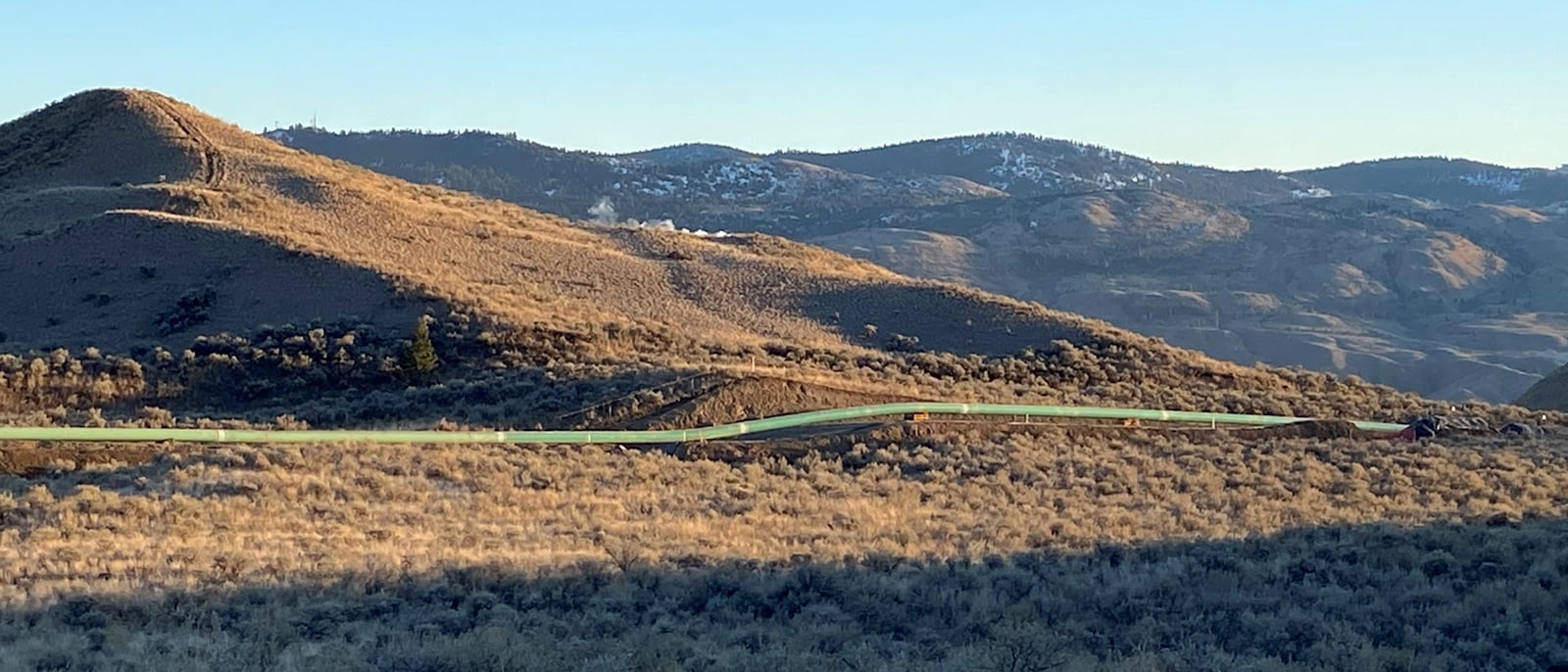
Twinning the Trans Mountain pipeline led to huge cost overruns and the sale of the line to the federal government.
Photo via Trans Mountain.
‘There’s a lot of structuring behind this’
When Canada bought the pipeline in 2018, it created two corporations. Trans Mountain Corp., the more visible of the two, would build and operate the new and existing pipelines. A lesser-known company called TMP Finance Ltd. would hold the debt.
Described by Kung as a “classic shell company,” TMP Finance has no employees and is run by Canada Development Investment Corp. It takes out loans from Canada’s coffers and passes money to Trans Mountain Corp.
Something important happens in those transactions: TMP Finance uses a major portion of its taxpayer-funded loans to “invest” in Trans Mountain Corp., buying a progressively bigger stake in the company in exchange for injections of funds.
Even though the money is originally borrowed from the public, Trans Mountain Corp. treats that money on its books like an investment, not a loan. So it doesn’t have to pay interest on that windfall. But TMP does.
When the pipeline began operations in May 2024, Trans Mountain had about $10 billion of that interest-free money from TMP Finance to work with. But with $27 billion in debt still on its books, it was still unable to earn enough from its shippers to cover the interest payments, even with the injection of money from TMP Finance.
That changed on Dec. 13, 2024, when then-finance minister Chrystia Freeland provided a major government loan of $20 billion to TMP Finance. Most of the money was forwarded to Trans Mountain Corp. as an interest-free stake in the company. Trans Mountain then used the money to pay off an $18-billion bank loan, cutting its interest payments by more than half.
After the last infusion of cash, Trans Mountain’s profit streak began, and the company reported $148 million in profits in the first quarter of 2025.
Canadians should take Trans Mountain’s reported profits with “a spoonful of salt,” according to Mark Kalegha, an energy finance analyst at the Institute for Energy Economics and Financial Analysis.
“Without that intermediary, the company would show debt that needed to be paid back,” he said. “There’s a lot of structuring behind this that made the entity appear more viable than it otherwise would.”
Unlike Trans Mountain Corp., which publishes its financial reports quarterly, TMP Finance’s books are opaque. Its financial information is amalgamated with the accounts of the Canada Development Investment Corp. Trans Mountain Corp. has told the Canada Energy Regulator it is not privy to TMP Finance’s accounts.
Shippers call for a bigger discount
Despite taxpayers fronting about 50 per cent of the pipeline’s cost, oil companies shipping on Trans Mountain are not happy.
“Ironically, Trans Mountain is bad for everybody,” said Gunton. “It’s a lose, lose, lose.”
Though they pay a smaller share of cost overruns than Canadians, shippers’ fees to use the line are still 91 per cent higher than anticipated in 2012, when the project was estimated at about $5 billion to build.
According to Trans Mountain’s biggest customer, Canadian Natural Resources Ltd., the pipeline’s fees are “much higher than those of any other export pipeline.” Transporting oil on Trans Mountain costs about $9 more per barrel than using Enbridge pipelines that ship to the United States.
“The problem Trans Mountain has is that its tolls are higher than its competition,” said Gunton. “Even at the subsidized rate.”
Those higher tolls might help explain another ingredient in Trans Mountain’s faltering financial picture: a dearth of so-called “spot” shippers — companies that pay a premium to use the pipe as desired but have no contractual obligations to the pipeline company.
If Trans Mountain’s contracted shippers are long-term renters, spot shippers are Airbnb bookings. In its financial projections, Trans Mountain assumed the pipeline would be 96 per cent full, but the majority of that customer base hasn’t materialized, leaving the room mostly unused.
“They're hardly shipping any spot at all,” Gunton said. This means less money for Trans Mountain, but also for its committed shippers, whose pipeline tolls are reduced when the pipeline gets more spot customers.
For years, Trans Mountain and its contracted shippers have engaged in a document-heavy regulatory hearing to determine a “fair” fee going forward. But those hearings have now been put on hold for closed-door negotiations outside the regulatory process. If the shippers get their way, taxpayers could end up having to cover as much as $11 billion of legacy costs.
In its arguments, oil and gas company Canadian Natural Resources has said that government investment in the pipeline is to blame.
“The government of Canada must consider broad social and political interests that are not the responsibility of investor-owned companies,” it said in a submission to the regulator, adding that the added “loss of financial oversight from capital markets and ratings agencies” means the pipeline is now operating in a new world of non-economic incentives.
Canadian Natural Resources argued that companies like itself shouldn’t face the consequences of those non-economic decisions.
Indeed, Trans Mountain has already shown a far greater appetite for risk than its privately owned predecessor, Kinder Morgan.
Breaking down the benefits
Proponents with big, costly projects that require many years to pay off — like pipelines — use a routine formula called net present value to determine whether their projects are worth the risk. The formula tells them how much their project needs to make every year to be considered “profitable,” given the uncertainties involved.
When Kinder Morgan first pitched Trans Mountain to regulators, it assured them it “would not proceed” unless it made enough money to make the risks worthwhile.
Among the biggest risks? The pipeline’s lifespan. Kinder Morgan decided it wasn’t willing to assume companies would renew their 20-year contracts when the deals expire in 2043. Back when the project was expected to cost $5 billion, Kinder Morgan estimated it could pay off the project in 20 years with billions to spare. In other words, the project’s profit-making abilities were worth the risk.
Under its government owner, Trans Mountain still contends its project is “profitable,” but it refuses to apply that standard formula to its new $36-billion price tag, relying instead on new accounting methods Gunton describes as “unconventional” in its responses to the energy regulator’s hearing on tolls. It also substantially upped its risk appetite and abandoned the expectation that the project will pay itself back in 20 years.
Some say that extended timeline is reasonable.
University of Calgary professor Trevor Tombe also adopted a longer payback time when he wrote a piece arguing that the project was “worth every penny.” Tombe’s analysis also didn’t consider the debt-shielding function of TMP Finance.
“Every year this thing is profitable,” he said in a recent interview with The Tyee. Tombe added that he rejects claims that the pipeline brings in insufficient revenue.
Beyond the pipeline itself, Tombe points to the pipeline’s wider benefits.
“A broader macro effect here vastly outweighs the cost of building the pipeline, even over just a couple of years’ time horizon,” he said.
The federal government agrees. In a statement to The Tyee, a spokesperson wrote that the pipeline has boosted Canada’s energy sector and “helped cement Canada’s position as a secure and reliable energy producer on the global stage.” The statement said the pipeline has made sourcing oil from Canada cheaper and quicker than doing so from the U.S. Gulf Coast. The statement did not acknowledge the comparatively cheaper prices to ship oil to the Gulf Coast through Enbridge’s pipeline.
With the addition of new pipeline space, proponents point to Trans Mountain’s potential to trim a long-held thorn in the industry’s side: the so-called “discount” between Canada’s oil and the standard price for oil in North America, which grew to almost $50 per barrel in 2018. When Canada’s oil is stuck without enough transportation routes, the discount tends to rise.
But Kalegha of the Institute for Energy Economics and Financial Analysis said it’s too early to confirm Trans Mountain will play a lasting role.
“I don't see the data that supports that argument,” he said, noting that various factors can shape the discount. Notably, the discount had begun to fall prior to Trans Mountain’s start date.
Tombe notes that cheaper pipeline fees tend to curb the differential, putting Canada’s role as a pipeline owner and political actor in tension: it could try to raise the tolls in negotiations with shippers, but that could unravel its simultaneous efforts to boost Canadian oil production.
“From the government’s perspective, there are a couple of things to think about,” he said.
Kalegha noted that bigger forces than pipeline fees could unseat Canada’s oil sector anyway, making its efforts to forestall the crash with new toll subsidies a losing bet.
Trans Mountain’s transition risk
So long as its oil company tenants don’t go bankrupt in the next 20 years, Trans Mountain has a committed, albeit partial, income stream.
But it faces major risks when its contracts come due in 2043, when, according to the International Energy Agency and other analysts, Asia and many other regions around the world will want less oil. That could erode Trans Mountain’s business case, leaving it with billions in unpaid debts and less income to pay them off.

Why Carney’s Pipeline Deal Risks Canada’s Future
read more
“There’s a climate problem that’s been acknowledged across the board in different economies and different governments,” said Kalegha.
The International Energy Agency has predicted that China, which is currently the biggest buyer of Trans Mountain’s oil, will see its demand peak in 2027. Booming electric vehicle sales, including harder-to-electrify vehicles such as transport trucks, signal big changes on the horizon.
“If the transition unfolds and there's no demand, then you start the question ‘Are these wise investments?’” Kalegha said. “Or should these funds be used for other projects that could have the same effect on the economy and prosperity of Canada?”
As a future oil pipeline to B.C.’s north coast looms on the horizon, Janzwood sees the government’s risky bet on Trans Mountain as a cautionary tale.
“There’s actually a finite amount that corporations are willing to risk,” she said. “But when it's the state, that doesn't exist.”
If the gamble goes wrong, taxpayers could be left holding the bag. ![[Tyee]](https://thetyee.ca/design-article.thetyee.ca/ui/img/yellowblob.png)
 Log in