 Log in


For half a century, a house on the coast in southern Lebanon has kept vigil over Al-Mansouri beach and the blue Mediterranean waters beyond. Mona Khalil's grandfather built the house in the 1970s, around seven miles from the border with Israel. A decade later, the Khalil family fled the Lebanese Civil War and left the house behind. Khalil eventually settled in the Netherlands and found work as a porcelain restorer. In 1999, on a visit to her grandparents' old home, Khalil walked along the shores, a beer in hand, when she heard a soft crunch. She watched, mesmerized, as a sea turtle lugged herself across the sand to lay her eggs, each soft and white and big as a ping-pong ball.
This turtle altered the course of Khalil's life. After she learned Lebanon's sea turtles were under threat, she devoted her days to protecting them. The following year, Khalil moved back into the house, which she painted tangerine—a tribute to the safe haven she had found in the Netherlands—and transformed into a conservation hub with a partner, a woman named Habiba Fayed. This became the Orange House Project, a bed and breakfast where guests could help clean litter off the beach, watch for turtle tracks, and monitor nests. In a 2017 interview, Khalil vowed to continue this work "as long as God gives me life."
Earlier this month, on June 4, an Israeli airstrike hit the Orange House and grievously wounded Khalil and burned another woman. On June 19, the 76-year-old Khalil died of her injuries, one of the 4,175 people killed in Israeli attacks across Lebanon since March 2. (Lebanon's health ministry does not distinguish between civilian and combatant deaths.)
The vibrant orange home was a conspicuous civilian target. And Khalil, who was one of the most esteemed conservationists in Lebanon, was a conspicuous civilian. Over her years working with the turtles, she made some enemies, chiefly property developers and fishers who used dynamite fishing, a practice Khalil successfully fought against. She was shot at with assault rifles. People tried to burn down her house. For her work, she was beloved by her community of environmentalists, whose tributes have poured in since her death. "The strike targeted a site that had long been known for environmental conservation, biodiversity protection, and public awareness," the Lebanese wildlife conservation group Green Southerners wrote in a statement. "Her death stands as a stark reminder of the devastating toll that Israeli attacks continue to exact on civilians, environmental defenders, and the natural heritage they sought to protect."
On the day Khalil died, Israel and Hezbollah agreed to a ceasefire. But such agreements have never stopped Israel from bombing. Since a ceasefire was declared in the Gaza Strip in October 2025, Israel has violated the agreement at least 3,300 times, per Al Jazeera. It is now turtle nesting season, but it is unclear when the volunteers Khalil trained will be able to return to the beach to keep watch as the turtles enter the world in the most vulnerable stage of their lives.
Conservation takes many forms. It can involve political advocacy or laboratory research. The conservation work Khalil did might best be described as labor. Each day during sea turtle nesting season, which spans roughly May through October, Khalil woke before dawn to walk the beach. She placed metal grates above any eggs she found to secure them from hungry foxes, dogs, and crabs until they hatched. She watched for the tracks of adult turtles and moved eggs away from the surf in times of high-tide flooding. She was trained by scientists from the Mediterranean Association to Save the Sea Turtles (MEDASSET), presented her data at conferences, and shared it with conservation groups. She held beach cleanups, did television interviews, and wrote monitoring guidelines for future volunteers. She invited families vacationing in the area to join her on her morning patrols and taught them about the turtles, their habitat, and the threats they face.
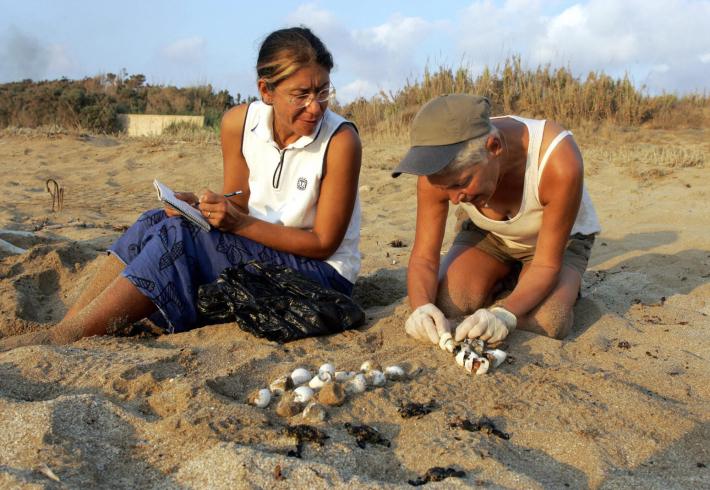 Habiba Fayed and Khalil collecting turtle eggs at Al-Mansouri Beach in 2004.Joseph Barrak/AFP via Getty Images
Both endangered green sea turtles and loggerhead turtles nest at Al-Mansouri beach, where gardenias and pink bougainvillea grow wild. For millions of years, female turtles have hauled their heavy bodies out of the water to lay their eggs in the sand. For millions of years, hatchling turtles have scurried to the safety of the open water while dodging the hungry mouths of predators. Although Al-Mansouri beach is small, less than a mile long, it has become one of the last undeveloped havens for nesting turtles amid the factories and beach clubs that dominate Lebanon's shores, with one resort built just a 15-minute walk away. In one 2005 paper assessing the turtles of Al-Mansouri for MEDASSET, Khalil called for the beach to be given legal protection and defined as a national park. "Southern Lebanon is the least developed part of the country and has been devastated by the war," the authors wrote. "Effective protection and management is essential in the region before these pristine beaches are overrun."
Pristine did not mean clean. Khalil and Fayed found needles, syringes, and medicine bottles with labels in Hebrew, Arabic, and Greek. They found diapers, plastic cups, and picnic paraphernalia. Khalil suspected that much of this trash was swept in by coastal winds from rubbish dumps less than a kilometer away. All this litter was unsightly for people and treacherous for the hatchlings, which often became entangled in refuse. The trash also sheltered scavenging ghost crabs that preyed on the baby turtles.
In her conservation work, Khalil recognized one of the brutal ironies of Israeli occupation of south Lebanon, which officially ended in 2000 and restarted this year. The military occupation kept the beaches free of development for decades, which ensured the turtles would have empty beaches on which to nest. Khalil wrote about how the nesting beaches of Northern Sinai experienced widespread tourist development after the end of Israeli occupation there, and worried the same would be true for south Lebanon.
In a 2013 paper, Khalil and colleagues wrote about how Al-Mansouri had changed over the years. They observed how the beach had eroded, with a stretch of sand more than 500 feet long reduced to a rocky shelf. They referenced plans to build a tourist resort on the land next to Al-Mansouri. A new private beach house flooded the beach with bright security lights that disorient hatchlings, which evolved to follow the light of the moon and stars sparkling on the surface of the sea. As Khalil and colleagues placed the protective metal cages over clutches of turtle eggs, they installed signs reading: "Will you help us protect the sea turtles nests? Please Do Not Disturb." They were signed, "Friends of the Sea Turtles."
 Khalil holds a turtle hatchling to be released to the sea off the coast of Lebanon.Mahmoud Zayyat/AFP via Getty Images
By this time, Khalil had ensured Al-Mansouri's recognition as one of the most important sea turtle nesting spots along the Lebanese coast. She and her colleagues called for formal protections, such as the removal of old army structures, barriers to keep cars off the beach, and a local awareness program that encourages locals to take part in the conservation work. "Any conservation project will ultimately only succeed with the involvement of the local community," the authors wrote. What the authors meant by this is that many of the people of southern Lebanon live in poverty, a socioeconomic strain that has persisted since Israeli occupation. North of Al-Mansouri beach, the city of Tyre—also often referred to by its Arabic name, Sour—is home to three Palestinian refugee camps. Local fishers, farmers, and refugees will not care about the livelihoods of sea turtles if their own livelihoods remain imperiled. Khalil knew she alone could not save the turtles; if they stood a chance at survival, she needed not just to make people care about them, but to see their futures as entangled. She wanted people to understand the health of the fisheries impacted every species in the area, human and non-human. She wanted to rebuild the infrastructure of the region, for the good of all—turtles and people.
In the turtle nesting season of 2006, Khalil had persisted in her work despite heavy Israeli bombing. When Khalil and Fayed encountered Hezbollah fighters on one patrol, the two asked them to leave to prevent an Israeli strike. "They agreed—albeit perplexed about what two middle-aged Lebanese women staying in a war zone to look after sea turtles might be thinking," Khalil wrote in the State of the World's Sea Turtles 2007 report. "The turtles paid no heed to the strife, but our own plight became starker, with no electricity and constant explosions," she wrote.
When an Israeli strike destroyed her neighbor's house, costing Khalil some of her hearing, she and Fayed fled to safety in Beirut. When they returned, they found the Orange House had also been hit by a shell. But Khalil and Fayed found Al-Mansouri had evaded the worst of the war's pollution—up to 15,000 tons of fuel oil that spilled from a bombed power plant to the north. They estimated around 5,000 turtle hatchlings made it to sea that year. And Khalil made a statue from the fragments of the Israeli shell that hit her home.
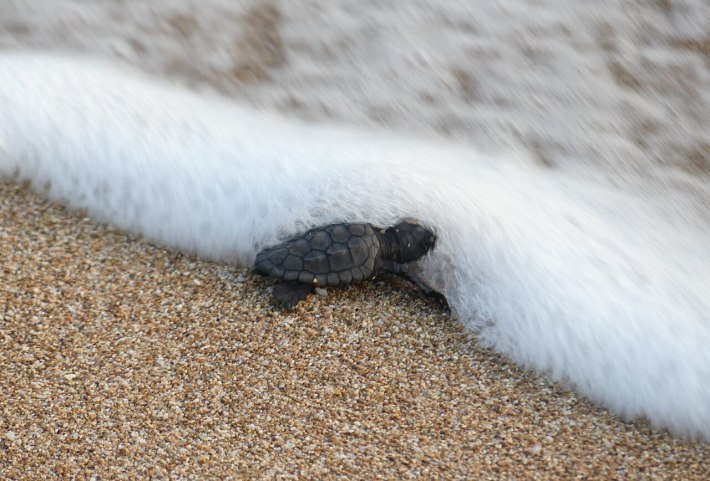 A hatchling released by Khalil and Fayed at Al-Mansouri reaches the surf.CC by-sa 4.0, via Wikimedia Commons
In a 2013 interview, Khalil said she wished to remain in the Orange House for the rest of her life. She considered it her heaven on Earth. She made jam from whichever fruits were ripest in the groves surrounding the bed and breakfast: strawberry, grapefruit, passion fruit. She wanted the Orange House to be a haven for people and turtles. "It's a place that nobody is going to judge them, so long as they respect the nature," Khalil said in the interview. "Homosexuals, lesbians, whatever—nobody will judge them here." In this recent bout of war, Khalil refused to leave her house despite its proximity to Israeli forces, her relatives told The New Arab.
As baby turtle hatchlings dash toward the waves, they imprint upon the magnetic field of their home nest so that they might return to lay their own eggs after decades spent exploring the open sea. There is an easy allegory here: Some species inherit magnetic signatures from their forebears, others seaside homes. Both Khalil and the turtles she worked to save felt compelled to return to a shared homeland that had changed irrevocably since their youth. The beach at Al-Mansouri has borne the terrors of airstrikes, pollution, and foxes, but it has also felt the presence of protectors who woke before sunrise to give the most vulnerable a better future. Khalil spent years fighting for a world where no individual should be displaced from their home, and her legacy lives on in the people and turtles who will return to the beach despite certain peril, who labor to shield the lives of those yet to be born.


