Few political wonks outside of California were likely paying much attention to the Golden State on Tuesday night, as Democrats’ anticipated blue wave crested. But the state did have one close, consequential race on the ballot: insurance commissioner. On Friday, Bernie Sanders-endorsed progressive Jane Kim won the race to lead the California Department of Insurance, which oversees the state’s $452 billion insurance market.
Kim declared victory over the more moderate State Senator Ben Allen, who was backed by the California Democratic Party, after reaching a nearly six-point lead on Friday. In a brief speech before supporters, Kim said Allen called to congratulate her that morning. (A spokesman for the Allen campaign confirmed the call to The Orange County Register.) Kim ran on a proposal for a state-run, single-payer insurance program that would cover homeowners against wildfire damage — though the plan would ultimately need approval from both the California legislature and Governor-elect Xavier Becerra.
The idea is that homeowners would automatically receive public coverage for wildfire-related losses, with payouts capped at roughly what it costs to rebuild a typical California home. Policyholders would keep their regular private insurance for other risks such as theft, burst pipes, or an ordinary kitchen fire. Kim says Californians wouldn’t pay more overall, since the money for the program would come from the share of premiums that already goes toward wildfire coverage, though each household’s bill would partly depend on its own wildfire risk.
“It would be nonprofit, and so any excess capital would stay in the state of California and would be used to drive down risk,” Kim told my colleague Matthew Zeitlin a few weeks ago. “That’s the most important piece about this actually, is that it would create another revenue stream for mitigation.”
The insurance commissioner job has taken on an increasing sense of urgency as wildfires — intensified by climate change — continue ripping through communities in California. Mounting losses from hotter, drier conditions combined with decades of new construction in the wildland-urban interface have squeezed insurers’ profits, leading many to drop policyholders in high-risk areas or simply stop writing new policies in the state altogether.
California’s homeowners insurance premiums climbed 84% between December 2020 and March of this year, according toStanford researchers. Meanwhile, a growing number of residents have been pushed onto the state’s FAIR Plan, which my colleague Matthew described as “the barebones insurer of last resort.” The share of California’s single-family homes covered by the plan has nearly tripled over that same period, from under 2% to about 5%, as homeowners in even low- and moderate-risk wildfire areas increasingly find themselves with few alternatives.
The insurance crunch has become yet another front in California’s broader affordability crisis, alongside persistently high housing, electricity, and gasoline costs. Kim’s victory suggests frustrated voters are increasingly willing to support more radical solutions that once seemed politically out of reach. And while Kim doesn’t have a background in the insurance industry, she’s no stranger to public office. The former civil rights attorney served on the San Francisco Board of Supervisors from 2011 to 2019 before becoming a regional director for Sanders’ 2020 presidential campaign.
But throughout her run for the Insurance office, critics have continually questioned how, exactly, her plan would work. No state has attempted a public disaster insurance program like this before; critics argue there’s no relevant model to work off of, no white paper laying out the details, and no price tag attached to the idea. Kim herself acknowledges that there’s plenty of uncertainty surrounding the plan. “This is a concept and a proposal, and could look quite different by the time it works its way through the process,” she told Matthew. In other words, the program that eventually emerges from negotiations with lawmakers — if one does — could end up looking considerably different from what Kim campaigned on.
Her opponent, Allen, who chairs the state senate’s Energy, Utilities and Communications Committee, argued that creating a public wildfire insurance program would impose a significant financial burden on the state. The California Earthquake Authority, an agency that sells earthquake insurance and administers the state’s Wildfire Fund, examined the potential costs of such a program this spring, estimating it would require roughly $25 billion upfront to have a 75% chance of staying solvent for 20 years. But Kim points out in her policy brief that buying reinsurance — essentially insurance for the insurer — could cut that to about $6 billion.
Allen, on the other hand, pitched a series of reforms to the existing market, including speeding up rate reviews, rewarding homeowners and communities for wildfire mitigation, expanding financing for home-hardening projects, and discouraging development in high-risk areas.
Voters opted instead for the insurance revolution. But Kim argues that her plan isn’t totally without precedent. On the campaign trail, she frequently pointed to New Zealand, where the government’s Natural Hazards Commission provides homeowners with public coverage for disasters including earthquakes, landslides, volcanic eruptions, and tsunamis — though notably not ordinary wildfires. And while France and Spain also operate state-backed disaster insurance programs, these don’t cover wildfires either, a far more common occurrence in California than the comparably rare disasters these programs were built around abroad.
Ultimately, Kim’s ambitious plan will require a champion in the legislature to go anywhere. But in the meantime, there are other issues she could get to work on. On the campaign trail, she said she wants to push insurers to fund a disaster mitigation program run by the Department of Insurance, require companies selling auto policies in a region to also offer homeowners coverage there, and impose minimum loss ratios compelling home insurers to pay at least 65% of premiums in claims and auto insurers at least 70%. It’s unclear, however, whether Kim can implement either of the latter two proposals without new legislation.
Kim will also immediately face the question of what to do with outgoing Insurance Commissioner Ricardo Lara’s Sustainable Insurance Strategy reform package. Designed to entice insurers back to California, these new rules allow companies to set premiums using forward-looking risk models rather than relying on historical losses, and to pass a portion of their rising reinsurance costs onto policyholders. In exchange, insurers are required to write more policies in wildfire-prone areas.
Kim has criticized this approach, arguing that insurers have exploited loopholes to raise premiums on lower-risk customers while continuing to underserve high-risk communities, all without doing enough to address the underlying factors driving wildfire risk.
That leaves Kim in a tricky situation. Until she is able to secure legislative backing for some version of her proposed public insurance program, she’ll have to decide whether to scrap or simply build on the existing reforms. She hasn’t yet laid out any plan for doing so. But whatever direction she takes could ultimately reshape California’s insurance market well before a new state insurer gets off the ground.
I wrote two years ago about the role that AI/ML was playing in helping accelerate useful developments in climate models. In a field where literally new possibilities are emerging on a week-by-week basis, that might as well be prehistory.
So it’s worth reviewing what directions have been fruitful, which ones are going slower than expected, which are struggling, and what is going gangbusters that I didn’t even know about back then. This update is in part due to a workshop I attended last week at the Allen Institute in Seattle, but since a lot of what was discussed there is not yet published, I apologize if I’m a little coy about some details.
Emulation for the win (mostly)
The anticipated success of emulation (of whole models or major components) has been continuing – for model calibration/tuning, for scenario filling, attribution, forecasting, and bigger ensembles. This draws in no small measure in the ability to evaluate the results from the ML version directly using the original physics-based model, and so the appropriate degree of confidence that the emulation is doing what it’s supposed to be doing can be assigned. This issue of ‘trust’ comes up a lot in conversations around this topic.
The highest profile emulators are those being used for weather forecasting (e.g. AIFS from ECMWF, and Google WeatherNext 3) which are doing well and sometimes better (on some short-term forecast metrics) than the physics-based models they are emulating. Emulators for climate and longer-time scales (such as Samudra (Dheeshjith et al. (2025)) or ACE or HiRO-ACEv2) are also appearing to do well in limited situations.
There is an effort (AIMIP) that is attempting to benchmark these efforts (at this point only for atmospheric emulators based on ERA5) and interestingly, is finding that the emulators work well in the domain for which they were designed (i.e. short term forecasts), but have very diverse and mostly unreliable responses in out-of-sample tests such as what happens if you increase the ocean temperatures uniformly. This is perhaps unsurprising – the emulators are not learning physics that they then apply, they are learning correlations which they assume persist. Indeed, there are now many examples of ML-models that have good in-sample validation failing to maintain conservation of energy (for instance) when given a forcing of some sort.
This seems a generic enough problem that their might be a generic reason why this is so, and there is some very clear work by Elizabeth Barnes (in prep) that diagnoses this (something to look forward to!). There is a broader discussion about how to optimally train these emulators if we want them to respond well to out-of-sample tests. Some results were presented at the workshop suggested that spectrally-complex near-random forcings (for instance in ocean temperatures), despite not being physical, might be better at getting the atmospheric emulators to distinguish what is really causal from what is merely correlation.
To give an example, weather emulators trained on ERA5 will generally recognise that persistence is a pretty good forecast most of the time (as have humans!). That correlation gets baked into the machine learning. But if something sudden happens (say you’d like to know what happens when the ocean temperatures are higher), the emulator will follow persistence rather than warm up as a physics-based model would. But if the training data included a lot more sudden and uncorrelated changes in SST then that might lead the emulator to pay more attention to a physically consistent response as opposed to the time-step to time-step inertia. This would need the physics-based models to be run in very different ways than they currently are, but that is not insurmountable.
However, to be clear, none of these emulators are real climate models yet: they don’t have a climate sensitivity to CO2 (or most any other forcing except SST), they can’t be used for paleo-climate out-of-sample tests (like the last glacial maximum), and don’t provide any understanding for why things change. Thus the need for physics-based models to continue to be developed and used has not gone away (phew!).
Hybrid models
Physics-based models that successfully include ML-parameterizations remain a little thin on the ground. Despite the promise of faster execution the combination of legacy code issues (tying fortran-based models to python-based ML components is trickier than you might expect) and reliability concerns (ML components sometimes blow up or give nonsense results more often than standard parameterizations), these kinds of models are still mostly in an experimental phase and are (as far as I can tell) not going as fast as expected (feel free to disagree with examples in the comments!).
The new kid on the block: Agentic AI
This is the crazy thing. Two years ago, I did not know what Agentic AI was, and even six months ago, I was not fully aware of what it could do. But there is a real use case in climate modeling that this is more or less perfect for.
As readers are likely aware, until very recently, climate models were written in Fortran and run on CPU-based high performance computers. Some groups have embarked on multi-year multi-million dollar translation efforts (to C++/Kokkos, or CUDA) but most did not because of the time it would take and the extra expense in a time of shrinking budgets. Some scientists had thought about the potential for using LLMs to do this (for instance, Zhou et al (2024) or Lalhou et al (2026)), but while these efforts were interesting, they were limited. However, three months ago, a preprint from Koldunov et al showed that a full ocean model could be quickly and successfully translated to JAX using agents. This provided automatic differentiation (!) and GPU capabilities without compromising the physics. One month ago, the same group used the latest Claude model to translate MITGCM (another ocean model) from Fortran to JAX over a weekend. Software engineers at NASA a few weeks ago took a configuration of the GISS ESM and converted it in 18 hours. This, quite frankly, is fundamentally game-changing.
To be clear, this is not trivial. The agents need to develop there own tests to verify that their translations are correct, they need to be guided in how design the new code base, and in and of itself translation to JAX (or CUDA or Julia) doesn’t guarantee code speed up on GPUs. But once this is in place (and the performance issues put aside for a moment), a task that would have taken multiple people multiple years to complete can be done in under a day. Say 20 person-years to under 1 person-day – a factor of nearly 10,000 times faster (and cheaper).
The questions climate modeling groups are dealing with thus have very dramatically changed from ‘what is your multi-year strategy to move towards hardware agnostic codes’, to ‘what does it even mean to be a climate model center when anyone anywhere can fork a version of their own and run it anywhere’. The broader questions (that are also hitting software engineers in industry or open source projects) about the shift from human to agent-written code are also profound. What does it mean to be scientist who’s main expertise was coding? Can people re-envisage their role as code managers? Should people still want to edit code themselves at all? How do we maintain momentum and community on group projects? These issues will take some time to work through and I’m not at all confident I know where we’ll end up. However, what is clear is that any climate model code development plans that were written more than three months ago, are basically obsolete.
It is conceivable that groups that are currently working on their CMIP7 simulations (for the most part using their legacy codes on standard HPC machines) may be able to augment these simulations with newly-translated code bases very quickly – say in the next few months. We shall see!
Coda
Speaking personally, I am quite critical of the majority of uses for LLMs – in replacing search, plagiarizing creative industries, summarizing your email (FFS!), replacing human decision-making in crucial fields (medical insurance, benefit payments etc.), providing fatal ‘medical’ advice, and creating massive problems in science for journal editors and program managers as they get spammed with hundreds of low-quality AI-generated submissions with hallucinated references. The environmental damage of un-permitted gas-based electricity generation for massively debt-laden data centers is increasingly bad for both local pollution and global climate. And the danger of AI slop overwhelming our ability to even discover what is true or known is very real. However, there clearly are cases (such as described above) where (under controlled conditions) they can dramatically accelerate work that would have been very difficult or impossible to do before. Some of the recent AI results in mathematical proofs may also fall into this category (but some definitely do not!). How we should square this circle is not obvious (though here are some thoughts on how to use Generative AI ethically). It might also be smart to save some research dollars to pick up some second-hand cheap GPUs for science if (when?) the AI industry boom turns to bust.
In the meantime, it’s a brave new world that has such creatures in’t.
References
S. Dheeshjith, A. Subel, A. Adcroft, J. Busecke, C. Fernandez‐Granda, S. Gupta, and L. Zanna, "Samudra: An AI Global Ocean Emulator for Climate", Geophysical Research Letters, vol. 52, 2025. http://dx.doi.org/10.1029/2024GL114318
B.C. premier-designate Lorne Doerkson has appointed Dimitri Pantazopoulos, a former lobbyist and pollster, as his chief of staff. (The Canadian Press/Ethan Cairns)
The B.C. premier-designate’s new right hand man is a former lobbyist who has worked on behalf of waste management companies, media groups and Uber.
Last week, B.C. Conservative premier-designate Lorne Doerkson tapped political strategist Dimitri Pantazopoulos as his chief of staff. A party news release says Pantazopoulos has more than two decades of experience in government, politics and business and played a “central role” in the Conservative Party’s successful fall election campaign.
For 30 years, Gérald Chouinard visited Quebec orchards every week of the growing season, helping apple growers use fewer pesticides. Today, his right hand trembles as he speaks. Medication controls perhaps half of it, the former agronomist and researcher says. Some days, even cooking or walking is hard.
Chouinard was diagnosed with Parkinson’s disease in 2019, at 56. In 2022, Quebec’s administrative labour tribunal ruled that his illness was directly linked to his job, which for 20 years exposed him to more than 40 pesticides sprayed in orchards. His employer, Quebec’s Agriculture Ministry, did not contest the claim. The province’s workplace safety board told him he was the first such case.
Now he is challenging Ottawa. A House of Commons petition he launched closed last week with 21,410 signatures. It targets two federal budget bills: C-30, passed in June, which lets cabinet approve pesticides Health Canada has found too risky for the environment, and C-31, still before Parliament, which would end the requirement that every pesticide be fully re-evaluated at least once every 15 years.
“It’s a complete change of direction,” Chouinard told The Narwhal in French. “For decades, we’ve been going in one direction to reduce the risks, reduce the use of these products. … Now, suddenly, two bills that go the other way.”
These bills arrived as recent studies have documented a link between some pesticides and the risk of health issues like Parkinson’s and cancer, and as the federal government’s own data shows how much is still unresolved about pesticides in Canadian water.
In late October, the commissioner of the environment and sustainable development — part of the auditor general’s office — released an audit of Health Canada’s water monitoring program for pesticides. It was largely positive: the program, launched in 2024, works as intended, and its data is already shaping regulatory decisions. But the auditors also found the department “took limited action on higher-risk pesticides.”
In 2024, sampling partners collected nearly 4,000 water samples. Thirty of the 233 pesticides analyzed exceeded levels Health Canada considers safe for aquatic life. Four landed in the highest-risk group, the audit found. Two of the four pesticides Health Canada identified to The Narwhal are what are known as neonicotinoids — insecticides long linked to harm to bees and aquatic insects.
Yet for half of these highest-risk pesticides, the auditors found, Health Canada had not started looking at whether action was needed. The department spokesperson said it is waiting for quality-checked 2025 data, though preliminary results “showed some exceedance patterns.” The audit also found Health Canada has no thresholds for action when pesticides exceed levels that may pose a risk to human health. The department agreed to draft them by June 2027, then consult the public.
The auditors point to an insecticide called clothianidin as an example of the monitoring program doing its job. A neonicotinoid used on corn, potatoes and other field crops, it is known to be harmful to pollinators. In 2024, the report found the clothianidin limit was exceeded 360 times, more than any other pesticide, at sites in Prince Edward Island and Ontario. Health Canada used that data to widen a re-evaluation of the insecticide, under way since 2016, to include its effects on aquatic invertebrates.
“Without the sampling results from the program, Health Canada would not have had the data on clothianidin to support these actions,” the auditors wrote. And even those actions are less drastic than those taken by the European Union, which now bars imported food containing detectable residues of clothianidin — which could impact everything from oranges and potatoes to beans, oil and coffee — after a three-year transition that ends this year.
That kind of review is exactly what Chouinard fears is now at risk.
The feds and industry say changing pesticide rules helps food security
In June, Parliament passed Bill C-30, which implemented the government’s spring economic update. Tucked inside were amendments to the Pest Control Products Act, the law that governs pesticides in Canada.
The amendments let cabinet authorize a pesticide even after Health Canada concludes its environmental risks are unacceptable, if ministers decide it is needed for economic or food security.
The government fast-tracked the bill, limiting House debate and wrapping up committee study in two hours. The Senate committee that studied the bill concluded changes of this significance “should have warranted a separate study rather than being included in an omnibus bill.”
So far, cabinet has not used its new power to approve a pesticide, the health minister’s press secretary Alexandre Bergeron told The Narwhal.
The government frames the changes as part of a wider push on food security. In June, Ottawa unveiled a $3.2-billion national food security strategy it says was aimed at lowering grocery bills.
Industry welcomed the shift. “Food security is, ultimately, national security,” Darren Anderson, CEO of Canadian pesticide maker Vive Crop Protection, told the Senate agriculture committee in June. He said he had long asked the regulator to consider economic factors in pesticide decisions, and called C-31’s review changes “much more of an efficiency play.”
Most major farm groups agreed. Stéphanie Levasseur of the Canadian Federation of Agriculture told the Senate finance committee the organization would “welcome and support the recognition of economic and food security,” as long as implementation doesn’t add bureaucracy or delays. The Fruit and Vegetable Growers of Canada “strongly supports” the changes, Chris Duyvelshoff, chair of crop protection, said, while insisting food security must not weaken health or environmental protection.
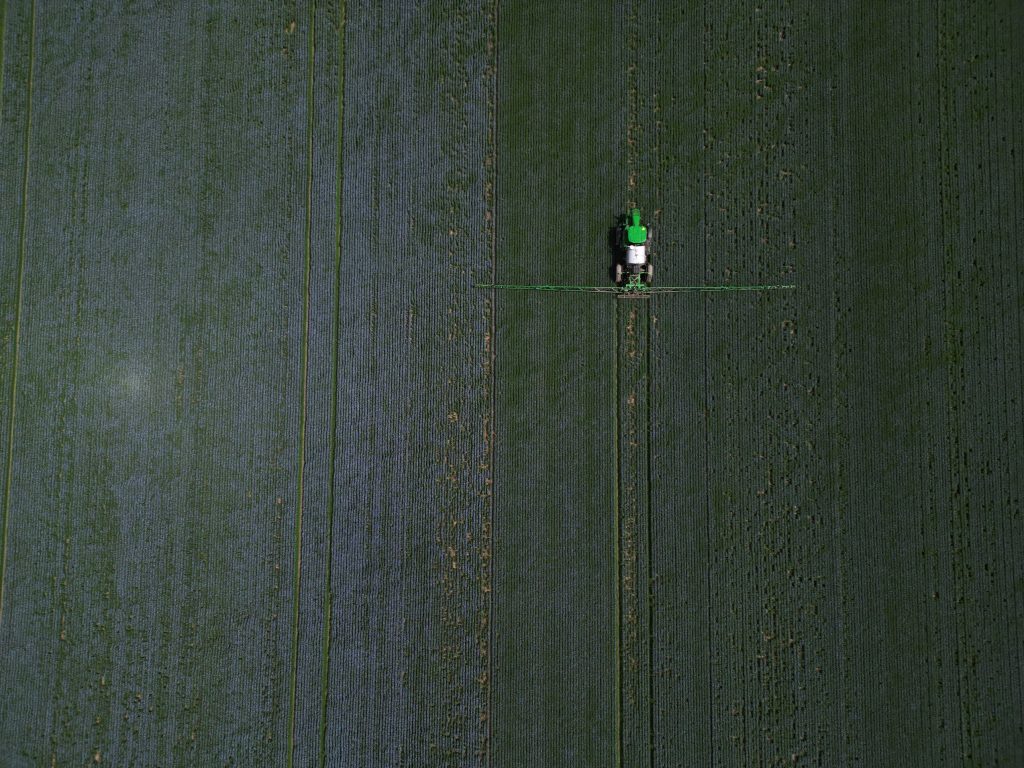
The federal government says changing pesticide rules will help national food security. Many in the agriculture industry say it’s a more efficient way to regulate. But not everyone is convinced. Photo: Tim Smith / The Narwhal
But not all farmers are on the same page. In June, the National Farmers Union asked members of Parliament to scrap the pesticide changes altogether. Cabinet deliberations stay confidential for 20 years, the union noted, so the public would not learn why a pesticide was approved until any effects were irreversible. The union also raised concerns about well-resourced companies lobbying for Health Canada exemptions.
Chouinard doesn’t blame farmers. Climate change has brought warmer temperatures, which in turn bring more insects and more disease, he said, which makes it harder for growers to limit chemical use. “They’re the first victims” of both climate change and pesticide exposure, he said.
Feds will also drop required re-evaluations of pesticides
A second bill, C-31, still before Parliament, would go further. Today, Health Canada must re-evaluate every registered pesticide at least once every 15 years. A re-evaluation can require new studies from the manufacturer or consult the public. C-31 would replace that with an “assessment” of information already available. A full re-evaluation would be required only if the health or environmental risks have “increased significantly.”
A transitional provision would also let the minister end re-evaluations already underway on the same basis.
“The 15-year checkpoint remains in place,” Alexandre Bergeron, press secretary to Health Minister Marjorie Michel, said in an email. “These changes will help reduce backlogs and ensure regulatory resources are focused on higher-risk products and emerging concerns, rather than automatically reviewing products simply because 15 years have passed.”
Backlogs are real: the clothianidin re-evaluation has now run for a decade. Health Canada said it has “no plans” to end it, but did not say how many other ongoing reviews could be affected.
Chouinard saw the effect of re-evaluation in the orchards himself. As part of his work, he tracked the toxicity of all the products applied there, compiling what he calls a “risk index” for the pesticides used. “We could see that the risk index, over the years, was going down,” he said, explaining that “products with high risk indices tend to disappear during re-evaluations. And new products that come on the market tend to have lower risk indices. … So, year after year, the record improves.”
He now fears dangerous products “could stay on the market much longer.” The new criteria, he said, are vague and “subject to outside pressure rather than based on science.”
In 2024, sampling partners collected nearly 4,000 water samples for an audit of Health Canada’s water monitoring program. Thirty of the 233 pesticides analyzed exceeded levels Health Canada considers safe for aquatic life. Four landed in the highest-risk group. Photo: Tim Smith / The Narwhal
Other critics say the government’s economic argument is weak. Pesticides can’t ensure food security, they say, when Canada is the world’s fourth-largest pesticide importer. It imported $3.02 billion worth between September 2025 and August 2026, about 72 per cent of it from the U.S., according to data compiled by the Observatory of Economic Complexity.
With that dependence, loosening the rules won’t protect Canada’s crops or food supply, according to Pascal Priori, who coordinates a support network for pesticide victims run by the Quebec Public Health Association. “Deregulating does not strengthen our sovereignty or our agricultural competitiveness,” he told the House finance committee on Oct. 8. “On the contrary, it weakens it.”
Trade is also at stake. The European Union’s rules on pesticide residues cover more than one neonicotinoid, which the coalition opposing Canada’s changes warns could put up to $1.4 billion in exports at risk — just as Ottawa tries to diversify trade away from the U.S.
Pushback on pesticide bills spans the country
The pushback isn’t limited to Quebec. In Saanich, B.C., on Vancouver Island, Alena Gavrilenko, a fourth-year political science student at the University of Victoria, runs volunteer workshops on growing and canning organic food. Her neighbourhood recently built a seed library.
When the pesticide changes came up at a workshop this summer, she launched her own House of Commons petition. It has about 2,700 signatures, more than 1,000 of them from Ontario.
The consensus in her community, she said, is that “science should decide whether a pesticide is safe, not cabinet.” She also questions the government’s affordability argument.
“Nobody has shown that this power will even lower grocery prices,” she said. “Food prices are high, farmers need the tools, but I don’t think this is the way to go about it.”
Soaring oil and gas prices following the war in Iran have encouraged people to look beyond fossil fuels, leading to an easing of climate-damaging carbon emissions this year.
Carbon dioxide from oil, gas and coal is forecast to flatline for 2026, based on data from the year so far, according to a comprehensive assessment by scientists. Emissions from burning oil alone will drop by 2% as drivers economise on fuel use and flock to electric vehicles instead.
It’s not easy to extract iron from its ore. But the peoples of the ancient city of Great Zimbabwe—the capital of a thriving kingdom in southern Africa between 1000 to 1700 AD—were masters.
At sites near the city’s stone ruins, clusters of iron-smelting furnaces survive today as mounds of rubble. At Mashava, a village 25 miles northwest, fragments bear fingermarks of those who long ago smoothed the structures’ clay interiors.
Some of the furnaces were nearly an adult’s arm span in width, with walls thick and strong to contain the heat of more than 2,100° Fahrenheit needed to smelt iron. Unlike other furnaces that required workers to force air into them with bellows, these were designed to suck air in, then out through a chimney, no human labor required. This would have made it significantly easier to produce the iron, which was fashioned into hoes, axes, and arrowheads.
“The number and size of these furnaces, together with the use of natural-draft technology, indicate intensive and technologically sophisticated iron production,” says archaeometallurgist Ezekiel Mtetwa of Chicago’s Field Museum of Natural History, who has long studied the furnaces.
Scientists are extremely interested in the peoples who created this and other iron-powered societies across eastern and southern Africa. Research points to an adaptable and innovative group from western Africa as the masterminds. Known as Bantu speakers, these communities began gradually expanding across the continent’s southern half, starting from 6,000 to 4,000 years ago. In doing so, they introduced a fundamentally new, sedentary way of life—characterized by farming, raising livestock, pottery-making, and metalworking—to regions previously dominated by hunter-gatherer communities.
This migration transformed not only the region’s history and technology, but also its languages: Today, around 350 million Africans speak one of roughly 500 distinct Bantu tongues, from southern African Zulu to eastern African Swahili. And at least as many Africans—as well as many African Americans and Afro-Latinos—carry Bantu ancestry in their DNA.
Reconstructing this expansion has been a tough puzzle, especially given the region’s sparse written historical records and limited research funding. But a unique blend of scientists—linguists, archaeologists, and geneticists—have teamed up to unearth clues about the deep origins of the Bantu-speaking people, their path across Africa, and their relationships with other cultures. Although much debate and uncertainty remain, little by little the work is uncovering one of history’s largest and longest human migrations.
“It completely reshaped the demography in sub-Saharan Africa, and we are really interested in trying to understand it,” says population geneticist Sandra Beleza of the United Kingdom’s University of Leicester.
People on the move
The first evidence of the Bantu expansion came from observations of similarities among Bantu languages. They’re so alike, in fact, that when the Portuguese explorer Vasco da Gama sailed around the southern tip of Africa in 1497, a Portuguese crew member who had spent time in west-central Africa could reportedly communicate with locals in southeastern Africa.
Linguists working in the 19th century started referring to the language family as Bantu, the plural of muntu, meaning “human being” in many Bantu tongues. Later linguists reasoned that the languages stemmed from an ancestral people who migrated across the continent from western Africa, which harbors the greatest diversity of Bantu languages (as would be expected for where the languages originated).
Soon, archaeologists found supporting evidence: across eastern and southern Africa, pieces of pottery of similar yet diverse styles, alongside first-time traces of village life, metal-making, domesticated animals, and western African crops—all developed within the last 2,000 years. Northern sites usually dated back to earlier time periods than sites farther south. “You can clearly see a north-to-south progression,” says archaeological scientist Shadreck Chirikure of the University of Oxford.
By the 1990s, however, some scholars began to question the idea that Bantu languages and skills spread through a migration. Couldn’t these cultural habits have spread while people stayed in the same place, with hunter gatherer communities passing along new technologies, languages, and habits to each other?
Genetic techniques that could analyze people’s ancestry helped to resolve that debate. All of us share DNA with our relatives: 50 percent on average with siblings, 12.5 percent with cousins, 3.3 percent with second cousins, and so on. Though these proportions become minute the further back in time a shared common ancestor lived, statistical techniques can tease out patterns.
Sure enough, a 2009 genetic analysis of 2,432 Africans found that Bantu-speaking people from western, central, and southern Africa are much more closely related than one might expect given their geographic distance. And in 2024, a team of scientists analyzed the genomes of 1,763 Africans and found the greatest genetic diversity among Bantu speakers in western Africa. As distance from the region increased, diversity declined. “This is a typical signature of a population expanding from one place to another,” explains coauthor Carina Schlebusch, a geneticist at Uppsala University in Sweden.
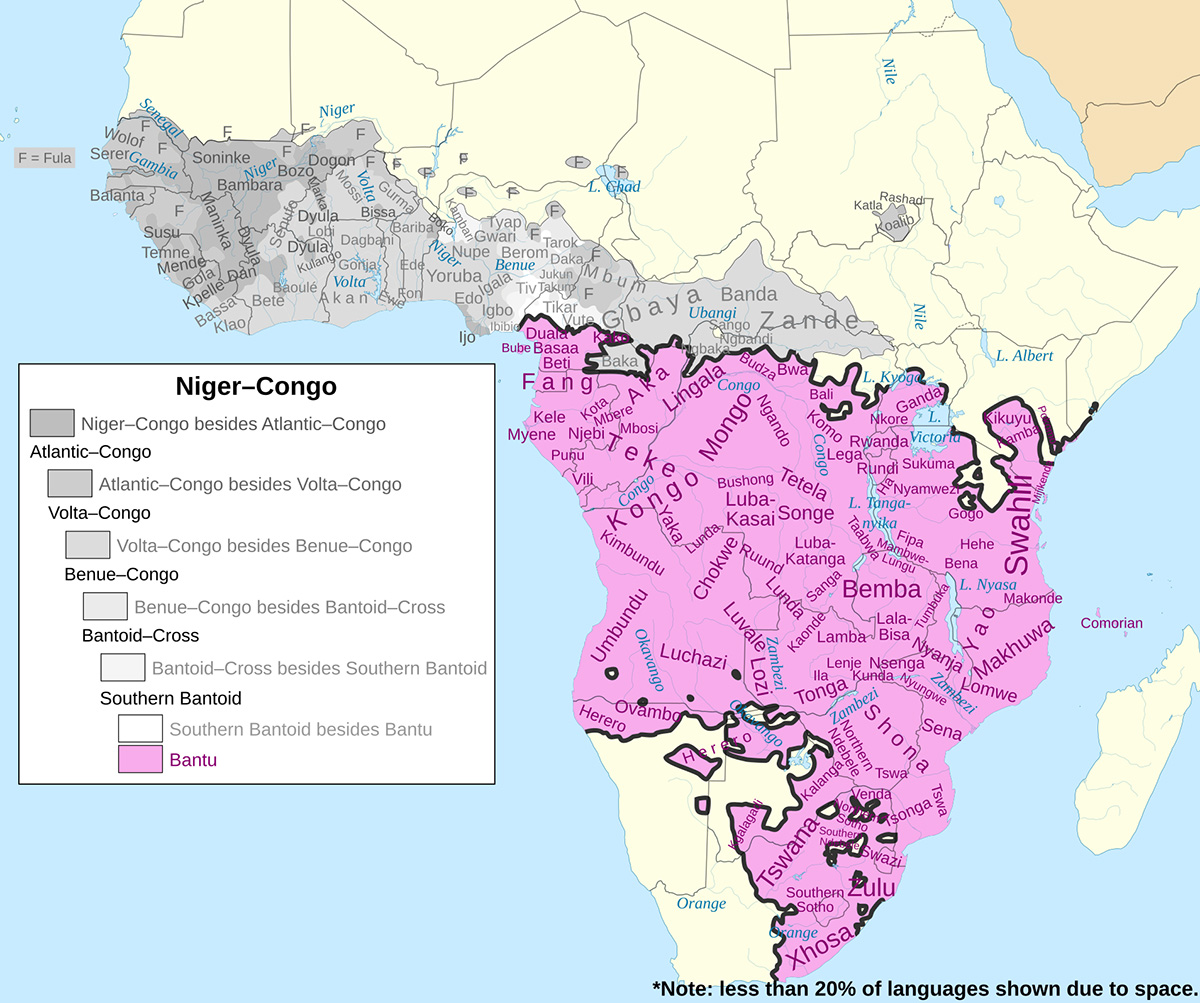
Roughly 350 million people across sub-Saharan Africa speak one of roughly 500 Bantu languages—from Swahili in eastern Africa to Xhosa spoken in southern Africa.
Roughly 350 million people across sub-Saharan Africa speak one of roughly 500 Bantu languages—from Swahili in eastern Africa to Xhosa spoken in southern Africa.
Credit:
Wikimedia Commons
Mysterious roots
But while linguistic and genetic data point to western Africa—particularly the Grassfields region of Cameroon—as the Bantu homeland, conclusive archaeological proof is thin. At the best-studied archaeological site in the Grassfields, a rock shelter called Shum Laka, pottery fragments appear dating from 7,000 to 6,000 years ago and become abundant by 5,000 to 4,000 years ago. Bowls and jars at first decorated simply with incisions and stamps and later bearing the marks of carved or braided tools rolled over wet clay are a possible, yet inconclusive, trace of Bantu ancestors.
South of Cameroon, archaeologists have searched for artifacts in one of the Bantu-speaking people’s first destinations: the Congo rainforest. A handful of times between 2010 and 2023, archaeologist Alexandre Livingstone Smith of Belgium’s Royal Museum for Central Africa traveled via boat along the Congo River as part of a team led by linguist Birgit Ricquier. In a number of villages, Smith found pottery shards of a style consistent with that found farther west, dating back to 2,300 to 2,000 years ago. “That would be the potential first Bantu settlers of the forest,” Smith says.
Many experts interpret the trails of pottery as evidence that ceramics traditions were brought by Bantu-speaking people all the way from their original home. What’s unclear, however, is when and how Bantu-speaking peoples acquired their farming and metalworking skills—and, in particular, whether they invented iron smelting themselves or learned it from neighboring, iron-extracting cultures.
Scientists have been able to deduce the path that Bantu speakers took to eastern and southern Africa. Some scholars have argued that the path split into two before entering the Congo rainforest, with one group heading east while another went south through the forest. But evidence is now mounting that these groups crossed the rainforest together, and only upon reaching its southern fringes roughly 2,500 to 3,500 years ago did they split into east-moving and southward-moving groups.
Some of this evidence comes from linguistic studies. Not unlike the evolution of species, languages diverge and transform over time, creating “trees” that linguists can reconstruct from similarities in grammar and vocabulary. In 2015, a group of researchers did this computationally using data from about 400 Bantu languages. They observed a much larger diversity—and deeper splits—among the Bantu languages spoken in the Congo rainforest, suggesting that Bantu-speaking ancestors spent a long time there, allowing their languages to diversify. Languages spoken farther east and farther south appeared to stem from a less diverse subset of this larger group, explains coauthor Koen Bostoen, a linguist at Belgium’s Ghent University.
Later linguistic studies, as well as genetic analyses, have reached similar conclusions. In 2023, Beleza and her colleagues compared the genomes of Bantu speakers from Angola—south of the Congo rainforest—with those from the eastern African country of Mozambique and ones from Cameroon, the Bantu homeland.
Remarkably, the eastern African samples were more genetically similar to those from Angola, hundreds of miles to the south of Cameroon and south of the rainforest, than to any of the samples from Cameroon. That points to a recent common ancestor in the Angola region—suggesting that the Bantu split into eastern and southern streams only once they reached the rainforest’s southern edge, Beleza explains.
By the time the Bantu people commenced their movement east and south, they had already come into their own as a farming, iron-making, livestock-herding, and pottery-making people, Chirikure says: Many ancient Bantu settlements across eastern and southern Africa contain evidence of this Bantu “package.”
Mixing and mingling
Key to the Bantu’s success in southern and eastern Africa, experts suspect, was their sedentary lifestyle. This—and their iron tools—would have allowed them to produce more food and grow in number, propelling them to occupy new territories. Their lifestyle affected the landscape as forests turned into farmland, and it also affected the hunter-gatherer communities who were already living there. Some groups were likely crowded out and disappeared, experts suspect, while others were probably pushed to marginal regions, including Indigenous groups such as rainforest hunter-gatherers and Khoisan peoples, who continue to live in central and southern Africa, respectively, to this day.
Still, scientists are learning that Bantu peoples had deep relationships with these two groups. In the 2024 genetic analysis, Schlebusch and her colleagues found that some Bantu-speaking groups in central Africa share about an eighth of their DNA with rainforest hunter-gatherers, and some southern African Bantu speakers share a similar amount with Khoisan groups. Clearly, their ancestors once intermixed.
Curiously, in the case of the Khoisan, this mixing tended to arise from pairings of Bantu-speaking men with Khoisan women. One 2021 study of southern African Bantu speakers found that the DNA inside their mitochondria—which people inherit only from their mothers—had greater-than-expected proportions of Khoisan DNA. But the Y chromosomes, which come from fathers, had much higher proportions of DNA with Bantu ancestry. Some experts speculate that this pattern could be the result of Bantu men raiding Khoisan women or preferentially marrying Khoisan women for whom the traditional bride prices would have been cheaper. “Whenever there is a power difference… between two groups, it tends to melt down to this,” says coauthor Ananyo Choudhury, a geneticist at the University of Witwatersrand in South Africa.
This pattern also left marks on the language. The characteristic clicks of Khoisan languages also occur in southern African Bantu languages Zulu and Khosa. Bostoen suspects that the children of Khoisan-Bantu pairings were, at first, bilingual. Eventually, “they lost their mothers’ languages, but they left a substrate of the mothers’ languages in the Bantu language.”
Archaeologists are also studying the relationships between Bantu farmers and their neighbors. While there may have been conflicts over land, the groups also cooperated with and learned from one another, says Décio Muianga, an archaeologist at Eduardo Mondlane University and the research institute Kaleidoscopio in Maputo, Mozambique. He’s been excavating a rock shelter in Mozambique containing thousands of years’ worth of stone tools, wild animal bones, and wild plant remains—telltale signs of hunter-gatherers living at the site. But interestingly, Bantu-style pottery also appears. “My assumption is that the hunter-gatherers were getting these ceramics from the farmers,” Muianga says. “They were interacting, communicating, and exchanging resources.”
There is evidence, too, for cultural exchanges: European anthropologists have reported that some Bantu-speaking groups would solicit San hunter-gatherers to conduct traditional rainmaking ceremonies, for example.
Bantu social networks eventually extended well beyond Africa. By 1100 to 1600 AD, many of the complex state societies that Bantu speakers built developed trade networks across the Indian Ocean. Archaeological data shows they imported Chinese porcelain and glass beads; in return, they exported gold, ivory, and iron. In fact, a 12th century Muslim cartographer once wrote that iron from parts of southern Africa—likely referring to Great Zimbabwe’s iron-producing hinterlands, Mtetwa suspects—was deemed to be of much higher quality than that from other places like India.
Mtetwa has found evidence that iron smelters near Great Zimbabwe would add bone fragments to the furnaces, perhaps as part of a smelting-blessing ritual, but one with scientific merit: This material contains calcium, which can accelerate the separation of iron from the rest of the ore. That may be a testament to the Great Zimbabweans’ iron-smelting skills: “Some materials introduced within ritual or medicinal practices may simultaneously have had technically beneficial effects on the smelt,” says Mtetwa.
Though they’ve made great progress in reconstructing the Bantu world, scientists are aware of, and trying to address, the limitations of their research so far.
Linguistic studies, for instance, have been a popular tool to reconstruct Bantu history, but Bostoen cautions that very few Bantu languages have been documented thoroughly enough to definitively trace linguistic trees back in time. Linguists may never get a complete dataset, because some old branches of the Bantu language family may have died out.
Another limitation of computational Bantu language-family reconstructions is that they’ve usually assumed that languages have evolved in isolation after different Bantu groups separated. But there may have been extensive cross-pollination among languages as different groups met and interacted.
In fact, when linguists factored in the possibility of contact among Bantu languages in a 2026 study, they couldn’t reconstruct the diversification patterns described by previous linguists, says coauthor Igor Yanovich of the University of Vienna, who wrote about the challenges of Bantu linguistic studies in the 2025 Annual Review of Linguistics. In his view, linguists should first focus on thoroughly documenting Bantu languages before attempting to use them to understand Bantu history.
In hopes of adding new insights, Schlebusch is working to obtain DNA from ancient human remains. By revealing the identity of people who were living in particular places at particular times, this could help to elucidate when and where different Bantu communities moved into, overlapped with, or repopulated areas. “What we see more and more in genetic data is that the movement was probably complex—that it was these ‘spread over spread’ events,” Schlebusch says.
Archaeologists, for their part, hope to fill in the vast gaps in the archaeological record of sub-Saharan Africa—by both conducting new excavations and re-examining existing artifact collections for fresh insights. But all this work requires funding for research and laboratories, especially from African governments, says Chirikure; he, like many of his colleagues, has largely relied on funding from Europe, which is limited. Without more funding, “you are not generating fresh ideas, you are not formulating new hypotheses and testing them using some of the cutting-edge science,” he says.
Scientists from all three disciplines are hopeful that they will eventually tell the complete story of how an innovative people spread and diversified across sub-Saharan Africa, mixing traditions with those of earlier peoples and of others who still live there, to create myriad cultures, each one a unique blend of food, philosophy, language, music, and traditions. “If you travel from West Africa today all the way to East Africa, you have a unique cultural diversity that is very hard to find in many other parts of the world,” Muianga says. Combined with the legacy of other groups, he says, “this is the result of the Bantu migration.”
 Log in












 reply