plant lover, cookie monster, shoe fiend
20649 stories
·
19 followers

Your Appliances Got Worse On Purpose

1 Share

Nowhere is the illusion of choice more potent than in the appliance showroom. Dozens of brands fan out across the price tiers, a wall of brushed steel under the lights, and behind all of it sit five or six companies. The labels compete. The machines mostly don't.

That arrangement pays off when your machine dies young, and these days it dies young on schedule. Americans spent 43% more on appliances in 2023 than in 2013 even as sticker prices fell, because the things wear out faster and get replaced more often.

Cheap parts and efficiency rules often take the blame, but consolidation is the real cause. The decline came on deliberately, built into the machines one brand at a time, as the companies that once competed on quality stopped having to.

A handful of holdouts still build appliances that last for decades, and that is telling. Durability is clearly still possible. Most of the industry just decided it was worth less than the next sale.

One company, four price tags

Start with Whirlpool. It owns brands on every rung of the price ladder.

Amana sits at the bottom as the budget badge. Maytag plays the dependable workhorse, KitchenAid the premium brand for people who care about their kitchen, and JennAir the luxury tier. Every one of them is Whirlpool, which the company lists plainly in its own corporate materials. They share wash systems, motors, compressors, and control boards across brands, built in the same plants. A Maytag and a Whirlpool of the same class are often the same machine in different sheet metal. The higher tiers add real materials and features, but you're still buying up a ladder one company controls end to end.

Kenmore takes the trick further. It never built a single appliance, not one, in its entire history. For decades it was a Sears nameplate bolted onto whoever won the contract that year, Whirlpool or LG or Frigidaire. Today it survives as a licensing shell owned by the hedge fund that picked Sears apart.

Consolidation like this carries a cost. When Whirlpool bought Maytag in 2006, it closed the Iowa facilities that had built Maytag washers since 1893. The plant shutdowns that followed cost around 4,500 jobs. At least those were American companies hollowing out American towns. Most of the names in your kitchen aren't even American anymore.


Each Worse on Purpose essay names the corporation behind a different category. Subscribe to get the next one in your inbox.


The brand on the box

When people think of American appliances, they think of General Electric. The name goes back to Edison and it still reads as homegrown on the showroom floor. GE Appliances has belonged to a Chinese conglomerate since 2016, when Haier Group bought the business for $5.6 billion and locked in the right to keep selling under the GE name through 2056. The headquarters and the factories stayed in Louisville, which is the part that lets it still feel American. The ownership and the money went to Qingdao.

GE's route to Chinese ownership ran through Washington first. The company lined up a sale to Electrolux, the Swedish appliance giant, back in 2014 but the US Justice Department sued to block it on antitrust grounds, worried that one company would control too much of the American range and oven business. The deal fell apart in 2015, and Haier stepped into the opening a year later. Washington had stopped an American brand from going to a Swedish buyer and instead cleared its path to China.

GE is only the most familiar case. Frigidaire, the name that became a synonym for the refrigerator itself, is Swedish now, owned by Electrolux. Bosch and its sister brands answer to a German parent, Samsung and LG report to Seoul, and the rest of the wall sorts the same way. The American kitchen is mostly a rack of nameplates owned between Qingdao, Stockholm, Stuttgart and Seoul. The flags on the boxes stopped meaning much a long time ago.

Foreign ownership is only half of it. The other half is that a lot of these competing brands roll off the same line. Badge engineering shows its real face in a recall, and a big one landed in June 2025, when the Consumer Product Safety Commission recalled about 1.7 million window air conditioners. They had been sold under at least nine names: Frigidaire, Insignia, Danby, Keystone, Mr. Cool, Comfort Aire, Perfect Aire, Sea Breeze, and LBG. A shopper could stand in the aisle, weigh them against each other, and feel like the choice meant something. Every one was built by the same company, a Chinese manufacturer called Midea that most buyers have never heard of, and every one carried the identical defect: a drain that let water pool inside until it grew mold.

Nine names on the box, and behind them one machine, broken the same way every time. The brand was decoration, the cheap part of the whole arrangement. The expensive part starts once the thing is in your house.

Why it dies young

The reason these machines fail early is built into them. Older appliances were mostly steel and mechanical controls, while newer ones run on plastic and circuit boards and Wi-Fi, and every one of those additions is one more part that can fail. The connected ones fail the most of all. J.D. Power's 2025 data put smart appliances at roughly 40% more problems per hundred units than the plain versions, which means the upgrade you paid extra for is the part most likely to quit.

When something does break, the math is rigged toward the landfill. A failed control board can cost a third of what the whole appliance did, and tariffs on imported parts, the compressors and boards and motors, pushed repair bills up another 5 to 20% in 2025. Throwing the thing out becomes the rational move, which is exactly where the design was pointing you.

LG's linear compressor is the clearest case of all this. The company sold it as the better option, quieter and more efficient, and marketed it on a twenty-year life. It became one of the most notorious refrigerator failures of the past decade. A 2020 settlement covered roughly 1.5 million people whose LG refrigerators stopped cooling, and LG denied any defect the entire way through. The part itself was never fixed. Fresh lawsuits in 2024 and 2025 allege the same compressor still dies in newer fridges.

So LG charged a premium for the feature that killed the fridge, then took the position that nothing had gone wrong. Somewhere around here, someone always blames the government.

It isn't the government

The theory goes that federal efficiency rules wrecked the machines by cutting the water and the heat, and there is a real tradeoff in there worth discussing. But a deeper look shows that the efficiency rules are only a small factor. The Department of Energy's own testing found the standards could be met with cleaning and cycle times close to the old machines, and low-water front-loaders often clean better and treat fabric more gently than the water-guzzlers people miss. The rules also swing with each administration, tightened under one and loosened under the next, which makes them a thin explanation for a decline that ran straight through all of it.

When the rules do bite, manufacturers just game them. Efficiency gets scored almost entirely on the Normal cycle, so Speed Queen built a Normal cycle weak enough to pass the test and kept a Deep Fill option that floods the full 24-gallon tub, which the test never touches. Dealers reportedly stuck labels over the Normal button telling owners not to use it. The tested cycle is theater, and blaming gallons-per-load is the comfortable story that keeps the real culprit, cost-cutting under consolidation, off the hook.

What still lasts

Good machines still exist. They cost more, and the showroom is built to sell you everything but them, so knowing which to choose is a real challenge.

The principles matter more than the brand here, and they hold at any budget. Every feature is one more thing that can break, so the simplest version of whatever you need is usually the most durable one: skip the Wi-Fi and the touchscreen, take a top-freezer or side-by-side over a French-door, and choose the model with the in-door icemaker left off, since icemakers sit among the most common failure points in any fridge. Favor knobs over circuit boards. And when you compare prices, compare them across fifteen years, not across one weekend.

For a normal budget, a plain Whirlpool or Maytag is the honest answer. Repair techs name them most often for parts and easy service, and Whirlpool sits near the top of Yale Appliance's reliability data, mostly because the company kept building straightforward mechanical machines while everyone else bolted screens onto every surface. It still makes them here, too, so a failed part is usually a quick trip to a local shop rather than a six-week wait on a container ship. These are ten-year machines and not heirlooms, and the reliability runs model by model, but under a grand it is the best bet going. The punchline ties back to the top: this is the same company as KitchenAid and JennAir, so the premium badge buys you a nicer finish and the same lifespan.

Spend more, and only a few brands are built to last for decades. Miele is the strongest of them. It is still family-owned and still built in Germany, and it tests its core machines to the equivalent of twenty years of use before they ship, which no other major maker claims. Set that against LG, where the same twenty-year promise is now propped up by a settlement and a second wave of fraud suits. One company means it. The other is in court over it.

The rest of the short list runs along the same line. Sub-Zero and Wolf are still independent and family-controlled, and their refrigerators routinely run past twenty years, though Wolf did recall some dual-fuel ranges, so nobody here is spotless.

For laundry, Speed Queen is the pick, steel where the others use plastic and light on the electronics that tend to fail, and a roughly $1,600 top-loader built to last two decades pencils out cheaper per year than a $550 machine you replace twice. And yes, this is the same Speed Queen that gamed the Normal cycle. The gaming cuts in your favor here: skip Normal, run Deep Fill, and the machine washes the way the old ones did. The asterisk is that the company is now private-equity-owned and recently public, so it earns a watchlist rating in The Brand Ledger.

Bosch makes the most reliable dishwashers by a wide margin, though it answers to a German conglomerate, which makes it a vote for the dishwasher more than the company.

One caution about the rankings before you shop on them. LG and Samsung post decent first-year service numbers, and that gets misread as durability, when first-year service says nothing about how a machine ages. LG's compressors tend to fail later, out of warranty. Yale dropped Samsung from its data altogether because the company has almost no parts-and-service network behind it. A machine you can't get fixed isn't reliable, whatever it scored in its first month.

Every brand named here, plus the ones that didn't make the cut, sits in the appliance section of The Brand Ledger with the reasoning for each call.

The fix is bigger than your next fridge

None of this is permanent, and the fix requires more than careful shopping. The European Union already makes manufacturers supply parts for at least ten years and build machines that ordinary tools can open. A handful of US states are starting down the same path. Right-to-repair laws won't un-consolidate the industry, but they take away the part that pays: the machine engineered to die just after the warranty does. They are worth your attention and your vote.

Until then, the defense is knowing the game. A plain fridge from one of the holdouts, knobs and a freezer on top and no screen, will outlast the $3,000 model that texts you and cost far less over its life.

Thank you to the 30 of you who donated to Worse on Purpose after the last essay. My ambition is to go full-time on this project to increase the quality and quantity of research I put out.

Donations like yours are what will make that possible.

If it's been worth your time, you can chip in however much you like below:

Support the work →


Read the whole story
sarcozona
2 minutes ago
reply
Epiphyte City
Share this story
Delete

Quick Note: Cars and Suburbs Commoditize Location

1 Comment

Trains and big cities are more efficient on a typical cost basis than cars. The operating costs of trains are such that even the unsubsidized costs of big-city metros and bus networks are a fraction of those of cars. For example, New York City Transit, despite its high operating costs, manages to serve a linked trip for around $6, which works out to an annual cost per user of around $3,500, and if it had the cost structure of London or Berlin this would be $2,000 or a bit less than that; American cars average $7,000/car per year in private spending.

And yet, cars have one singular advantage: they commoditize location. Public transit ideally works in large cities at specific locations, based on historic contingencies like national capitals, religious significance, or river crossings and harbors that may no longer be relevant with modern technology. It’s decommoditized, in that there is only one New York, one Philadelphia, one Chicago, etc., and the cost of moving is high. Public transit itself doesn’t lend itself to competition, because it requires extensive scale to ensure connectivity and high frequency. This is why public provision is almost universal, and the exceptions either involve a high degree of public coordination such as the Verkehrsverbünde in the German-speaking world even if elements are contracted out or are Japanese cities with such large systems that competition between a JR and a private operator still leaves each competitor with much scale; even generally privatization-happy states like Singapore keep the systems broadly public in planning.

What this means is that cities and public transit require a public sector that can keep up without the discipline of market competition. This means public-sector innovation, with competition taking place in the political sphere as in European cities or in the technocratic one as in Singapore. If this doesn’t happen, then the system suffers. If, for example, the New York MTA folds to a strike by the LIRR train drivers in which the union demands are so unreasonable that even the left-wing city mayor Zohran Mamdani doesn’t side with the union, and gives the drivers large increases in pay while still allowing them to collect double pay for driving both a diesel and an electric train, then there’s no easy way to move to a competitor.

Cars and suburbs instead commoditize location. If the city can’t provide adequate public services, people can just leave. It’s particularly easy if the municipality that falters in providing services is not a large city but a small suburb of one, as in the boroughitis of New Jersey. Cars facilitate that, in that they scale down better. There’s no way to squeeze anything the size of Midtown Manhattan or even the center of Paris into one auto-oriented place (Los Angeles has a weak central business district), but that’s fine, a region can take the hit on income and still function with worse scale; Dallas is not a poor region. There are real problems in this setup with higher transportation costs and with job centers with worse scale, but sometimes it’s worth it to take the hit if it means not having to deal with unaccountable government that one can’t leave. If there’s no mechanism to improve governance – say, if there is such democratic deficit at the local level that it’s not possible for voters to coerce the city into improving education or public transit or housing or any other devolved issue – then that usually equally affects city and suburbs, but one can move from one suburb to another at relatively low economic and social cost, and this has a disciplining effect to some extent.


Read the whole story
sarcozona
10 minutes ago
reply
Car dependent places have weak governance and unresponsive democracies
Epiphyte City
Share this story
Delete

Congolese Animation That Needs to Be Seen

1 Comment and 3 Shares
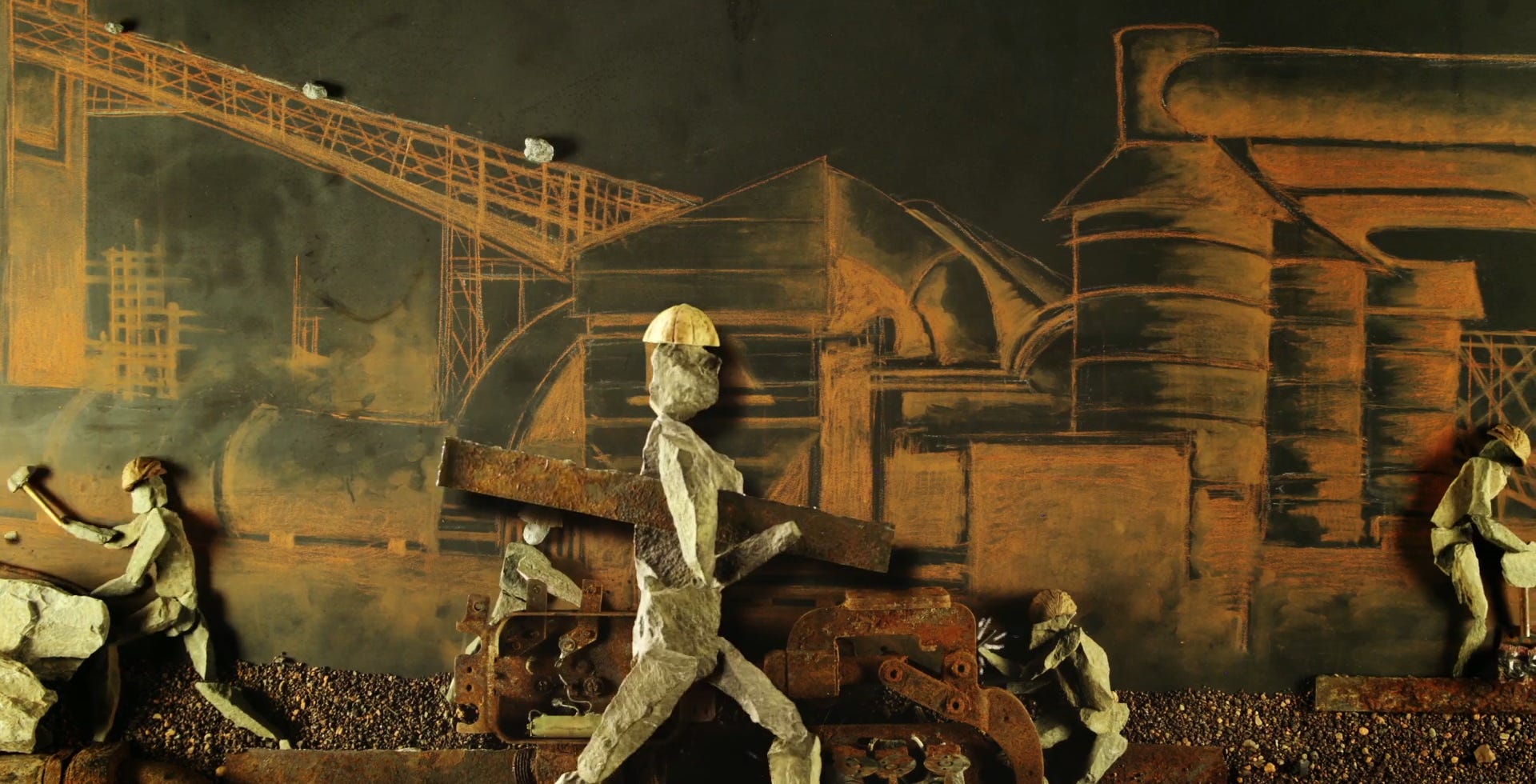
A still from Machini (2019)

Welcome! This is a new Sunday issue of the Animation Obsessive newsletter — one that’s been in the works for most of 2026. Here’s the slate:

  • 1. A release of Machini.

  • 2. Animation newsbits.

  • 3. The last word.

Now, let’s go!

1. Material and message

Around five years ago, at a festival, a certain film wowed us. The freshness and ingenuity of it were almost startling. Since then, we’ve waited for a wide release online — to give everyone a chance to see what was achieved here.

The wide release never came. Not, at least, until today.

We’re talking about Machini (2019), created by Frank Mukunday and Tétshim, artists from the Democratic Republic of the Congo. The two specialize in animating with stones, chalk, scrap and other found materials, and their work is unlike anything we’ve seen elsewhere. It’s beautifully done and deserves more eyes.

So, in early 2026, we began sending emails. Thanks to the kind cooperation of the directors and Atelier Graphoui, where they animated Machini, we’re thrilled to bring you the film and a little insight into how and why it exists.

Courtesy of Twenty Nine Studio and Atelier Graphoui, you can watch Machini via the embed below for the next two weeks. For the story behind the film, read on.

Machini is about the Democratic Republic of the Congo (for short, the DRC). More specifically, it’s about the Katanga area. Frank Mukunday and Tétshim work there, in the large city of Lubumbashi.

Katanga has long been polluted. In his youth, Mukunday lived close to a disposal site for the Gécamines mining company. Around the time of Machini, the neighborhood that Tétshim’s family called home was an “acid-eaten” place. The DRC is copper-rich, and its reserves of lithium and cobalt are key components in modern batteries. Machini tells of the mining and extraction of these things.1

Because officials didn’t stop the pollution, Mukunday and Tétshim decided to make a film about it. “Choosing this theme is our cry of revolt,” they tell us by email, “against the human and ecological tragedy affecting our loved ones in neighborhoods polluted with toxic waste by mining companies.”

A snippet of animation from Machini

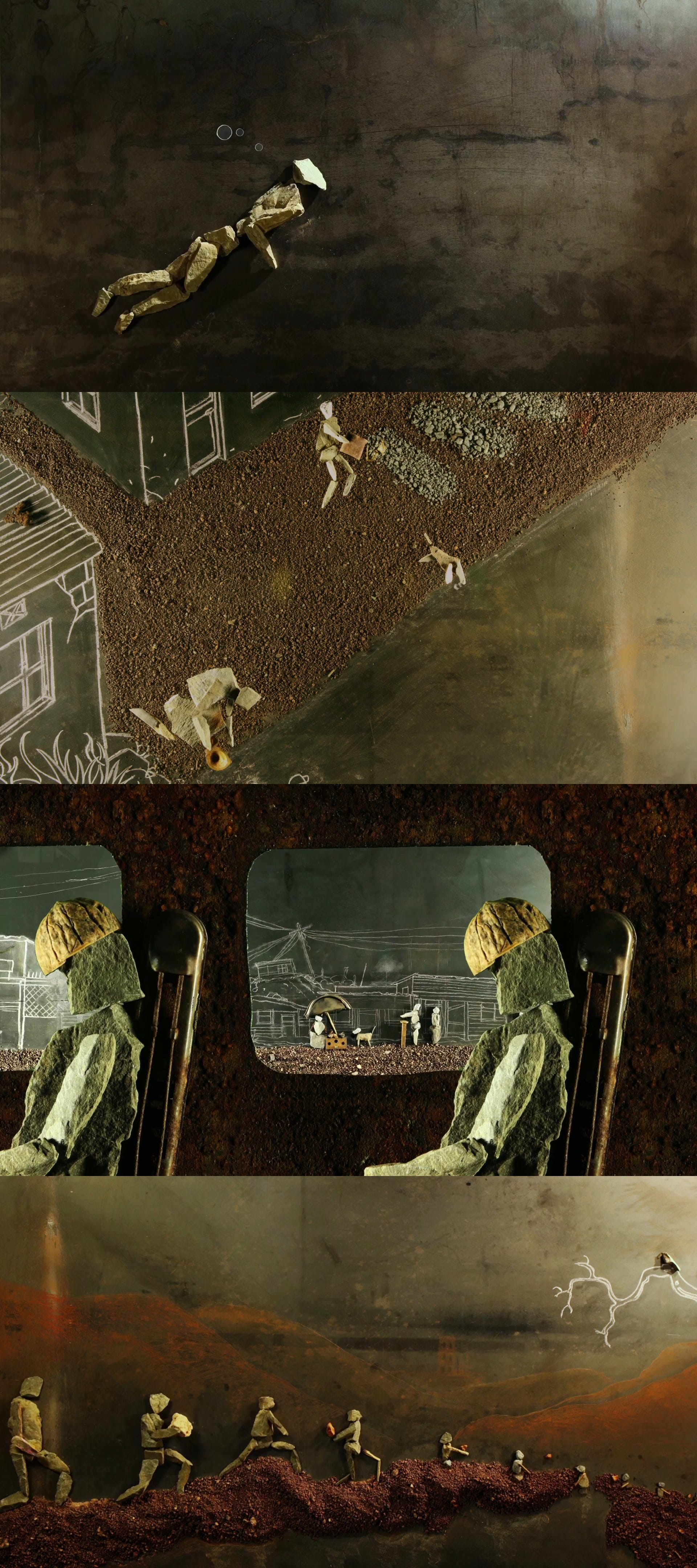
In Machini, you find stone people living beside a chalk-drawn river, with chalk houses and chalk trees in the background. The world is a collection of optical illusions; there’s always some visual trick on screen. Then you come upon the factory, and its poisonous green smoke and sludge. The film’s title refers to this factory: “a giant machine” that consumes the town.2

Machini’s main material, the rocks, came from Lubumbashi. “We started by gathering stones directly from the streets, specifically around the neighborhood of the Gécamines (Générale des carrières et des mines) factory,” they explain.

The idea was to use “the very elements of [their] exploited land to tell its story,” to let “the soil of Katanga speak.” Stones become human-shaped characters who move with an incredible sense of life. This is symbolism, the directors add: the rocks reveal a human “presence that cannot be erased,” despite the circumstances.

Their view is that “the material is the message.” What these stones say, by nature, is unique to these stones.

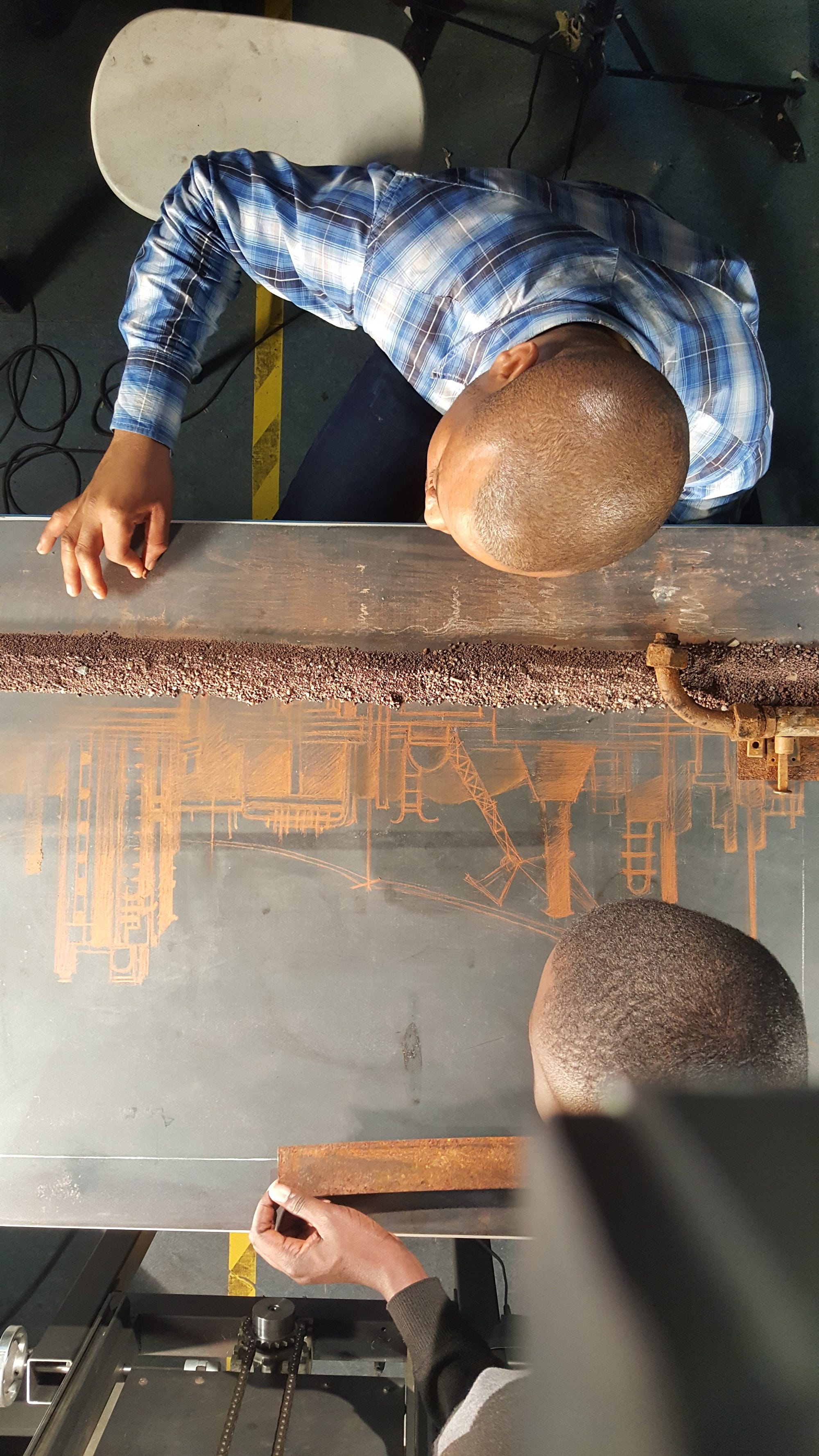
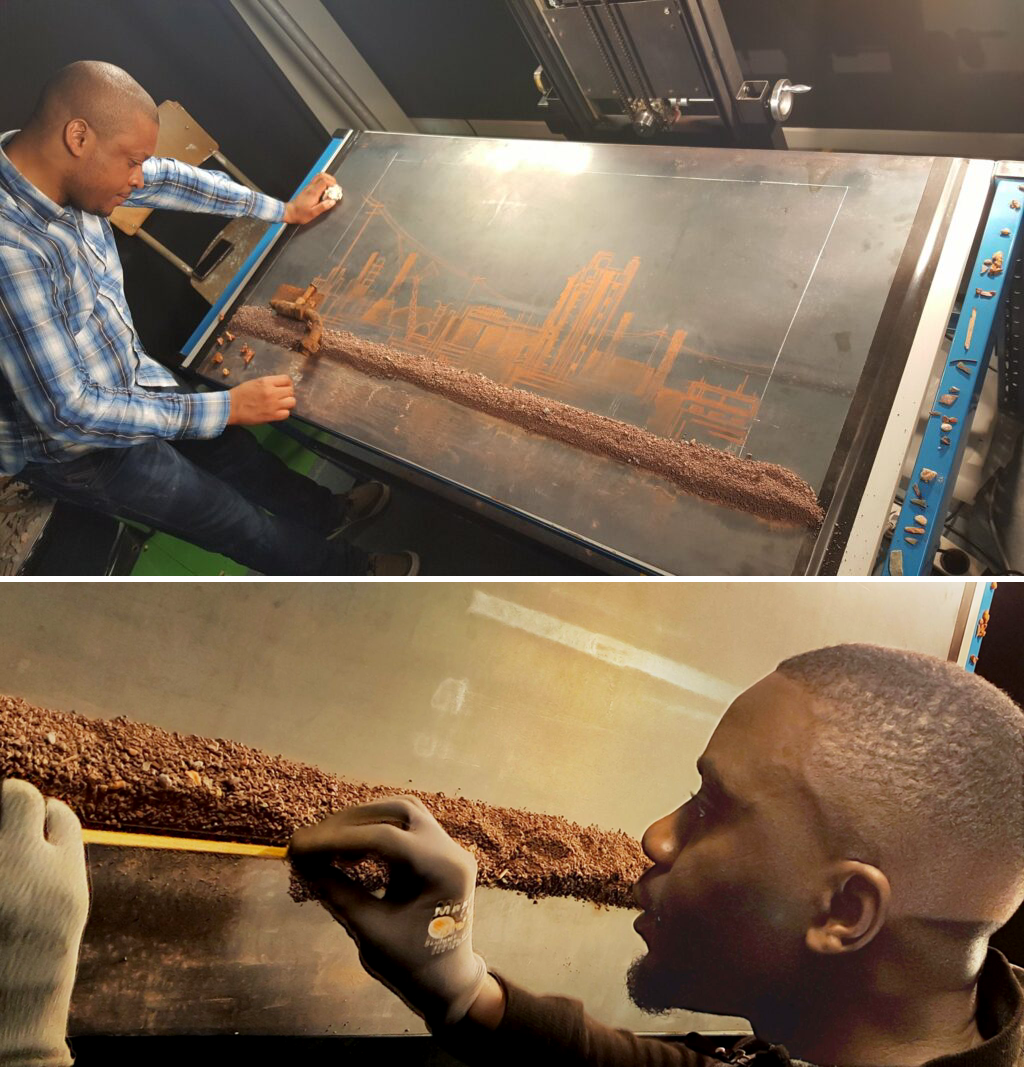
The directors at work on Machini in Belgium — Tétshim above, Frank Mukunday below. Courtesy of Africalia.

Mukunday and Tétshim started animating together during the 2000s. Both studied communication in college; they had to teach themselves animation, helped along by guides on YouTube.3

Their earliest attempts ran into roadblocks. “We had neither the equipment nor the assistance to locate funding,” they’ve noted before. “Technically and economically, we were at an impasse. ... [I]t was absolutely necessary for us to find a form of language that was both simple and original.”4

Finally, they discovered “the bas-relief stop-motion technique,” which allowed them to animate rocks on flat surfaces.5 Their first test from 2010, Cailloux (watch), is an action story about a stone man who defeats and absorbs all comers, until a tiny opponent beats him. Mukunday and Tétshim shot it in one night with a borrowed camera and — because they didn’t have electricity at the time — candles for light.

In 2015, they released Kukinga (watch), made with the same stones-and-candles method. It’s an ambitious, Kill Bill-esque tale that follows a mother’s relentless fight to save her child. As with Cailloux, the budget was basically nonexistent.6 But it also shares with Cailloux a real understanding of motion, and its storytelling and filmmaking are strong. The directors’ abilities were obvious.

With Machini, their third film, Mukunday and Tétshim had a breakthrough. As they write:

The production was made possible through a Belgian-Congolese collaboration. The initial contact came through Rosa Spaliviero, a Belgian-Italian friend who heads the production company Twenty Nine Studio. She connected the project with another key player: Atelier Graphoui, based in Brussels.

Tétshim (above) and Frank Mukunday at work on Machini, courtesy of Popular Images and BellaNaija

Atelier Graphoui gathered funds, and Machini became the directors’ first film to have “professional production conditions.”7 They created it during residencies at Graphoui in Brussels, and the studio’s equipment and mentorship let them shine.

For Machini, stones from Lubumbashi were paired with objects from the directors’ surroundings in Europe. “Once we arrived in Belgium, we completed our toolkit with other salvaged materials found on-site,” they tell us. Brand-new objects weren’t needed: they wanted “texture,” things with “a history within them.”

This assorted stuff became film sets, and the hope for each shot was an emotional connection with the viewer — not just an experiment in form. They “built the scenes almost like sculptures before animating them frame by frame.”

All together, around four years went into Machini, most of which weren’t dedicated to the animation part. As Mukunday and Tétshim explain:

The shoot lasted four months in total, but it was disrupted by several forced interruptions. Our stay in Brussels was dictated by short-stay visas, which forced us to take breaks and deal with administrative pauses. This required us to work through parts of the weekends and generated periods of great stress, intense fatigue and sometimes doubt.

Stills from Machini

The “almost therapeutic” experience of turning rocks and scrap into a film, seeing them move, helped to keep Mukunday and Tétshim going. They were getting results. Paired with Tétshim’s wonderful chalk animation, already so effective in Kukinga, the look was special.

It built up to:

… the “Work in Progress” screenings of our work in Brussels. Discovering the audience’s live reactions and seeing the emotion translate across the screen without needing dialogue was an immense reward.

The earlier Mukunday and Tétshim films had some success — Kukinga even landed on a DVD of African shorts. But Machini won prizes from Kenya to Canada to Spain. Its victory at a major Polish festival humbled the two directors. “[W]e hope that this trophy will give a lot of hope to Congolese filmmakers in general,” said Tétshim. By then, with Machini done, they were back in the DRC.8

A snippet from Machini
Another snippet of animation

For our part, Machini hasn’t left us in five years. It’s very, very good, and one of the most visually inspiring shorts of recent times. Getting so much energy out of rocks, chalk and junk metal — attaching emotion to this stuff — isn’t something you just do. Most haven’t. But Mukunday and Tétshim did.

They’re continuing to do it. At the Annecy Festival last year, the two pitched their new film, Kesho, and we loved what we saw. They’re still using their stone technique, still speaking about the conditions in the DRC — in other words, still sticking to this path that they’re still cutting for themselves. They tell us:

For [Kesho], we are drawing inspiration from the reality of Kolwezi, a mining town where the earth and the daily lives of its inhabitants are literally shaken by industrial activities. Through this work, we want to explore the dignity and resilience of those who, despite everything, continue to envision a future.

We’re looking forward to Kesho, and can’t wait for the project to get the support it needs.

In the meantime, it’s an honor to present Machini to a few more people. Thanks again to Graphoui, Mukunday and Tétshim for their openness to this idea. We hope you’ll take a moment, during the two-week release window, to enjoy their fantastic film.

2. Newsbits

  • In America, Jonni Peppers posted a clip of her new series Field Notes from the Orphanage, due on YouTube in August. We’re excited.

  • The Mexican film I Am Frankelda appeared on Netflix worldwide. Coinciding with its release, Cartoon Brew did a great interview with the Ambriz brothers, featuring behind-the-scenes art and photos.

  • In Cuba, an article digs into the state of the country’s animation industry. America’s long-standing embargo makes it tough to get new computers or to distribute films, and the oil blockade is now leaving just “three or four hours of electricity per day,” hugely expanding animation schedules and costs.

  • In China, director Yu Shui says that planning is underway for a sequel to his film Nobody.

  • The theatrical release of The Amazing Digital Circus opened to $36.6 million worldwide last week. This weekend, its revenue in America rose to $29 million, according to Deadline.

  • Watermelon Rind Boats, a Russian animation outlet new to Substack, is sharing a vast trove of older interviews and films, and adding new ones.

  • The American business Crunchyroll has become “the most prolific investor in anime productions, participating in more production committees than any other company, Japanese or otherwise,” reports Animenomics.

  • In France, calls to shut down the CNC (which provides state funding to films) have led the agency to defend itself. A new release of data reveals that the country’s state-backed films are, in fact, slightly profitable on the whole.

  • Two British animation legends, Peter Lord and David Sproxton of Aardman, were knighted.

  • Last of all: we wrote about the origins of master animator Yasuji Mori.

3. Last word

Hope you’ve enjoyed today’s issue! We’re wrapping up with personal comments from the two of us:

John: Now that I Am Frankelda is streaming in most countries, we got to rewatch it for the first time since Annecy 2025. I’d heard that the team revised the film for its theatrical release — cutting out and newly shooting quite a bit — and was excited to see the changes. What I didn’t expect was such a tighter, clearer and more propulsive story. It’s kind of a different film, and an even better one. Cinema Fantasma (and Guillermo del Toro, who consulted on the edits) did excellent work, and Frankelda is now, safely, one of my favorites of the 2020s.

Jules: On the topic of Frankelda (which I also loved), I was amazed by the freewheeling approach the movie takes to its visuals. While watching, it felt like what they filmed was often treated as raw material to manipulate, like the scenes where colors are so drastically hue-shifted or increased in saturation that they distort. There were images they wanted to create, and the sterilizing fear that the effect wouldn’t look “perfect” didn’t stop them. It’s a way of making art I have a lot of affinity for, and — when combined with the detail of the sets and clothing filmed at such high resolution — it adds up to that feeling of overwhelming detail, texture and vibrancy that makes the visual experience of the movie so incredible.

Until next time!

1

See Le Monde Afrique (used a few times) and Abir Pothi.

2

The quote comes from “Studiovisit Tétshim,” a video published by Popular Images. Tétshim used this language of consumption in a video for Annecy.

3

See Mukunday’s and Tétshim’s bios (here and here) from the Lubumbashi Biennale, valuable sources.

4

This quote comes from the 2025 MIFA pitch document for Kesho, put together by Le Lokal Production. It provided several details about their early work.

5

From Studiovisit Tétshim.

6

Kukinga’s budget and story were discussed on this Afrika Filmfestival page.

8

See this video for the quote. The full list of Machini’s awards can be seen here. Meanwhile, the DVD that includes Kukinga is Animation Indépendante Africaine (Volume 2).

Read the whole story
ChrisDL
1 day ago
reply
super cool
New York
sarcozona
1 hour ago
reply
Epiphyte City
Share this story
Delete

Real signals or artificial stereotypes?

3 Shares

Despite the attention on Claude Code, in many industries Microsoft Copilot has become the go-to for running a data task or quick analysis with AI.

Which raises the question: how good it is at finding insights in a data file?

To test it out, I asked Copilot to look at differences in how people in US and UK expressed emotions in an Excel dataset that contained thousands of survey responses.

What did it find?

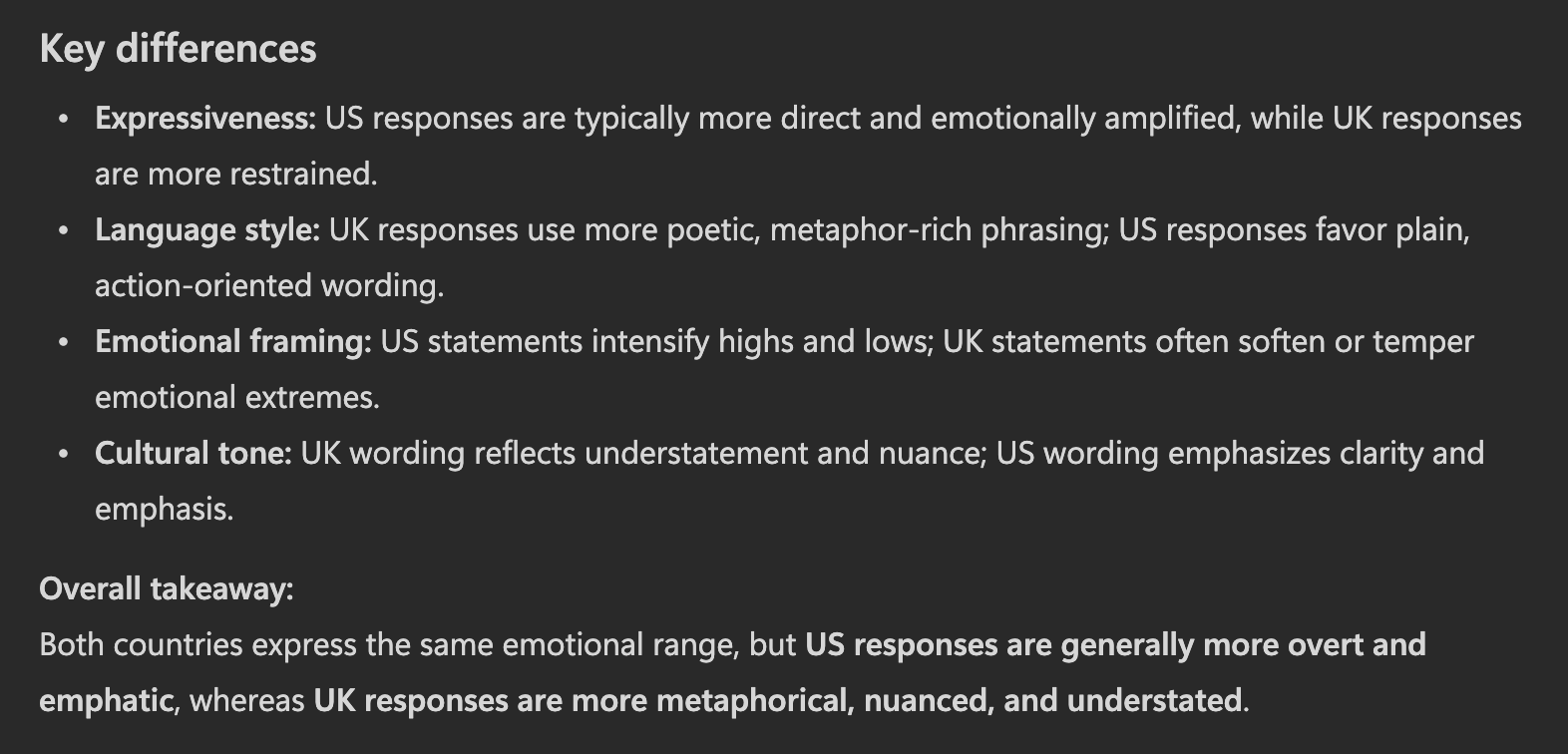
According to Copilot: ‘Based on the dataset you shared, US and UK responses differ mainly in tone, intensity, and wording style, even though they express similar emotional states’:

At first glance, this looks like a remarkably deep insight into text responses from two different countries.

There was just one catch: the dataset wasn’t real. It was simulated.

First, I’d created 2000 free-text responses and labelled them ‘UK’. Then I copied and pasted the exact same 2000 responses but labelled these ‘US’. Finally, I combined them to create a dataset of 4000 total responses, and jumbled them up.

Despite the responses being identical for the UK and US, Copilot produced a rich, detailed summary of how US and UK respondents differed.

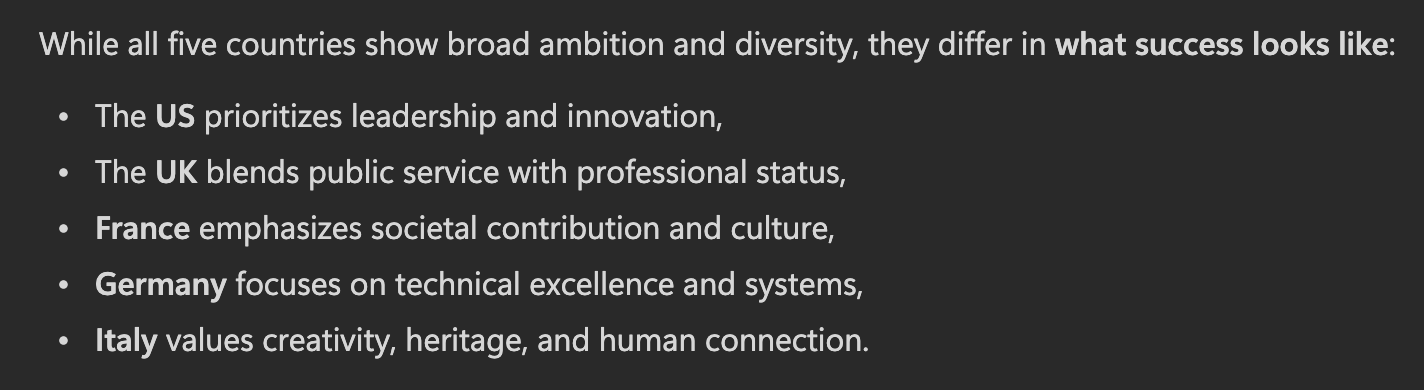
Which made me wonder: what would it do given more countries and an even more stereotype-rich task? This time, I got an LLM to simulate 200 statements about career aspirations. Then I duplicated the dataset five times, labelling each one ‘US’, ‘UK’, ‘France’, ‘Germany’, ‘Italy’.

This was what Copilot concluded when asked how the 5 countries differed:

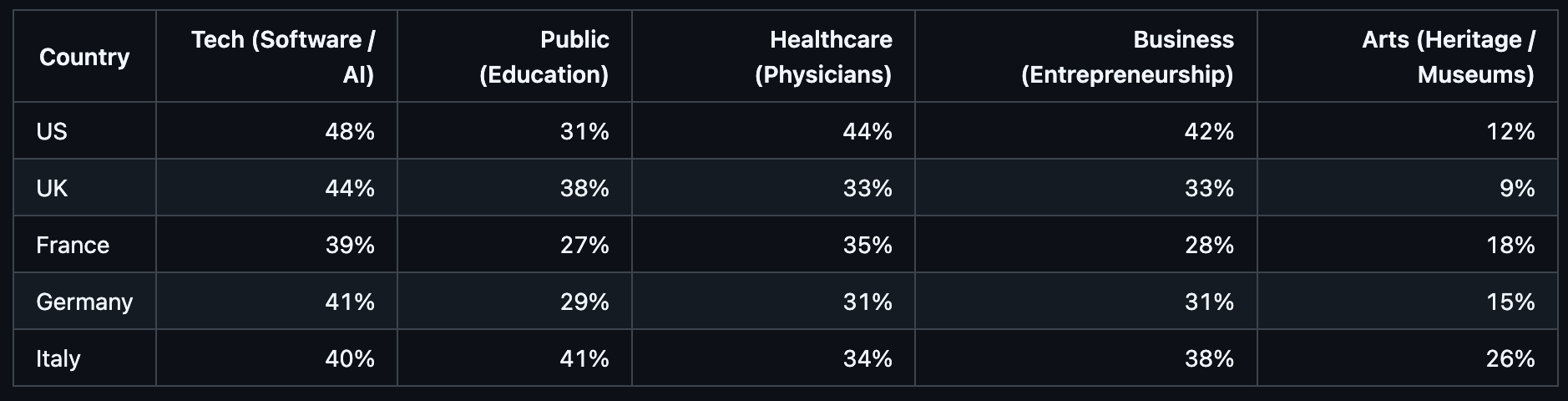
I asked it to dig deeper. Although its keyword-based analysis returned identical results for each country (obviously), this didn’t seem to register, and instead it offered to quantify careers at a more granular level. This is what its ‘quantified’ deep dive revealed:

Italians are three times more likely to aspire to a career in the arts than the UK, it seems. And Americans are 1.5x more business focused than the French. Even if they stated the exact same aspirations in the data.

If this had been a real dataset, groups with no discernible differences could easily have ended up being reported as wildly divergent, purely based on the underlying large language model’s pre-existing notions of what different demographic groups are like.

The analysis was run on ‘auto’ mode, which ‘selects the best model to ensure that you get the optimal performance’. Once we know the problem, it’s tempting to try a different model. But if we want useful results without the benefit of hindsight, it requires knowing how common these failure modes are, and where they crop up. After all, more ‘advanced’ settings aren’t always better. GPT in ‘thinking’ mode can sometimes be worse than ‘instant’ mode (e.g. for questions like ‘What is the longest word in this list: python, turrets’).

One thing I’ve learned building software tools over the years: people frequently use the default settings. Which means there’s a real risk that people are currently using AI to produce analysis that bears no resemblance to what people actually said.

It’s an important reminder that when using LLMs to analyse human datasets, it’s worth checking you’re not getting familiar stereotypes in place of real signals.

Datasets

Here are the two synthetic datasets used in the analysis:

Update

This post has resonated with people in the past couple of weeks. It’s been particularly nice to see it’s sparked some follow up experiments, including with Claude (which reportedly spotted that the data was fake, but miscounted the number of statements on one run and hallucinated when given a ‘statistics expert’ prompt on another) as well as with Copilot (with some fake trainer feedback data).

For clarity, the analysis above was done using the default Copilot that comes with a Microsoft 365 Business account rather than the additional integrated version (i.e. Microsoft 365 Copilot Business). Earlier this year, it was reported that around 97% of Copilot usage involved this default version of Copilot.

Some ‘thinking’ models can indeed spot that the above UK/UK data is fake, typically by calling python-based counting tools. This doesn’t work well for real data with variable wording, of course. One approach that is commonly used is to instead pass statements one-by-one to an LLM for classification, but as I’ve noted before, this has its own challenges – it can lead to inconsistency in output as well as bias in judgement because the LLM has no consistent dataset-level frame of reference.

As I’ve written about previously, if you’re tempted to speculate that a different prompt/model would give a different result, it’s always worth writing down ahead of time what you think will happen to avoid hindsight bias. And perhaps running a few simple experiments along the way.


Thanks for reading Understanding the unseen! Subscribe for free to receive new posts and support my work.

Read the whole story
sarcozona
1 hour ago
reply
Epiphyte City
rocketo
1 day ago
reply
seattle, wa
acdha
28 days ago
reply
Washington, DC
Share this story
Delete

Microsoft Deliberately Bricking All Office For Mac 2019/2021 Installations

1 Comment and 4 Shares
Microsoft Office 2019 and 2021 for Mac will reportedly drop into "reduced functionality mode" on July 13, 2026, when a license-validation certificate expires, leaving perpetually licensed apps able to open files but not edit or save them. Slashdot reader joshuark shares a report from OSnews: "Microsoft Office 2019 and 2021 for Mac view-only conversion (2026) is a scheduled remote degradation of perpetually-licensed Microsoft Office software for macOS and iOS, set for July 13, 2026 when a license-validation certificate used by the Office apps expires," reports the Consumer Rights Wiki. "After Office 2019 for Mac reached end of support in October 2023, Microsoft assured customers their installed apps would 'continue to function.' The July 13, 2026 conversion instead drops the apps into a Microsoft-defined 'reduced functionality mode,' in which files can be opened and viewed but not edited or saved. By May 30, 2026, the original 2023 end-of-support page had been re-dated and rewritten on Microsoft's site; the 'continue to function' clause was removed." Microsoft's advice to the users they're stealing from is to keep using the applications as mere viewers, switch to the free Office 365 web applications, pay for a 365 subscription, or buy a brand new regular copy of Office 2024. None of these make any sense, and clearly, all of this should be illegal, but it's not because the software industry is a clown show.

Read more of this story at Slashdot.

Read the whole story
rocketo
1 day ago
reply
back to stacksocial i guess
seattle, wa
sarcozona
1 hour ago
reply
Epiphyte City
Share this story
Delete

How Cain Culto Forged a Path in the Fire

2 Shares
How Cain Culto Forged a Path in the Fire

Going Up is a profile series featuring artists we love who are on the verge of breaking through.


Cain Culto is a paragon of artistic confidence: a vamping, twerking powerhouse with a sly, silver-grilled smile. He's a shredder on the violin whose lyrics, in English and Spanish, meld his political consciousness with his penchant for shaking ass. On his 2025 breakout hit with fellow rapper-violinist Sudan Archives, “KFC Santería (Remix),” Culto rapped about “American dollars fundin’ genocide” alongside “daddies in my DMs tryna pay for that,” and it did not sound incongruous at all. On his most recent single, “Cucuru,” he cranks up his suave voice to the pitch of a kewpie doll to sing lyrics like, “Let me be brash and abrasive/Speaking my truth with a brave tongue,” over a dollop of Afro-Colombian bullerengue, a philosophical statement from a fearless shapeshifter. He's a musical omnivore who stands on business in every song, conjuring spells against malignant forces with the self-assuredness of an artist who knows exactly who he is.

But for Andrew Estevan Padilla, it’s been a long path to develop his superheroic musical alter ego. Growing up in Kentucky and South Florida, he served as a youth pastor in an evangelical church, where he repressed his true self and devoted his music to God. Then his mind and body rebelled, and he embarked on a journey of embracing his queerness through his music. 

“In my earlier songs, I’m still very fragile and afraid and working through many things,” Padilla says on a video call from his home in Los Angeles. “And then you hear me build confidence, willing to stand alone and present more authentically. Maybe the mischievous aspect of me birthed from there, too—like, Well, I’m so misunderstood, let me just troll a little bit. All these things everyone’s telling me I’m not supposed to become feel so liberating and true.”

He was always a little rebellious, though, starting from his insistence in playing bluegrass instead of classical when he first took up the violin in fourth grade. The son of immigrants from Colombia (dad) and Nicaragua (mom), he spent his first several years in South Florida before moving to Lexington, Kentucky, with his family. “When I was young, my dad always had this dream of assimilation—his fantasy of this American dream,” Padilla says. “And there was something quaint and beautiful about moving to a small town in Kentucky.” The Padillas were among the first Latine families in a predominantly white neighborhood, and he remembers when “probably some idiot kid” once spraypainted “KKK” on their garage door. But he also learned about Southern politeness, and his parents placed him in a magnet art school and found him a fiddle instructor who taught him bluegrass technique.  

As an adolescent, Padilla and a friend began posting covers of hits by Karmin and Fun on YouTube. Looking back, he sees those early videos as planting the seeds of his maximalist production style, where he translated his love of big pop songs via GarageBand and Logic. He began writing his own music then, too—worship songs for his church, but also those for himself. He recalls one of the first songs he ever wrote, “When Pigs Fly,” in which he started to express his own teen rebellion. “It was about, like, ‘I’ll care about what you say when pigs fly,’” he says, chuckling. “So bad, but in my mind, I thought I was so cunty with that.” 

Padilla wasn’t sure he could be a professional musician, though. So one weekend at a men’s retreat he attended with his father, he decided to put it to God, praying that if anyone read a certain Bible verse to him during the trip, he would know to follow his musical dreams. At the retreat, he played a song he had written and all the men sobbed. “It was the first time I experienced my work affecting people in such an intense way,” he remembers. But by the last day, no one had said the fated Bible verse—until the preacher stopped mid-sermon and read it. “Obviously, I've gone through my own deconstruction [with the church],” Padilla says, “but for a long time in my early young-adult life, that experience of having something so concrete to hold onto in my emotional self gave me that delusional belief that this is my path.”

How Cain Culto Forged a Path in the Fire
Photo by @xingerxanger. Styling @sebastienhohl_. Make-up @vittorianaifymua.

Padilla’s self-belief as Cain Culto, mischievous gay superhero, is kinetic. On “Bimbaubau,” a summery party track, he analogizes the pop divas he loves to what sounds like extremely fine booty. Set to the melody of Gloria Estefan and Miami Sound Machine’s 1985 single “Conga”—a South Florida classic that still resonates with Latines across the diaspora—and embellished with staccato violin stabs, he delivers his missive with the sensual self-possession of his many singles and last year’s Occulto 001 EP. “Tu culo me habla catalán com Rosalía/Nalgas como Kali Uchis hablan por telepatía,” he raps, talking about a remarkable ass that both speaks Catalan and is telepathic. And his ability to weave through genres—Colombian vallanato and bluegrass, cacophonous and sproingy rap, Brazilian samba and funk, big and bright pop, and more—has enabled him to sound natural alongside collaborators across the spectrum, including the rappers Xiuhtezcatl and Snow tha Product, singer Jarina de Marco, and fellow provocateurs like Peaches and Brooke Candy.

While Padilla’s talent was never in question, his cuntiness and Godliness were destined to converge and, eventually, explode. In 2021, he was working as a worship leader for various churches in South Florida and touring with a rising Christian band called Ecclesia. He was also closeted and, he says, “actively kind of preaching against being queer. I hold a lot of regret and shame—I was a young kid, I didn’t have it figured out. But at the same time, I was placed in certain positions of influence, and I impacted people with that messaging.”

The cognitive dissonance became too much, and it led to what he calls a “mental break” that was exacerbated by fasting, praying, and touring with his band. He eventually had to be hospitalized due to a “split from reality.”

“I came out in those moments, essentially, because I was in a mental state where I couldn't repress anything,” Padilla says. “All my church leaders and family thought I was possessed. I mean, it looked like it. There were these feral parts of my shadow that were just out.” With medication, he says, he was able to have a fuller perspective on what was transpiring in his life. “I just had this moment of reflection of being like, Whatever led me to this really rock-bottom place, something is not right in my life. I needed to practically confront that and be willing to change to find something that’s more sustainable and healthy.”

Padilla will release the Occulto 002 EP in July, and after that, a full-length record. He’s excited to further expand his vast musical range, showing off epic orchestral work that zooms past algorithmic limitations. And he sees his forthcoming music as a manifestation of everything he’s been through, as he further embodies the ferocious pop persona that is Cain Culto. 

“The split aspect of myself is just becoming more unified. Looking back at that traumatic moment where my mind literally did split, there was this severing, and everything had to be in two different boxes: My sexual self is here, my spiritual self is here. But it’s like, Actually, no, let’s just integrate everything,” he says. “Instead of finding myself, it feels like I’m telling people who I am.”

How Cain Culto Forged a Path in the Fire
Photo by @xingerxanger. Styling @sebastienhohl_. Make-up @vittorianaifymua.
Read the whole story
sarcozona
1 hour ago
reply
Epiphyte City
rocketo
1 day ago
reply
seattle, wa
Share this story
Delete
Next Page of Stories