Log in


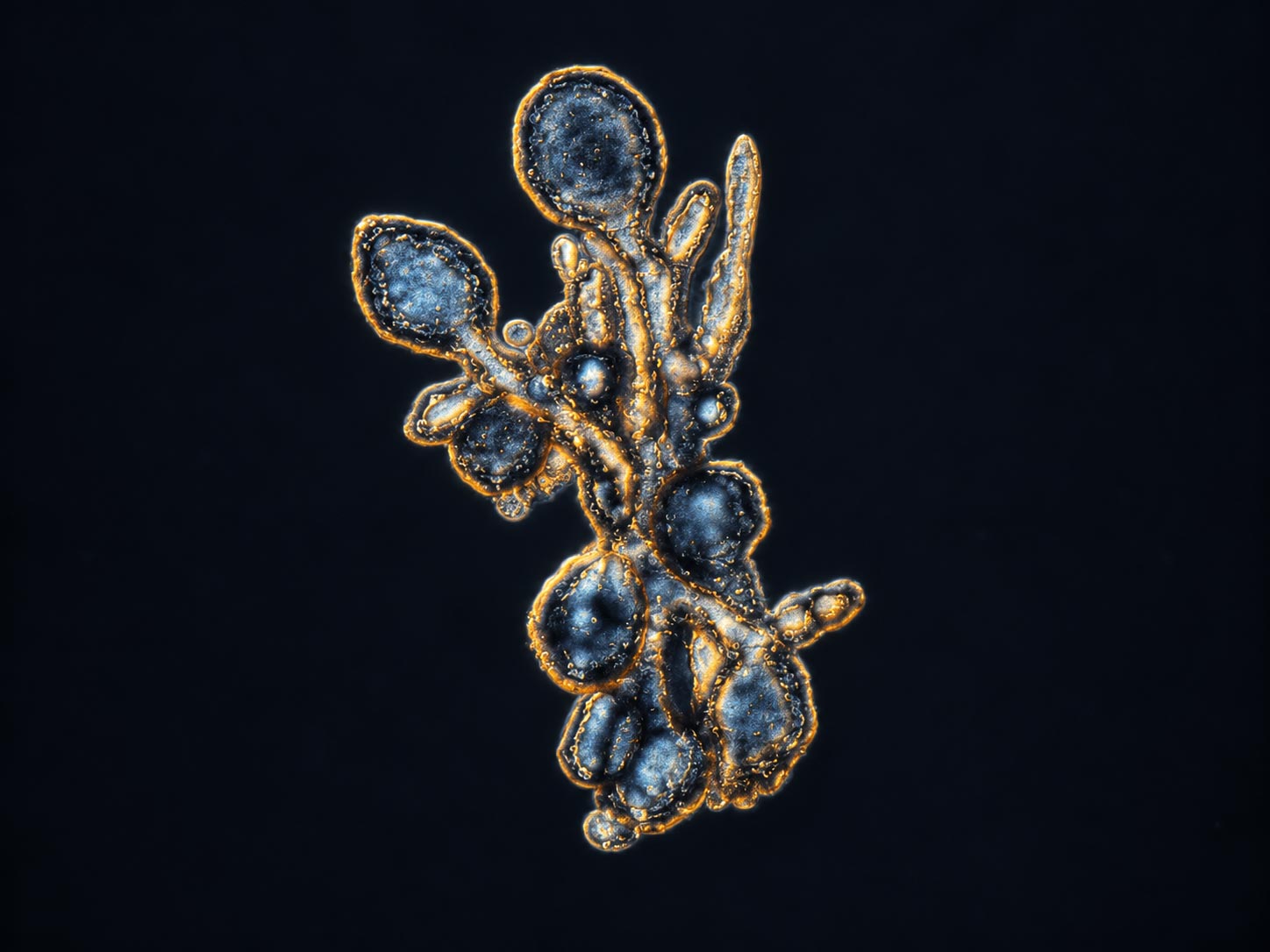 A breast tissue organoid that has been artificially colored. Credit: The Kuperwasser Lab
Chemicals that disrupt hormones may leave a molecular “scar” that could someday help identify people at higher risk of breast cancer, research in human breast tissue models suggests.
People are typically exposed to several chemicals at once, including endocrine-disrupting chemicals that can interfere with the body’s hormones. Scientists have increasingly questioned whether these exposures contribute to breast cancer risk. Much of the evidence, however, comes from animal models or laboratory-grown cells that cannot fully reproduce the complexity of human breast tissue.
Researchers at Tufts University School of Medicine and Boston University investigated those effects using three-dimensional models of normal human breast tissue called organoids. Their study, published in the Proceedings of the National Academy of Sciences, found that three common bisphenols, BPA, BPS, and BPF, produced relatively few changes when tested individually. When combined at very low concentrations comparable to levels detected in human blood and urine, the chemicals disrupted normal development in organoids from most of the tissue donors.
Breast development continues long after birth
The organoids were grown from breast tissue donated by 13 healthy young women. They contain multiple types of breast cells and can reproduce some aspects of human breast tissue development, allowing researchers to examine chemical exposures during that process.
“The breast also is unusual in that it undergoes major developmental changes well after birth, including during puberty and pregnancy,” said Charlotte Kuperwasser, the study’s senior author and a professor of developmental, molecular, and chemical biology at Tufts University School of Medicine. “And the concern is that breast tissue cells may be highly sensitive to environmental cues, such as chemical exposure, during critical windows of mammary gland development.”
As the organoids developed over about three weeks, the team exposed them to individual chemicals and mixtures. The panel included substances that disrupt hormones, chemicals that affect metabolism, and known or suspected carcinogens. Researchers then analyzed changes in gene activity and DNA modifications. Different chemicals affected development in different ways, with the bisphenol mixture producing the most striking finding.
“We intentionally used concentrations of chemicals that were relevant to real-world exposure rather than the very high doses sometimes used in toxicology studies,” said Kuperwasser. “We also tested a mixture of these because people are typically exposed to multiple chemicals at the same time.”
A molecular resemblance to lobular cancer
To explore how the changes associated with the bisphenol mixture might relate to disease, the team compared them with molecular data from human breast cancers. The exposure-associated pattern was most strongly represented in data from patients with invasive lobular carcinoma, a type of breast cancer that may not produce a detectable lump and can be difficult to detect with a mammogram.
That resemblance does not establish that the chemicals cause cancer or explain how the observed changes might contribute to breast disease. The researchers instead describe the work as a new way to investigate how environmental exposures affect normal human tissue before cancer develops.
“Historically, we have thought about cancer risk largely in terms of inherited mutations, lifestyle factors, and exposures that directly damage DNA,” said Kuperwasser. “These findings raise another possibility: Environmental exposures may subtly alter how normal tissues develop, leaving behind molecular changes that do not cause cancer by themselves but may make the tissue more permissive to cancer many years later.”
Molecular “scars” might guide earlier screening
Kuperwasser noted that persistent molecular changes could eventually serve as a biological record, like a “scar” of past exposure. If validated in people, such markers could potentially help identify individuals at higher risk of breast cancer and guide earlier or more targeted screening.
“If these results are validated by additional studies, they could change how we think about cancer prevention,” said Kuperwasser.
Studies involving larger and more diverse groups of donors, along with a broader range of chemicals and mixtures, are needed to determine how widely the findings apply. Researchers also need to establish whether the molecular changes seen in organoids persist in human tissues and whether they are associated with, or contribute to, breast disease later in life.
Reference: “Environmental chemical mixtures reprogram mammary epithelial development to epigenetic states associated with breast cancer” by Meadow Parrish, Meloryn Seraj, Helia Nikoueian, Nicole Traugh, Andrew Chen, Piyush B. Gupta, Stefano Monti and Charlotte Kuperwasser, 15 October 2026, Proceedings of the National Academy of Sciences.
DOI: 10.1073/pnas.2613054123
Supported by Find The Cause Breast Cancer Foundation.
Never miss a breakthrough: Join the SciTechDaily newsletter.
Follow us on Google and Google News.